


Two approaches to addiction aim to help as many homeless drinkers as possible
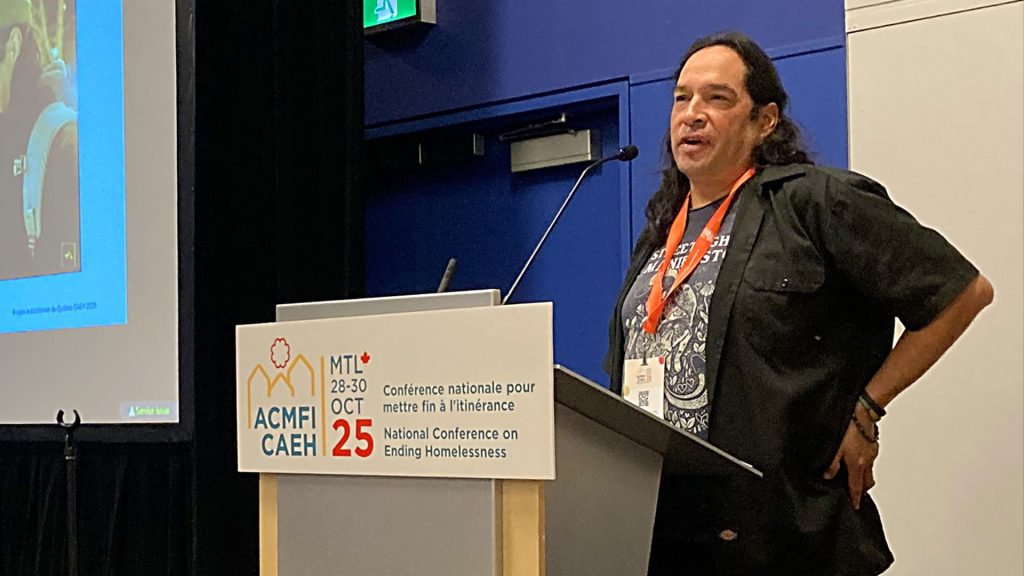
Chris Brown speaks to the 2025 National Conference on Ending Homelessness about his experience quitting drinking and leaving the street for Projets Autochtones du Québec's long-term sober residence. Photo: Jesse Staniforth/APTN News
Chris Brown has been sober for two years.
Born Christopher Lee Roy in Moose Jaw, Sask., Brown was part of the Sixties Scoop.
He was adopted into a non-Indigenous home and struggled with his life and family until 1992, when a friend told him he should consider running away to Montreal.
There, he became a street kid. He recalls discovering even at 16 he could walk into one of the city’s many dépanneur corner stores and buy a beer and a cigarette for under two dollars, no questions asked.
“That really kept me moving forward through my addictions,” he said.
Until two years ago, when he felt he was approaching the end of his time as a drinker.
“My body wasn’t holding on to it,” he recalls. “My mind was going. And you know, those things that they say to you, like ‘jail, insanity, death, those are the only options.’ I believe that. And I really thought about the insanity part of it. My mind was only thinking about my next drink when I woke up.”
Today, Brown lives in one of the 14 rooms at the Annagiarvik House in downtown Montreal, a long-term transitional residence for sober Indigenous people leaving the street.
The Annagiarvik House is operated by Projets Autochtones du Québec (PAQ), an organization providing shelter to members of the Montreal urban Indigenous community struggling with housing.
Brown discussed his experiences as part of a panel on Indigenous approaches to harm reduction and cultural safety during the 2025 National Conference on Ending Homelessness in Montreal.
KEEP READING👇
Along with Brown, who spoke of his experiences, the panel was composed of an administrator from Projets Autochtones du Québec and researchers from the Université de Montréal’s Laboratory for Indigenous People and Decolonization of Knowledge in Intervention (LIPDKI) , which works with PAQ.
Wet shelters for short-term solutions, managed alcohol for the long haul
PAQ runs multiple shelters around Montreal, including one short-term sober shelter, offering 54 beds, and one short-term “wet” shelter, with 50 private rooms, and a designated area in which residents can consume alcohol and cannabis on site.
The wet shelter became operational following the first year of the COVID-19 pandemic. At roughly the same time, the city of Montreal was working to create accommodations for drinkers as an offshoot of the Old Brewery Mission, a large short-term shelter downtown serving both non-Indigenous and Indigenous Montrealers.
Some other Canadian cities offer wet shelters, but many are still in development and often face opposition from politicians and residents who argue giving alcohol to people with alcoholism is self-defeating.
PAQ representatives and researchers on the panel were there to discuss PAQ’s two long-term housing options for people living with dependence. One home is Annagiarvik, where Brown lives, while the other is known as the MAP House—a residence for PAQ’s Managed Alcohol Program (MAP).
Esmé-Renée Audéoud was previously a frontline worker with PAQ, though today she’s a research assistant with the LIPDKI, which studies the MAP program, the first of its kind in Quebec.
Audéoud explains that the purpose of PAQ’s services, from sober housing to managed alcohol consumption, is to try to reach as many people as possible by providing what they need in the short and the long term.
“Just meet them where they’re at,” she says, “and keep them alive. Because you never know what they will be.”
Like Audéoud, Christie Chuprun spent several years as a frontline worker with PAQ, as well as the neighbouring Native Friendship Centre of Montreal. Today, she is a research coordinator at the LIPDKI.
“The managed alcohol program [looks at] a harm reduction model for Indigenous homelessness here in Montreal,” she explains.
The primary goal was to create a space from which people would not be turned away because they continued drinking.
“For somebody who’s not wanting to go the sober route,” Chuprun says, “or not ready to actually address those certain factors due to trauma, mental health, [or] a lot of different reasons, you have a place to stay and be and you don’t have to drink out on the streets. You have a home and you can also still consume alcohol.”
Managed alcohol: how it works, and what it offers
In a presentation, Audéoud explains how each MAP resident works with a physician onsite to determine their necessary alcohol doses and timing. Residents then receive, for example, a drink containing two servings of alcohol every hour throughout the day, up to a maximum number of servings agreed upon by the resident and physician.
Audéoud says offering residents alcohol lowers the likelihood they’ll resort to drinking non-beverage alcohol (like hand sanitizer and mouthwash), while also reducing interactions with police and visits to emergency rooms.
Naturally, the residents at MAP are not at risk of losing their housing for drinking, which they’re able to do in a far more controlled manner than on the street.
“Now you don’t have to stop drinking to be accepted indoors,” Chuprun says. “You don’t have to alter your consumption in order to have a home. You can have a bedroom and be accepted and you don’t have to hide it.”
Audéoud acknowledges the public does not always understand why MAP and its supporters believe giving alcohol to people dependent on it is the healthiest possible choice.
“Often we’re going to talk about the harms and the destruction of alcohol without realizing that it’s a form of survival,” she says. “It’s to get someone through the day. It’s to get someone through a night. It’s self-medication. Many people would say, ‘I drink so I can go to sleep. I drink so I don’t kill myself.’
“There’s survival in that, much more than destruction. So by stabilizing [consumption and] making it a little less harmful, then we could work on stabilizing other factors too.”
Leona Shecanapish is a former cultural facilitator with the Native Friendship Centre of Montreal from Naskapi Nation of Kawawachikamach, in the north-east of Quebec.
Today, she works part-time with the PAQ team to try to help them implement cultural components more consistent with isolated Indigenous communities.
“I think they do great work at PAQ,” Shecanapish says, “but I also want to look more at the cracks in between—what do they do when the houses are full? There is a waiting list, [and] they go back to the streets. Go back to using or drinking. What can we do more? I’m always trying to find ways we can improve on.”
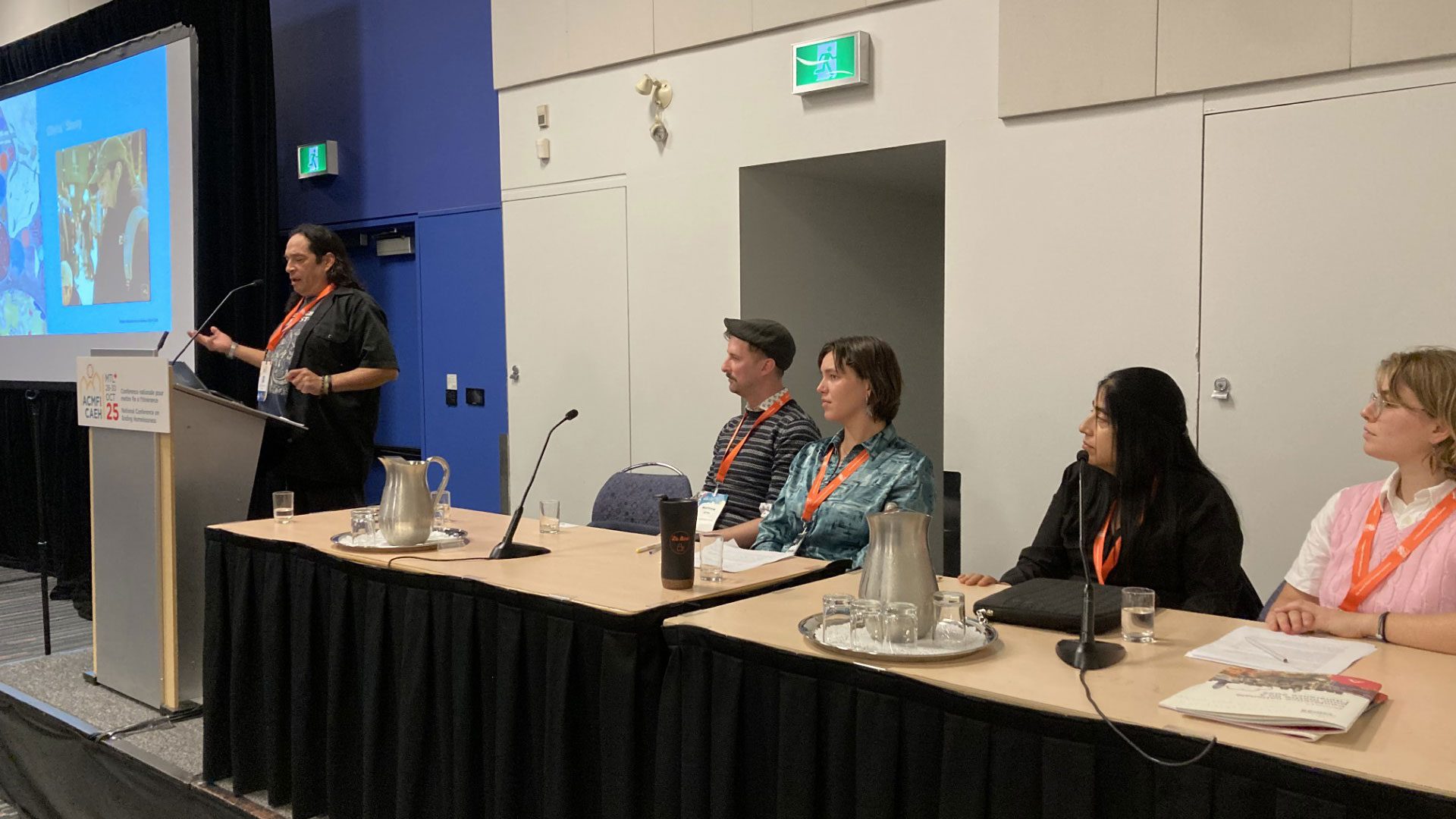 |
| Panelists—including Université de Montréal researcher Esmé-Renée Audéoud, second from left—watch as Chris Brown presents to the 2025 National Conference on Ending Homelessness. Photo: Jesse Staniforth/APTN News |
Filling time and space after sobriety
Brown says the choice to stop drinking wasn’t easy, and a challenge he didn’t expect was trying to contend with the empty space in his life that alcohol had previously filled.
“It’s the mental part of it all,” he says. “What am I going to do with my time afterwards? I spent so many years drinking. What am I going to do for my next 20 years? What am I going to do for my next 20 weeks?”
For a while, Brown found the simplest answer was to carry a basketball.
“Going to play basketball in the morning instead of heading towards where your homies are at, where they’re smoking and drinking,” he says. “I could have went there and hung out, but chances are I would have relapsed. Like they say in AA, ‘Play that tape forward.’”
Now Brown says he has plans for the future. The current lease on Annagiarvik House runs for the next five years.
“I have a soon-to-be five-year-old daughter,” he says. “So hopefully in five years from now, [I’ll have] a stable apartment on my own, a place for her to be able to come to. Still sober, still continuing to help people. I don’t really know about five years, but I just know that if I keep doing what I’m doing, it’s going to be a successful route.”









 Posts
Posts


No comments:
Post a Comment
Please: Share your reaction, your thoughts, and your opinions. Be passionate, be unapologetic. Offensive remarks will not be published. We are getting more and more spam. Comments will be monitored.
Use the comment form at the bottom of this website which is private and sent direct to Trace.