They Took Us Away

They Took Us Away
click image to see more and read more

it's free

click

How to Use this Blog

BOOZHOO! We've amassed tons of information and important history on this blog since 2010. If you have a keyword, use the search box below. Also check out the reference section above. If you have a question or need help searching, use the contact form at the bottom of the blog.


We want you to use BOOKSHOP to buy books! (the editor will earn a small amount of money or commission. (we thank you) (that is our disclaimer statement)

This is a blog. It is not a peer-reviewed journal, not a sponsored publication... WE DO NOT HAVE ADS or earn MONEY from this website. The ideas, news and thoughts posted are sourced… or written by the editor or contributors.

EMAIL ME: tracelara@pm.me (outlook email is gone) THANK YOU CHI MEGWETCH!

SEARCH

Showing posts with label Minnesota. Show all posts

Monday, March 30, 2026

The problem is much bigger than we can actually show you in a report

Minnesota schools are not meeting requirements for American Indian language and culture classes
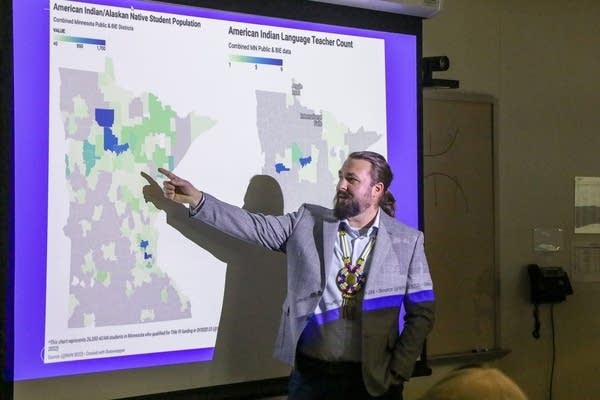
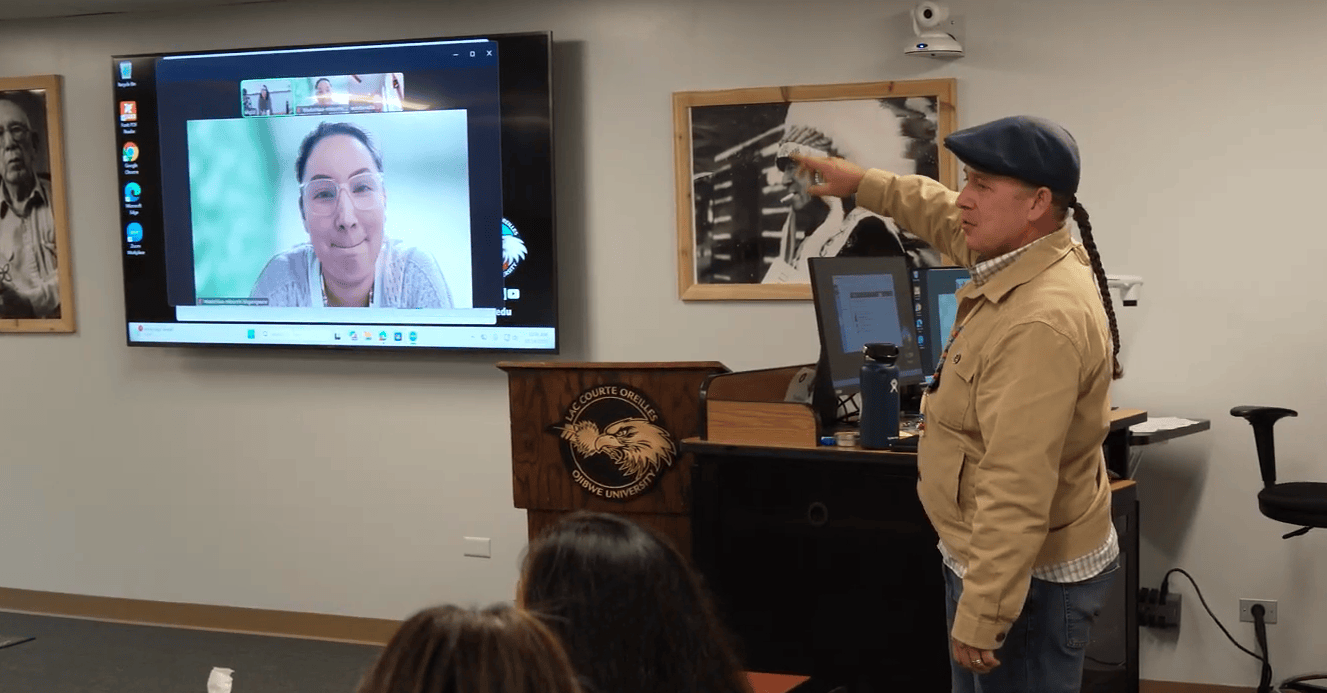
Man presenting and pointing at screen
President and Executive Director of Midwest Indigenous Immersion Network Gimiwan Dustin Burnette presented at Fond du Lac Ojibwe and Dakota Language Symposium, 2025.
Photo courtesy of the Midwest Indigenous Immersion Network  

Schools that are required to provide American Indian language and culture classes are falling short, according to a recent statewide report.

The law requires districts where at least 5 percent of students are American Indian — or where 100 or more Native students are enrolled — to offer language and culture classes.

The Midwest Indigenous Immersion Network’s American Indian Language Instruction Report found districts across the state would need to hire more than 150 American Indian language teachers just to reach compliance — and that still wouldn’t meet the needs of Native students enrolled in public schools statewide.

"We find there is a 1:257 teacher-to-student ratio among the school districts in Minnesota that are required to provide language and culture classes,” the report said.

Research consistently links Native language instruction to stronger cultural identity, better academic outcomes, and a deeper sense of belonging — outcomes that matter especially for the approximately 31,000 American Indian students enrolled in Minnesota’s public schools, who have historically faced the highest dropout rates in the state.

“Our students make up about 3.5 percent of the Minnesota state student population, and our American Indian language educators are numbered at 98 out of 200,000 licensed educators in the state,” said Gimiwan Dustin Burnette, President and Executive Director of Midwest Indigenous Immersion Network. “They see Ojibwe and Dakota languages being valued as part-time considerations. That, to me, is the real cost and we don’t talk about it enough.”

A comprehensive picture

The nonprofit surveyed 197 public school districts — those serving 20 or more American Indian students — and all four Bureau of Indian Education schools in Minnesota during spring of 2025. Of those, 194 districts completed the survey, a response rate of 99 percent.

Midwest Indigenous Immersion Network used contact information provided by district administrators to reach out to 87 American Indian language teachers directly. Fifty-five of those teachers completed the survey, with a response rate of more than 60 percent.
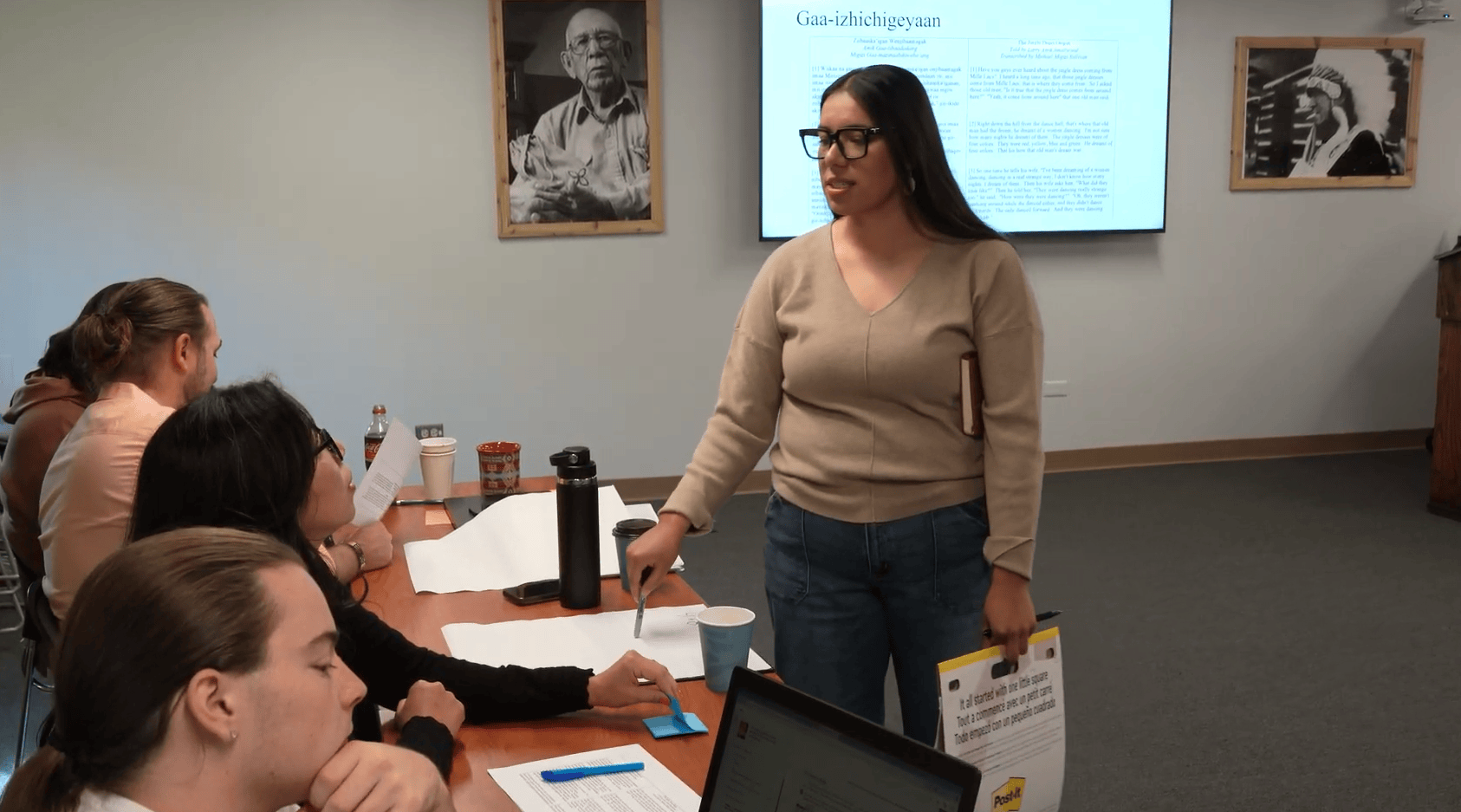
woman teaching a course
Hannah Orie taught a course for the Ojibwe immersion teaching program at Lac Courte Oreilles Ojibwe University, October 2025.
Photo courtesy of Midwest Indigenous Immersion Network

The data reflects some growth in the number of language programs offered by school districts, according to Burnette. When Midwest Indigenous Immersion Network conducted its first survey in the 2022-23 school year, only 35 districts reported offering American Indian language instruction. That number has since grown to 51 — a roughly 40 percent increase in two years.

Burnette credits a 2024 update to state law that strengthened the legal requirement for districts to offer language classes as a significant factor.

“The new legislation was a big contributor to that increase,” said Burnette. “But it’s been a well-known fact in Indian country for decades that we need more.”

Of the 98 American Indian language teachers working in Minnesota public schools, only 11 are teaching full-time. Half of those surveyed spend 20 hours a week or less on language instruction — juggling other job duties on top of their language classes. Many teachers travel between multiple school buildings, teaching students across multiple grades, according to the report.

“Ideally, we’d have multiple full-time American Indian language instructors at each school where student population demands the need,” Burnette said.

The report goes on to say that teachers who do perform the work largely do so without adequate support. Seventy-eight percent reported being responsible for developing all or most of their own curriculum. Just one teacher in the entire survey said their district provided sufficient materials. No comprehensive Ojibwe language curriculum exists at any grade level — early childhood through high school, according to the data.

‘The solution will take time’

Nearly two-thirds of school administrators said teacher recruitment is a challenge, and more than half pointed to funding, according to the report. The two problems feed into each other — without enough money, districts can’t offer positions worth taking, and without good positions, qualified teachers look for jobs elsewhere.
man in tan shirt teaching course
Michael Migizi Sullivan teaching a course for the Ojibwe immersion teaching program at Lac Courte Oreilles Ojibwe University, October 2025.
Photo courtesy of the Midwest Indigenous Immersion Network

The report recommends an increase to the state’s American Indian Education Aid formula grant and investment in training programs for language teachers. The report also seeks the state’s help in establishing standards and curriculum that exists for every other subject taught in Minnesota schools.

Burnette hopes state lawmakers and school administrators will dig into the data and look for ways they can invest.

“The problem is much bigger than we can actually show you in a report,” Burnette said. “The solution will take time, investment and work. You can’t throw five million dollars at this problem and be done with it. This is going to take time, consideration, collaboration and hard work and it’s going to be worth it.”

MPR: https://www.mprnews.org/story/2026/03/24/minnesota-schools-fall-short-on-american-indian-language-culture-classes 
Tuesday, March 10, 2026

Mutual Aid and more in Minneapolis!


VIDEO Mutual Aid Means We Will Save Us by W. Kamau Bell

Episode 8 of I SPENT 3 DAYS IN MINNEAPOLIS!

Read on Substack
 

Mutual Aid Means We Will Save Us

Episode 8 of I SPENT 3 DAYS IN MINNEAPOLIS!

I have some good news for you! SOME REALLY GOOD NEWS! In an era when bad news is all the rage, I encourage you to soak up this truly, good news up. Slip into it like a hot tub on your first night on vacation; you know you have to go home eventually, but you ain’t thinking about it now.

As I have written about here before, one of the stories that made me want to go to Minneapolis after the extrajudicial killings of Renee Good and Alex Pretti came from Modern Times Cafe owner, Dylan Alverson. In a video, Dylan sat at his desk, looking seriously annoyed. He begrudgingly looked at the camera and said a very simple thing:.

“My name is Dylan from Modern Times Cafe in Minneapolis. Starting today, January 26th and until the occupation of Minneapolis is over, we are a free restaurant, Post Modern Times.”

BOOM GOES THE ANTI-CAPITALIST DYNAMITE!

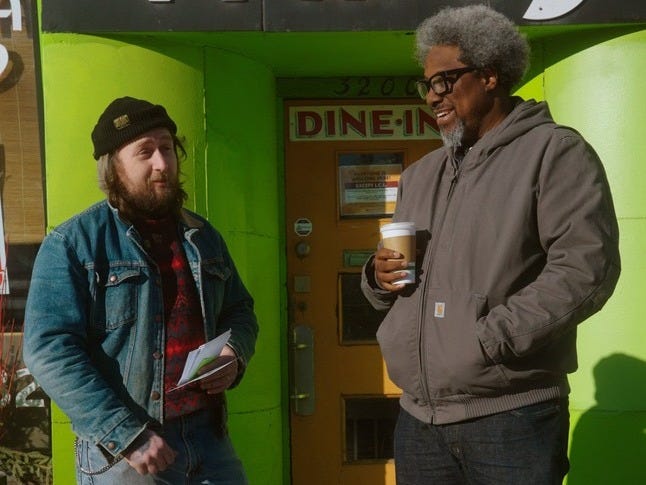
Dylan Alverson and me.

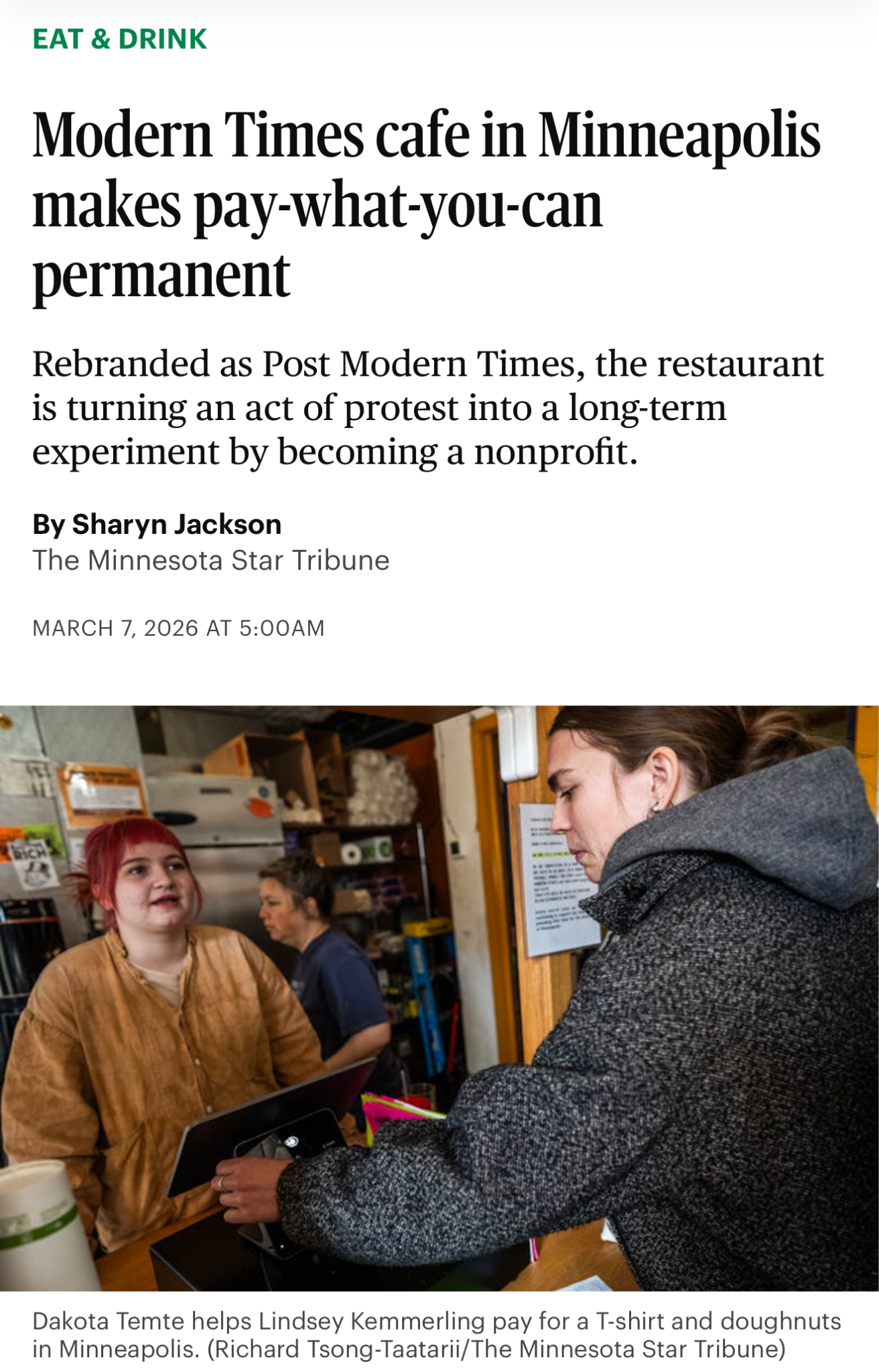
When I made it to Minneapolis only a few days later, I was so happy that Dylan agreed to meet with me. Dylan told me that making his restaurant free had gone so well that he was working on making it free even after the occupation (hopefully) ends. He had even officially renamed his restaurant Post Modern Times Cafe. If all went according to his (and his accountant’s) plan, the restaurant would turn into a nonprofit. Dyan wanted his restaurant to be pay-what-you-can or (more accurately) pay-what-you-want. That way one person could eat pancakes for free, and the next person could say, “THESE $20 WORTH OF PANCAKES ARE SO DELICIOUS THAT I’M PAYING $200!”

If you think about it, isn’t this how capitalism should work? Elon Musk should definitely be paying way more for eggs than a family of five living in a two bedroom apartment.

Over the weekend, my family friend Emily Goldthwaite, who also lives in Minneapolis, sent me an article from The Minnesota Star Tribune. Pay-what-you-wanna is now PERMANENT at Post Modern Times Cafe.

Let us slay.

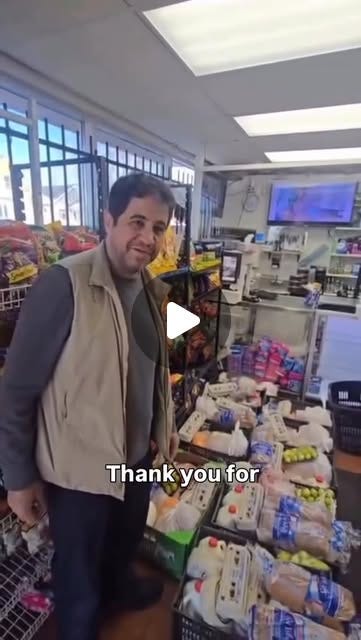
The article also mentions how my little trip to the Twin Cities has helped the greater cause. When I interviewed Dylan, he insisted that I talk to his friend Ammar Aref, a Palestinian immigrant, across the street. Ammar and his family own Amigos One Stop, a convenience store (or tienda) that primarily serves the Latino community. In the wake of the illegal federal occupation, Ammar noticed that many of his customers were no longer coming to the store, for fear of being kidnapped by I.C.E. In response, Ammar and his family began delivering groceries to his customers for free. No delivery fees charged, and sometimes no charge for the groceries either. Ammar is not rich. He and his family were committed to doing this even though it affects their bottom line. Once word of his efforts got out, people began to donate. Apparently, the videos I made helped too. In the article, Ammar says that after they were posted, “people started calling and sending donations from everywhere”. And I KNOW that some of those donations came from you! Thank you for doing that. The good news is that we are the good news. We can be the good news.

W. Kamau Bell on Instagram: "UPDATE on @aosmpls! Many of you as…

The work that Post Modern Times Cafe and Amigos One Stop are doing is under the broad umbrella of mutual aid. The Cornell Law School defines mutual aid, in part, as “a voluntary exchange of services and resources between members of society for mutual benefit.” Even though they used the word they were defining in the definition of the thing they were defining, that seems like a pretty good definition to me. Global Giving says:

“Mutual aid is about cooperating to serve community members. Mutual aid creates networks of care and generosity to meet the immediate needs of our neighbors. It also addresses the root causes of challenges we face and demands transformative change.”

That’s a better one, but kind of a mouthful.

When I was in the Twin Cities, I asked Ashley Fairbanks how she would define it. Ashley is an expert in mutual aid. She even built a website to help the people meet the needs of Minnesotans after Kristi Noem released her federal goblins in the area. What Ashley does for a living is complicated. We had a good laugh about how we both have a lot of slashes in our job descriptions. Ashley introduced herself as “a creative director, an author, a designer, etc.” That “etc” is doing a lot of heavy lifting. She also lists storyteller, narrative consultant, and artist. Luckily for Minnesotans “website designer” is in there too. Her site is called StandWithMinnesota.com. It includes a variety of ways to support the people who are the most heavily impacted by our rogue government. You can donate cash to help someone pay their rent because their breadwinner has been kidnapped by I.C.E. You can donate frequent flyer miles so that someone who was kidnapped by I.C.E., taken to Texas, and then released in the streets of Texas can get back home. You can just volunteer your time. You can also just learn about everything going on in Minnesota so you can be better able to talk about it.

We sat down at The McKnight Foundation to talk. McKnight, who partenred with me on this series, introduced me to Ashley. When I asked Ashley for her definition of mutual aid there were no frills.

Ashley: “Just helping each other.”

Although we didn’t talk about it specifically, I’m guessing that Ashley’s beliefs about mutual aid are connected to the fact that not only was Ashley born in Minnesota, she is native to the land that Minnesota exists on. Ashley is Anishinaabe. Her Indigenous name is Aasiniiwiikwe Indizhinikaaz.

When I think of all the things that I have learned from Indigenous folks there are two things that stick out.

1) The United States of America has broken every treaty we have ever made with Indigenous people.

2) Indigenous people didn’t even have the concept of homelessness until colonizers came in and fucked everything up.

It makes perfect sense that an Indigenous person would be a part of reintroducing the idea of mutual aid to the rest of us. Indigenous folks looked out for everyone in their community, until capitalism ruined everything. This is also true of tribes in Africa and other Indigenous folks around the world. Today, Indigenous people have the second highest rate of homelessness, despite only being around 2% of the U.S. population.

“Prior to 1492, Native communities had a 100% success rate in housing and demonstrated success in caring for our people.” – Colleen Echohawk, Executive Director, Chief Seattle Club

Ashley has combined caring for her Minnesota community with an easy to use and simple to navigate website. And let’s be clear. No matter what you have read in the news, there are still hundreds of federal troops on the ground in Minnesota. They may have “fired” Kristi Noem, but her damage is done (and still being done). Even after the last of the federales are gone, many people will still be afraid to leave their homes and afraid to go to work. They might not even have a workplace to return to. Mutual aid is not a band-aid. Mutual aid is the future, or for many of us, a return to the past. Mutual aid is the realization that we cannot trust our government to do its job. That’s not meant to be just an indictment of Trump. In our nearly 250 years, America has never had a proper social safety net. A Democratic president won’t be the solution. We are the solution. There is something we can all do to create more community. We can embrace mutual aid. While I heartily encourage you to Google the phrase “mutual aid” and the name of your city, I also encourage you to think the way Ashley encourages us to think:.

“[Mutual aid] is like the neighborly behaviors. Making your neighbor, who you know is out doing I.C.E. watch, a pot of soup. Whatever the need is, just meeting it without having an expectation of an exchange of money for services.”

WHO’S WITH ASHLEY? WHO’S WITH US?

Once again, I’m gonna open up the comments. Be productive and constructive. Put your mutual aid ideas in the comments.

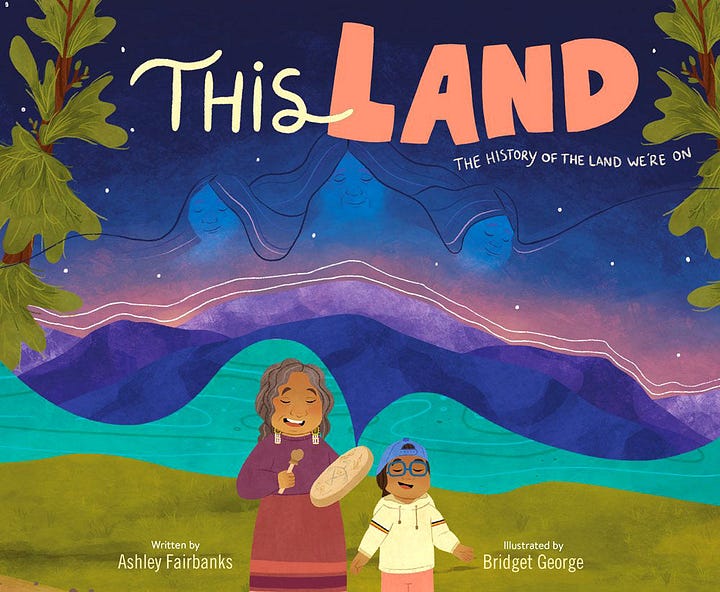
Ashley Fairbanks Is Also A Children’s Book Author

Both books focus on children hearing the Indigenous story from an Indigenous voice. Buy them at the buttons below.

This Land

Boarding Schools & the Indigenous Story

Mutual Aid with Stand With Minnesota!

You know what to do! We are the good news!


Saturday, February 14, 2026

The Racial Purge


The Failed Spectacle of Operation ‘Racial Purge’ by Sean Sherman

Or how Minneapolis became a modern day Sundown Town in 2026

Read on Substack

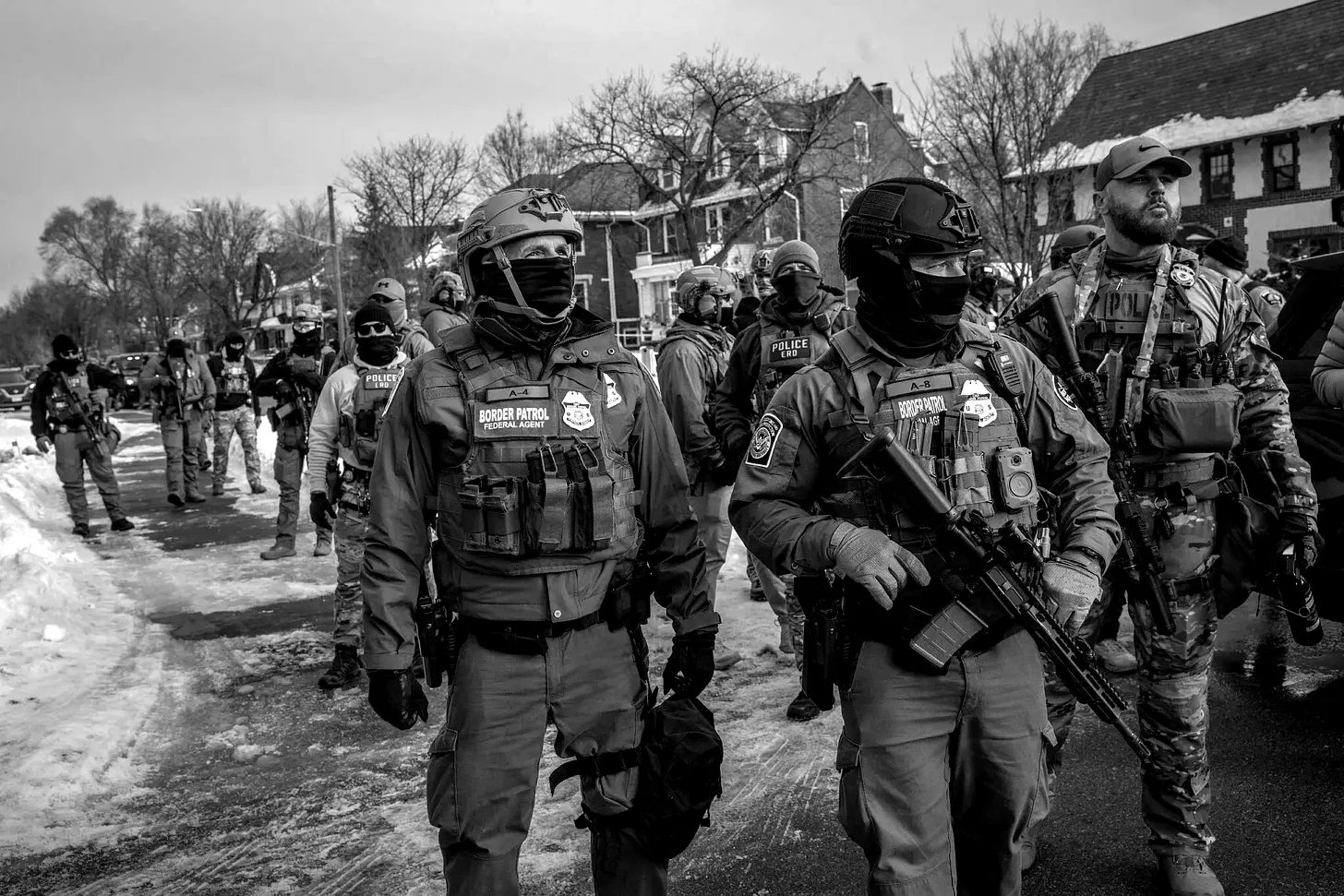
What we have witnessed over the past 60 days in Minneapolis was never about immigration enforcement for the safety of Americans.

This was a deliberate, calculated assault on communities of color masquerading as public safety. And as I write this from the headquarters of our Indigenous non profit NATIFS (North American Traditional Indigenous Food Systems) I can tell you that every person in our organization and thousands across the Twin Cities understands this the same way. This was a racial purge brought on by our own federal government.

READ:  https://open.substack.com/pub/siouxchef/p/the-failed-spectacle-of-operation?utm_campaign=post-expanded-share&utm_medium=web 


Wednesday, January 14, 2026

WE ARE WARRIORS | F*ck Your Fascism by Sean Sherman


WE ARE WARRIORS


F*ck Your Fascism by Sean Sherman

Life After Good Was Murdered in Minnesota

Read on Substack

The Trump administration understands escalation and thrives on it. It’s part of the plan.

  • Send more agents

  • Provoke confrontation

  • Allow violence

  • Justify more control

Violence creates urgency. Urgency creates permission. Permission creates normalization.  

And here is the part people need to hear clearly.

We are now hearing reports from hotel workers that ICE has blocked rooms across Minneapolis–Saint Paul through May.

Let that sink in.


Our Commmunity and Awareness

 WE ARE FIRST NATIONS! Please be aware: watch this video:

I’ll cut to the chase, as they say. I’m now on the ground in Minneapolis, representing our team on the frontlines and doing what I can to help build a defense amid the ongoing occupation by U.S. Immigration and Customs Enforcement (I.C.E.). I can gratefully report that the section of the city where many Native people live is no longer experiencing quite the same level of infiltration by I.C.E. personnel as it had been over the past days. That said, we remain on high alert. The federal government recently sent more officers here, and its attacks on this brave community are clearly far from over.

As part of my activities on the ground, I’m networking with local Native leaders and press outlets. Today, I sat down for an interview with host Robert Pilot on Native Roots Radio to discuss the situation. I encourage you to take a few minutes and watch our highlights video of the conversation right here. And, if you have the time, you can watch the entire, nearly one-hour broadcast on the Native Roots Radio Facebook page.

Lakota LawWatch: I discussed the ongoing I.C.E. attack on Minneapolis on Native Roots Radio.

It should go without saying that we’re now at a critical moment for the survival of our democracy as we know it. The echoes of historic fascism — from the brazen attacks by militarized I.C.E. agents on people it considers undesirable to Homeland Security chief Kristi Noem’s new podium slogan (”One of ours, all of yours”) echoing the Nazi fervor for mass retaliation — are striking and deeply disturbing.

You may recall that we’ve been sounding the alarm about all of this for quite some time. The Project 2025 agenda clearly laid out the administration’s aims, and its subsequent attacks on birthright citizenship were another giant red flag, ultimately giving rise to our Original Homegrowns series of videos laying out the danger to Native — and all — people of this land.

Now, we’re here. But we, as Natives, know that even this can be overcome — if we stand together. As things progress, it will remain extra important to continue speaking truth to power, building alliances and a united front, and taking action where and when appropriate to protect one another, halt the tide of fascism, and restore sanity. Please stay locked in with us. Watch and share our video. We’ll have much more to say, and we plan to provide opportunities for you to make a difference going forward. Are you ready?

Wopila tanka — thank you, always, for supporting our ability to assist.
Chase Iron Eyes
Executive Director
Lakota People’s Law Project
Sacred Defense Fund


Friday, January 9, 2026

Trump’s Desire to Shoot Protesters Is Our New Reality

I was born in Minnesota and lived in the Cities in the 1980s.... What is happening now, we must be very careful not to fall into the trap they are setting... BE CAREFUL if you do protest... Trace

The woman shot and killed by a U.S. Immigration and Customs Enforcement officer in Minneapolis on Wednesday was Renee Nicole Macklin Good, a 37-year-old mother of three who had recently moved to Minnesota.

Renee Good was MURDERED Yesterday by Sean Sherman

Trump’s Desire to Shoot Protesters Is Our New Reality

Read on Substack
 

VIDEO:  https://www.firstalert4.com/2026/01/08/woman-killed-by-ice-agent-minneapolis-was-mother-3-poet-new-city/ 

Thursday, October 23, 2025

The Healing Game Takes Root


LINK:
 https://www.npr.org/2025/10/22/nx-s1-5547180/a-native-american-game-the-forerunner-to-modern-day-lacrosse-makes-a-comeback

Thursday, August 7, 2025

Returning items takes time, research, negotiation and deep trust

 What a remarkable decision! Trace

Revere Auctions is the only known auction house with a formal process for returning spiritual and cultural belongings to Native nations.

The Minnesota Star Tribune | August 3, 2025

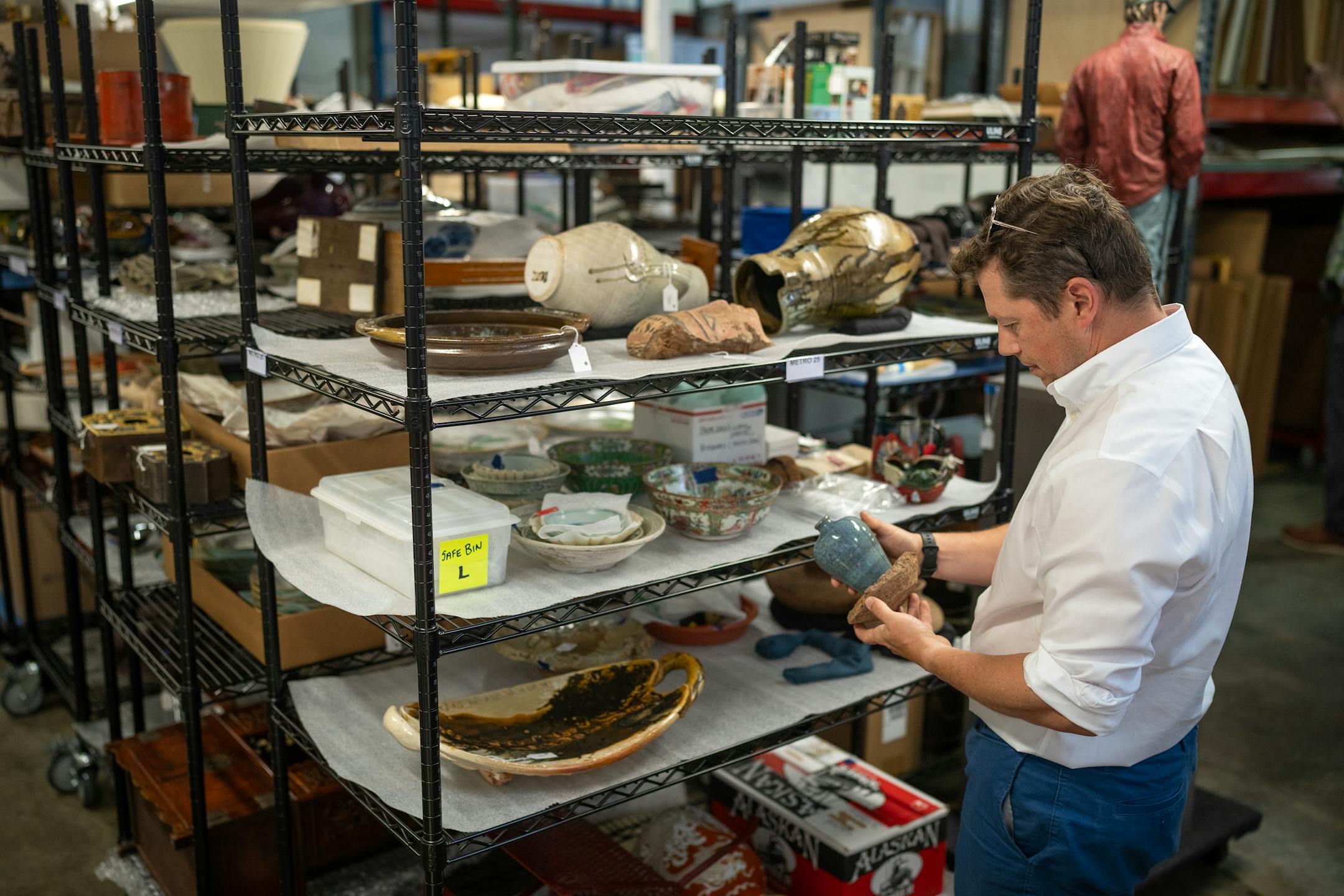
Sean Blanchet, co-founder of Revere Auctions, looks through the warehouse in St. Paul. (Leila Navidi/The Minnesota Star Tribune)

Before every auction, Sean Blanchet sends a spreadsheet to Washington, D.C., where it lands in the inbox of the Association on American Indian Affairs.

There, researchers comb through the list of Native American items up for sale at his St. Paul auction house — tribal masks, feathered war bonnets, ceremonial objects — and flag anything with spiritual or tribal significance.

And when they do, Blanchet doesn’t haggle. He pulls it from the Revere Auctions catalog and sends it home.

“My number one goal is to move the object from where it is, to where it should be,” he said.

Blanchet’s approach is practically unheard of in an industry where tribes are often forced to buy back their own stolen history — or watch it disappear into private collections.

According to AAIA CEO Shannon O’Loughlin, Revere is the only auction house in the United States — and the world — with a formal process for reviewing and returning Native items.

“It is extremely surprising,” she said, “because he’s taking his good faith responsibility, as well as his ethical and moral responsibility, seriously.”

O’Loughlin’s organization has tracked more than 15,000 potentially sensitive Native items sold at auction in 2025 alone. That number exceeded 20,000 last year. Despite the federal Native American Graves Protection and Repatriation Act, she said, there is no real enforcement mechanism for items held in private hands — where most auctioned collections originate.

An ethics statement on Revere’s website acknowledges that many Native American items currently on the secondary market were stolen or unethically purchased. Blanchet sees the moral gap clearly.

“Some of these super sacred objects,” he said, “definitely should not be sold.”

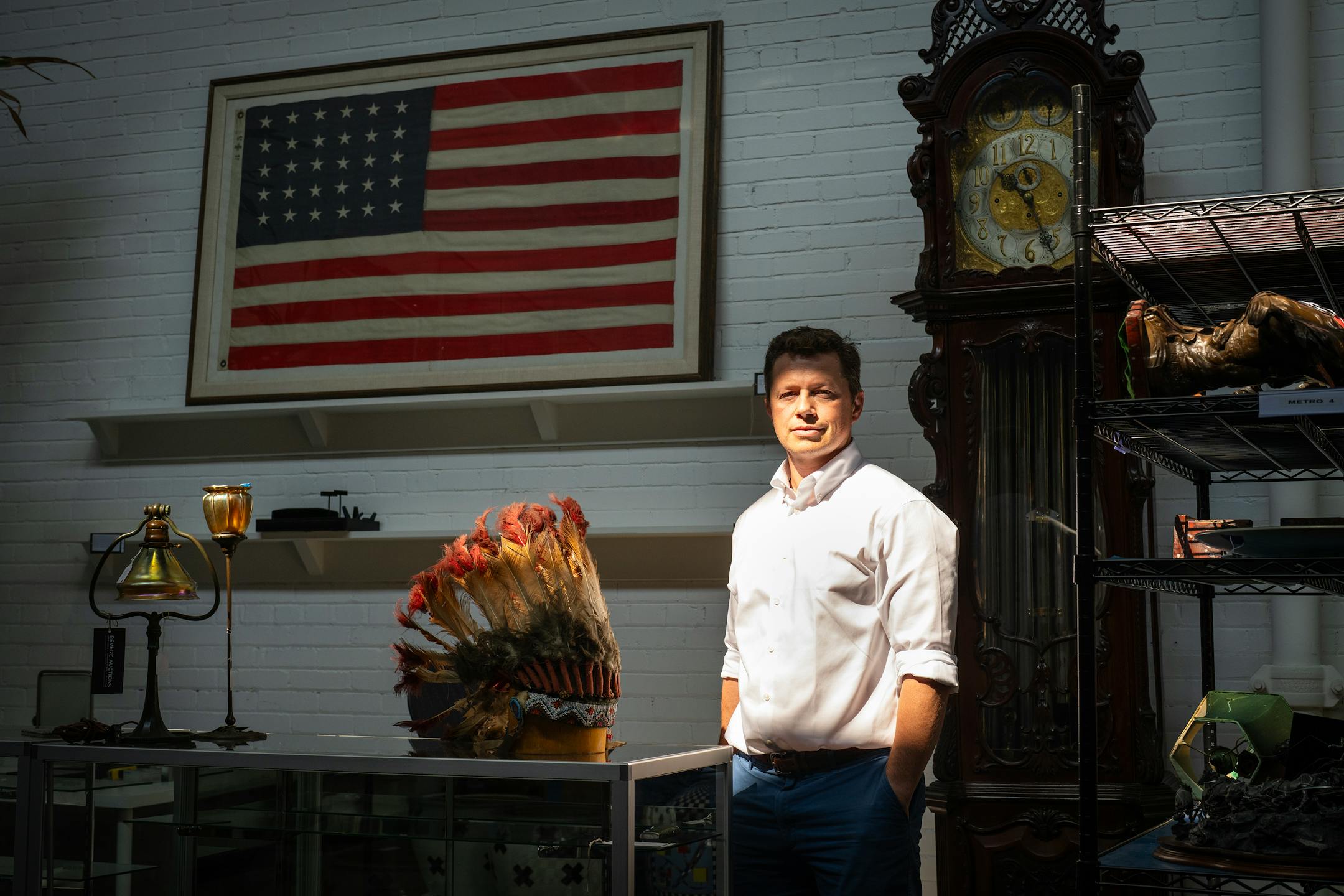
Sean Blanchet, co-founder of Revere Auctions, stands next to a Native American war bonnet that the St. Paul company is helping to repatriate. (Leila Navidi/The Minnesota Star Tribune)

keep reading👇 

Monday, August 4, 2025

Smudging, gardening and art: Summer Camp

 GREAT JOB Siena!!!

During the school year, Braun teaches Native cultural arts and Ojibwe language at Anishinabe Academy. For her, teaching the summer program is deeply personal.

Siena Braun guides her summer students through an activity to make faceless dolls in commemoration of missing and murdered Indigenous relatives. Credit: Aaron Nesheim | Sahan Journal

Prior to 1978, when Congress passed the Indian Child Welfare Act, three in 10 Native American children were taken from their families.  One of those children was Siena Braun. She was placed in foster care and adopted. Her birth mother tracked her down when she was 27.

“They called me one of the stolen kids,” she said. “I got taken at birth.”

KEEP READING:

https://sahanjournal.com/education/minneapolis-public-schools-anishinabe-academy-summer-school-native-science/ 

Friday, June 20, 2025

Vigil to honor Melissa and Mark Hortman

More than a thousand people attend a candlelight vigil for Melissa and Mark Hortman at the State Capitol building Wednesday. (Aaron Lavinsky/The Minnesota Star Tribune)

 “We wanted to sing her an honor song, a traveling song, to send her off in a good way, for all she did for our nation and for all native people, standing up for us, our sovereignty, and our treaty rights,” Strong said. “She would not only just work on our behalf, but she would be a part of our community. She came and participated in our community and our culture and our ceremonies, and she was very empowering.”

READ: https://www.startribune.com/minnesotans-will-gather-at-state-capitol-for-candlelight-vigil-for-melissa-and-mark-hortman/601374809 

Thursday, June 19, 2025

More can be done


Nelda Goodman, a Menominee tribal elder, remembers when her white friend, Miriam Horneff, bought a ceremonial Big Drum on eBay from a former Boy Scout leader.

The drum belonged to the Bad River Band of Lake Superior Chippewa.  Horneff wanted to return the drum to its original owners, so, with her will executors, she met with Alton “Sonny” Smart of the related Lac du Flambeau Chippewa tribe. 

Smart is a traditional helper — or “skapaewes” in Menominee — who can be given the cultural authority from Bad River elders to transport it back to its Wisconsin reservation. 

After Horneff died, Smart covered the drum with a blanket and returned it with a private ceremony.  However, Goodman said Horneff had a deep fascination with cultural artifacts, and her estate sold off much of her collection, which included other Native objects that were not repatriated with such care.


KEEP READING:  https://mndaily.com/294574/campus-administration/weisman-is-taking-steps-to-return-their-indigenous-artifacts-but-more-can-be-done/ 

Tuesday, December 31, 2024

2024: Review in Photos (MPR)


 GO LOOK: https://www.mprnews.org/story/2024/12/31/land-return-voting-rights-and-fashion-2024-native-news-coverage-through-photos

Personal histories, items can be claimed by adult adoptees from Minnesota’s DHS files

A small group of community members met at the Minneapolis American Indian Center in July to share information about how adopted adults can claim items left for them by their birth parents.

The conversation about the ability to retrieve personal effects came to the forefront with the law that went into effect July 1 — where birth records held by the state can be obtained by adopted adults.

More visuals for Native News can be found throughout online coverage.


GOOD READS:

Under a 'grandma moon,' Native Americans honor their sacred pact with salmon

Artnet News: How Native American Artists are Combatting Misrepresention with ‘Indigenous Joy’ 

High Country News: Indigenous affairs stories you need to read 


HAPPY NEW YEAR TO YOU ALL!   xox Trace 

Tuesday, December 3, 2024

Northfield History Center repatriates items to Prairie Island

 Cannon Falls, MINNESOTA,

  • Published on

PIIC logo

The Northfield History Center has repatriated a number of items from its collection to the Prairie Island Indian Community. 

The Northfield History Center voluntarily invited the Prairie Island Tribal Historic Preservation Office (THPO) to review its collection and then took steps for the THPO to take immediate possession of the items. In a process that has been historically fraught with difficulties for tribes, the willingness of the Northfield History Center made it a positive experience and cemented a foundation for future collaborations between the two entities.

“Oftentimes, it’s a struggle to get some of these objects returned so whenever we have a volunteer and cooperating partner, it makes the process so much easier and in this instance, we found a true partnership that we are building upon with our friends over at Northfield History Center,” said Franky Jackson, Prairie Island’s tribal historic compliance officer.

The Northfield History Center announced Nov. 18 that its Board of Directors approved the deaccessioning of the items. The items are sacred Native American items that have significance to local Indigenous people, according to the announcement.

“These items have been in the Northfield History Center collection for many years, but they do not belong to the Northfield community. They belong to the people that lived in this area long before us, and that made and used these items,” Executive Director Sean Allen said in a statement. “Today we are proud to be able to repatriate these important pieces to their rightful owners and to build a lasting partnership with the Prairie Island Indian Community.”


New federal rules

It’s important to tribes to identify which institutions have their items and which people within the tribe can benefit from having the items returned, Jackson said. 

“When it comes to our sacred items, this is part of how we heal our hoop. This is part of how we heal our communities, is by capturing and bringing home these sacred items that help us with our ceremonies,” Jackson said.

Repatriation is also related to the tribe’s cultural revitalization. It’s “crucially important” for Prairie Island’s artists to have access to the items to have a connection to their relatives’ handiwork, carry forward the artistry and pass it down to next generations, Jackson said.

“That’s a big part of what we’re doing with our Tribal Historic Preservation Office here. As we accession in items, it’s our goal to allow our community-based artists to have access to those items,” Jackson said.

The process for institutions to repatriate items to tribes is regulated by the federal Native American Graves Protection and Repatriation Act (NAGPRA) of 1990,which requires institutions that receive federal funding to transfer Native American human remains and objects of cultural patrimony to lineal descendants and culturally affiliated tribes. Despite the law, thousands of Native American human remains and artifacts remained in museums

A revision of NAGPRA went into effect in January that streamlines the repatriation process, gives tribes the power to define what is a sacred object and gives tribes more jurisdiction over the institutions’ use of human remains and objects. It also requires institutions to inventory all of their Native American artifacts within the next five years. 

Under the revised law, an institution has 90 days to respond once a claim has been filed. Prior to the change in January, "institutions could drag their feet and take as long as they wanted. In some instances, it has taken us literally years to reconcile some items,” Jackson said. 

An example of that is the noose that was known as the Mankato Hanging Rope in the Minnesota Historical Society’s collection.  The noose was used in the hanging of Wicanhpi Wastedanpi (Good Little Stars) on Dec. 26, 1862 in Mankato as part of the largest mass execution in U.S. history.  The Minnesota Historical Society returned the noose earlier this year after Prairie Island submitted a claim under the new NAGPRA rules.  The repatriation of the noose this year came after Dakota tribes’ “11-year struggle” to have it returned, Jackson said.

“With some of the new legislation that took place with the law, that strengthens the tribal voice when it comes to certain things and it allows us to have this done in a way that’s timely for us,” Jackson said.

Often, Prairie Island learns of an object belonging to the tribe when a museum contacts the THPO or the object is put up for auction to the highest bidder. Both can be a “tumulteous” process for the tribe, Jackson said. 

Museums who received the federal funding appropriated by Congress during the Covid-19 pandemic are now required to inventory their collections under the revised law. The Prairie Island THPO is seeing an influx of inquiries from institutions across the United States to review items in their collections that they believe belong to Prairie Island. Noah White, Prairie Island’s tribal historic preservation officer, estimates they’ve heard from 30-35 institutions since the beginning of the year. 

“Nobody ever really reached out to us in the past. We’d always find out from a different source,” White said.

After Prairie Island’s struggles to reclaim items, they had “jubilation and excitement” when the Northfield History Center reached out and the THPO was able to easily bring the items home, Jackson said. 

“They looked within their collection, identified some items that they knew were going to be controversial, some that may have fallen under the federal definition of that law, and they were proactive,” Jackson said.

The process with the Northfield History Center moved quickly.

“They rolled the doors open. They greeted us, they were very welcoming,” Jackson said.

After Allen and the Board of Directors reached out, the Prairie Island THPO visited the Northfield History Center to inventory its collection and identified several items that met the definition as a sacred object or object of cultural patrimony under NAGPRA, Jackson said.

Prairie Island had to formally file a NAGPRA claim on the items, but on the THPO’s second visit, the Northfield History Center established a temporary loan agreement to allow the THPO to take possession of the objects immediately. 

“That is very rare. That doesn’t happen often,” Jackson said.

When a tribe reviews a museum’s collection and identifies items it wants returned, it can create a lot of “anxiety” and “angst” for the tribe, Jackson said.

“To have this institution introduce a loan agreement as part of the solution just demonstrated beyond measures that they had more than a passing interest to return these objects to the appropriate people,” Jackson said. “That really demonstrated that we have a trusted partner at the table that wanted to do the morally right thing.” 


Repatriated items

Most of the items that were returned by the Northfield History Center will be held by the tribe as objects of cultural patrimony, meaning that they belong to the broader tribe, Jackson said. 

The items included two large ceremonial headdresses made of eagle feathers, handmade beads and other materials, according to the Northfield History Center. The headdresses are “exquisite,” Jackson said. The repatriation helps bring those items back into the Prairie Island community so they can view them and learn the story of the repatriation, he said.

Some of the objects are considered sacred and won’t have public access, he said.

There were several “wonderful and beautiful” sacred pipes in the collection, Jackson said. The provenance on some of the pipes was detailed and the THPO was able to identify the families to whom the pipes need to be returned.

“That’s a wonderful, wonderful experience for us to be able to work with this institution to be able to find that pathway home for some of these objects,” Jackson said.

Prairie Island is also working with several other museums in Minnesota on voluntary repatriation and to create repatriation policies. The cross-cultural exchange and collaboration with the Northfield History Center shows what’s possible. Prairie Island plans to collaborate with the history center on its exhibits and history center staff plans to visit Prairie Island to see their collection and buffalo herd, Jackson said. 

“The partnership with Northfield is going to go much deeper,” he said.


Happy Visitors!

WRITTEN BY HUMANS!

WRITTEN BY HUMANS!

Blog Archive

Featured Post

Your History Class Was a F*cking Lie | #NOMOAR

  Your History Class Was a F*cking Lie by Sean Sherman (Or: How the American Educational System Has Always Been a Racist Propaganda Program...


Native Circles

Native Circles
click logo for podcasts!

Most READ Posts

Bookshop

You are not alone

You are not alone

To Veronica Brown

Veronica, we adult adoptees are thinking of you today and every day. We will be here when you need us. Your journey in the adopted life has begun, nothing can revoke that now, the damage cannot be undone. Be courageous, you have what no adoptee before you has had; a strong group of adult adoptees who know your story, who are behind you and will always be so.

Diane Tells His Name


click photo

Lost Birds on Al Jazeera Fault Lines

Lost Birds on Al Jazeera Fault Lines
click to read and listen about Trace, Diane, Julie and Suzie

NO MORE STOLEN SISTERS

NO MORE STOLEN SISTERS
click image

ADOPTION TRUTH

As the single largest unregulated industry in the United States, adoption is viewed as a benevolent action that results in the formation of “forever families.”
The truth is that it is a very lucrative business with a known sales pitch. With profits last estimated at over $1.44 billion dollars a year, mothers who consider adoption for their babies need to be very aware that all of this promotion clouds the facts and only though independent research can they get an accurate account of what life might be like for both them and their child after signing the adoption paperwork.

Original Birth Certificate Map in the USA

Google Followers