BOOZHOO! We've amassed tons of information and important history on this blog since 2010. If you have a keyword, use the search box below. Also check out the reference section above. If you have a question or need help searching, use the contact form at the bottom of the blog.
We want you to use BOOKSHOP to buy books! (the editor will earn a small amount of money or commission. (we thank you) (that is our disclaimer statement)
This is a blog. It is not a peer-reviewed journal, not a sponsored publication... WE DO NOT HAVE ADS or earn MONEY from this website. The ideas, news and thoughts posted are sourced… or written by the editor or contributors.
EMAIL ME: tracelara@pm.me (outlook email is gone)
THANK YOU CHI MEGWETCH!
SEARCH
Showing posts with label Sisseton Wahpeton. Show all posts
Showing posts with label Sisseton Wahpeton. Show all posts
GRAND
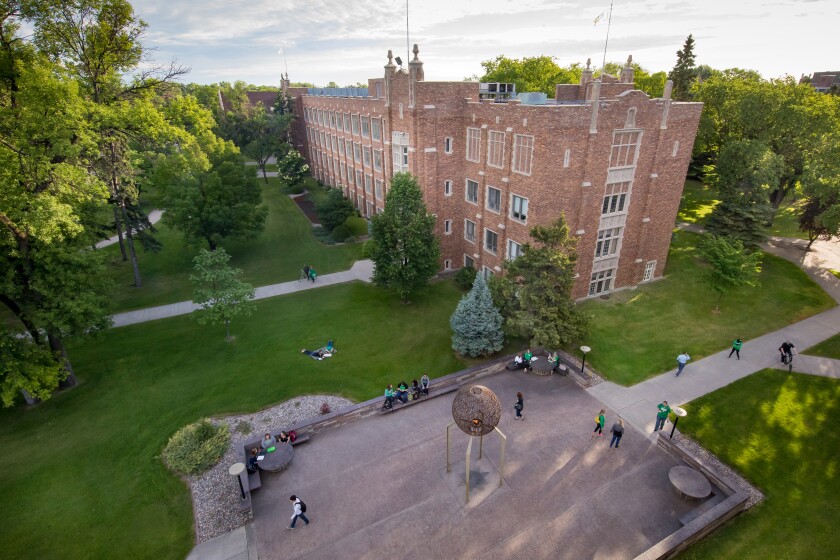
FORKS, North Dakota — A little over two years after UND officials announced they’d
identified the remains of dozens of Native Americans in the university’s
possession, the return of the deceased to their descendants can begin.
The
first of the human remains identified in the university’s archives
became available for repatriation to Native American tribal nations on
Thursday.
Now,
the remains of dozens of Native ancestors, along with more than 1,000
funerary objects and other artifacts, can be returned to tribal nations
across the region.
“It’s
finally done,” said Keith Malaterre, director of the Indigenous Student
Center and a member of the Turtle Mountain Band of Chippewa Indians.
“They finally get to go home.”
All
told, the remains of some 57 ancestors and associated funerary objects
are now available for repatriation, according to the two Federal
Register notices published in August. Tribes have been able to submit
written claims for ancestral remains since the notices went out.
Per
the Federal Register notices, the remains have a “reasonable
connection” to nearly two dozen Native tribes, including all five tribes
in North Dakota as well as tribes in South Dakota, Minnesota, and
Wyoming.
Many
of the remains in question came from excavations of burial mounds
across North Dakota. Ancestral remains were received by the university
as early as 1907 and as late as 1982, according to the notices.
The
university has also issued notices of intent to repatriate several
sacred objects to area tribes, including the Turtle Mountain Band of
Chippewa Indians and the Sisseton-Wahpeton Oyate of the Lake Traverse
Reservation in South Dakota.
An
unspecified amount of ancestral remains or related objects possessed by
UND was also transferred under the legal authority of the U.S. Army
Corps of Engineers in August, in order to comply with the Native
American Graves Protection and Repatriation Act.
The
return of ancestral remains comes just over two years after UND first
announced it had located what it estimated at the time as around 250
boxes of sacred objects and the remains of what was initially estimated
to be 70 Native American ancestors.
Faculty
had first identified ancestral remains in the university’s possession
in March 2022, beginning months of discussions with area tribal nations.
President
Andy Armacost issued an apology to tribal nations across the country
and pledged to return the remains and any sacred objects in the
university’s possession to their respective tribes.
Since
2022, the university has worked since then with the affected tribes as
well as multiple state and federal agencies to inventory the ancestral
remains and identify their rightful recipients while remaining in
compliance with NAGPRA.
Crystal
Alberts, co-chair of UND’s NAGPRA compliance committee, says staff has
searched “building to building, floor to floor, door to door” to
identify any ancestral remains in the university’s possession.
Even so, she did not rule out the possibility of more ancestral remains being found in the future.
“I
can’t definitively say no one else will be found and there is no one
else,” Alberts said. “That would be an irresponsible statement.”
Dianne
Desrosiers, the tribal historic preservation officer for the
Sisseton-Wahpeton Oyate tribe, credited UND for its handling of the
reparation process.
“I
have to commend UND,” Desrosiers said. “They worked with the tribes and
did everything they could within their power to make this process easy
and smooth for tribes.”
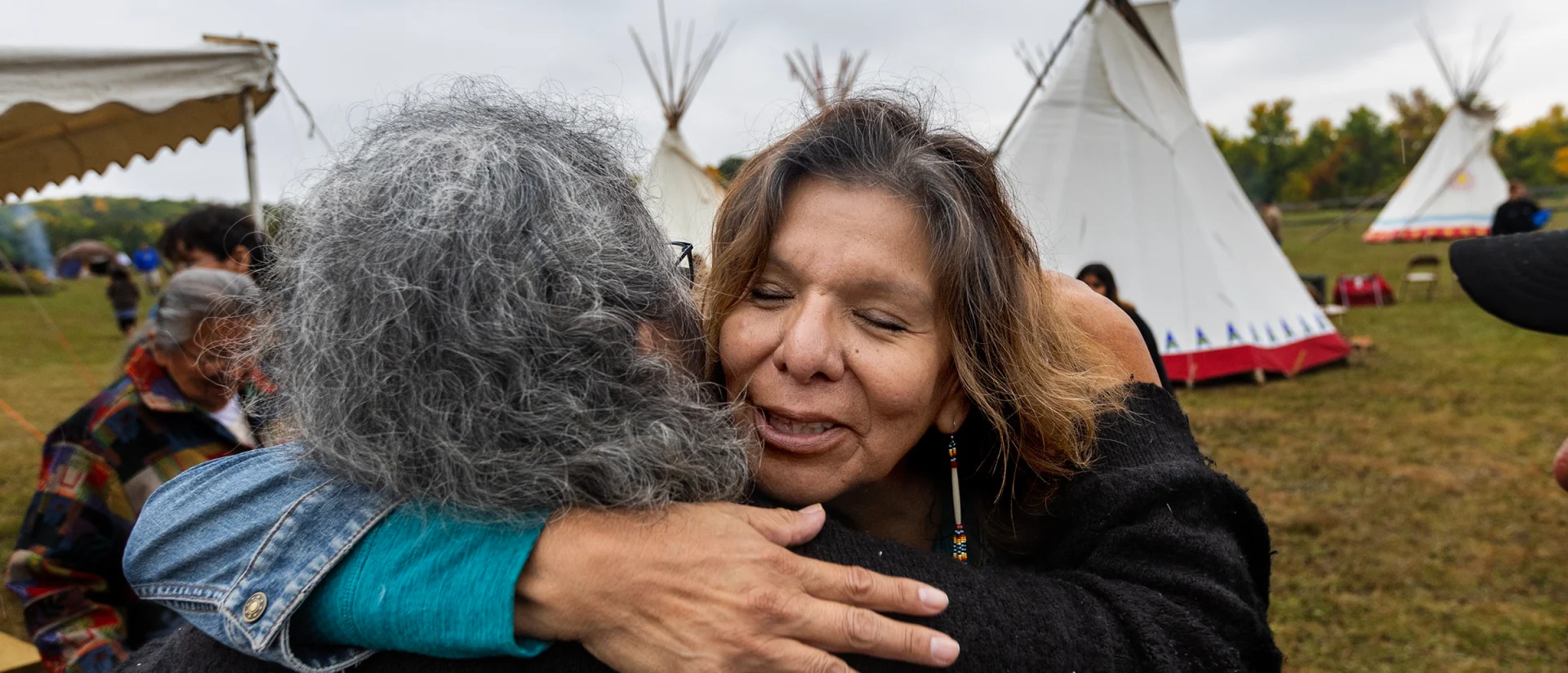
Kelley
Bova, right, receives a hug after speaking to a group of elders at the
Lake Traverse Reservation in South Dakota on Sept. 23, 2023. Bova,
Sisseton Wahpeton Oyate, brought home a pair of moccasins that had been
confiscated from a Native boy at the Carlisle Indian Industrial School
in Pennsylvania more than 100 years ago. They were repatriated to the
tribe along with the remains of two students who died there in the late
1800s. (Photo by Charles Fox for ICT)
WARNING: This story contains disturbing details about residential and boarding schools. If you are feeling triggered, here is a resource list for trauma responses
from the National Native American Boarding School Healing Coalition in
the U.S. In Canada, the National Indian Residential School Crisis
Hotline can be reached at 1-866-925-4419.
LAKE
TRAVERSE RESERVATION, S.D. — The moccasins sat for decades in the
corner of a glass-enclosed bookcase in Pennsylvania, nestled on a shelf
with a Davy Crockett trading card and Canadian Mountie knick-knack.
They
had long been separated from the unknown Native boy who had worn them
into the notorious Carlisle Indian Industrial School more than 100 years
ago, where they were taken from him along with his Native connections
to family, language and traditions.
By
the time they returned quietly home to Sisseton Wahpeton Oyate lands in
late September, however, their anonymity had made them universal, a
reminder of the forced assimilation that had formed the mission of the
Pennsylvania school.
“It's
all about those moccasins,” said Tamara St. John, a Sisseton Wahpeton
Oyate historian and South Dakota state representative. “They are the
symbol of everything that happened there.”
Their
journey home – accompanying the remains of two Sisseton and Spirit Lake
boys repatriated to their tribes and families – brought not only
another step toward reconciliation and healing for those involved but
also inner peace and a sense of purpose to others along the way.
Moccasin tracks
The
skilled craftsmanship of the moccasins’ quill and beadwork apparently
caught the attention of seamstress Susan Zeamer, who worked at the
Carlisle school from 1895 to 1908.
At
some point, she took them home for herself. Whether she slipped the
moccasins into her pockets or was given permission to keep them is lost
to history.
The
moccasins were then passed down through generations until a
great-nephew by marriage, John Baker, 72, now of Buckingham Township,
Pennsylvania, became their owner in 2011.
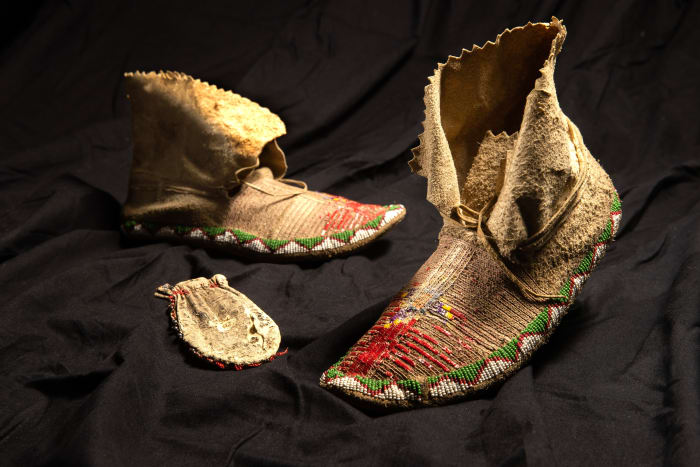
A
pair of moccasins and a medicine pouch that were confiscated from a
student at the Carlisle Indian Industrial School more than 100 years ago
were repatriated to the Sisseton Wahpeton Oyate on Sept. 23, 2023.
They had been in the possession of a Pennsylvania family for more than a
century before Kelley Bova, a tribal citizen, was asked to return them
to the tribe. (Photo by Charles Fox for ICT)
Baker
remembers being fascinated by the moccasins in the bookcase in his
parent’s home as a boy in the 1950s, when Westerns were popular on
television and movie screens. He visualized a young Indigenous boy
wearing them on adventures.
Over
the past decade, however, despite the sentimental attachment, Baker
became uneasy with possessing them. Like many who grew up in the
Carlisle area, Baker’s knowledge of the Carlisle school was limited, but
being the owner of the moccasins had enlightened him to the reality of
the harsh history of the school and the treatment of Indigenous
children. He felt a new responsibility. He understood the moccasins were
not his to keep, but his quest to find their home of origin was filled
with frustrations.
Museums
and tribes did not always reply to his queries, but his research
convinced him the moccasins were Plains Indian in style.
He finally reached out to Arla Patch, in Bucks County, Pennsylvania, a founding member of the Coalition of Natives and Allies
advocacy, group which has led a fight against Native mascots. He showed
her the moccasins on a Zoom call and told her of his desire to see them
returned.
"I
was getting pretty frustrated,” Baker said. “What’s going to happen to
these? … They're more than just an artifact, they're actually part of a
lineage that still is alive and well."
Patch introduced him to her close friend, Kelley Bova, a fellow member of the Coalition of Natives and Allies, who is Dakota.
Bova,
too, had been removed from her culture and traditions. Born in
Sisseton, South Dakota, she was adopted as a 3-month-old infant by a
White family and grew up far from her Native relatives.
Independent
research with tribal historians and museum experts confirmed the
moccasins were Plains Indian in style, though a specific tribe could not
be pinpointed. Officials with the Blackfeet, Dakota, and Rosebud Sioux
tribes all felt they were characteristic of their style.
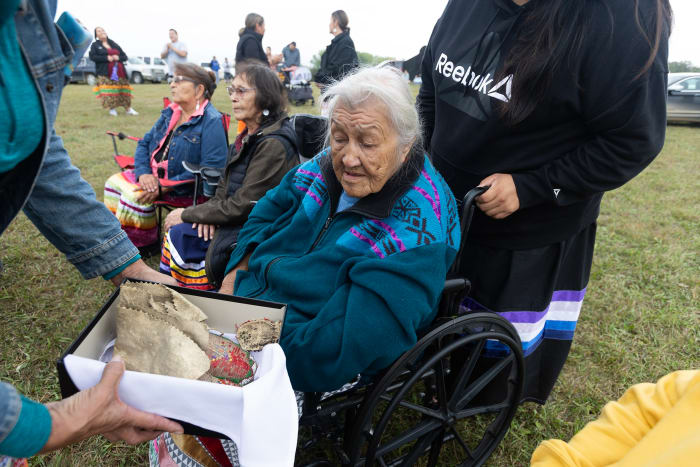
Kelley
Bova (not shown) shows the moccasins to Helena Little Ghost at the Lake
Traverse Reservation in South Dakota on Sept. 23, 2023. The moccasins
were confiscated from a student at the Carlisle Indian Industrial School
more than 100 years ago. They remained in the possession of a
Pennsylvania family for more than a century before being repatriated
back to the Sisseton Wahpeton Oyate. (Photo by Charles Fox for ICT)
Bova
believed her own tribe, the Sisseton Wahpeton Oyate, should take the
moccasins, and tribal officials agreed. Bova was tapped as the proper
person to deliver them to their symbolic home.
“I
find it mystical that Kelley and my path would cross, and that John's
and my path would cross,” Patch recalled. “It's just so amazing. You
couldn't write a script like this.”
Baker
presented the moccasins to Bova in November 2022, at Peace Valley Park
in Bucks County. He said he felt both a void and a peace to no longer
have them in his home in the antique bookcase that he inherited along
with the moccasins.
“It
was really strange to not have the moccasins in the bookcase anymore,”
he said recently. “They've been there my whole life. I kind of lost this
imaginary friend. But I can't tell you how much peace that brought me.
There was a real sense of well-being about it. Something definitely was
settled.”
A different era
While
Baker felt the absence, Bova quickly formed a close bond with the worn,
leather shoes. They had been on similar journeys, more than a
half-century apart, and Bova felt it was time to take them home.
“I
would actually talk to them, tell them that they were safe now,” Bova
said, as she waited to take the moccasins to Sisseton. “I have prayed
with them, and I treat them like a child. I take care of them and plan
to be able to bring them home.”
Finding your way home is something Bova knows about.
Her
journey began as Rose Anne Owen, a Dakota infant taken from her family
at birth and moved to Rosebud to await adoption. At age 3 months, she
was placed into the hands of Salvatore and André Petrilli, a suburban
Philadelphia dentist and his wife. The Glenside couple, of Italian and
Irish descent, had struggled to have their own biological children and
had arranged for the adoption through Catholic Charities.
Rose
made her 1,900-mile journey to Glenside, Pennsylvania, and was renamed
Kelley Elizabeth Petrilli. A new birth certificate was created to
reflect that she was the child of two Caucasian parents. Her American
Indian heritage was wiped away on paper. A Montgomery County Orphans
Court clerk, ironically with the last name of Custer, gave the final
stamp of approval to the adoption.
She
had become a child of the Native adoption era, a decades-long forced
assimilation of Native children established under the Indian Adoption
Project, which started in 1958 and evolved to include 50 private and
public placement agencies across the United States and Canada.
By
then, boarding schools had proven to be expensive and unsuccessful.
Adoption was the new attempt at assimilation, but the expenses would be
the responsibility of the adopting parents and not that of the
government. Raised in a White home, without the communal support of
other students, adoption was viewed as a more successful tool for
assimilation.
In
the next 20 years, until the Indian Child Welfare Act ended the
adoption project, almost 13,000 Native children were adopted. Native
children are still four times more likely to be removed from their
families and placed in foster care than non-Native children.
Love without identity
Unlike
many other adoptees, Bova did not suffer a childhood of abuse. The
Petrillis provided a loving, middle-class home and private schools,
while never hiding her Native heritage.
Eventually,
they would have five biological children on their own, but Bova always
knew she was different, a Native island in an ocean of White suburbia.
“You’re an Indian, you’re an Indian,” one of her cousins would taunt.
“No, I’m not,” she would scream back, a denial that still embarrasses her and causes her pain today.
“When I was younger, I wanted to be White; I still feel guilty about that,” Bova told The Philadelphia Inquirer in 2021. “I just wanted to fit in and be like my sisters. … I did not like being tall and brown and different.”
For Bova, that feeling of isolation led to what she calls her “dark years” after high school.
“Deep
down, when you are adopted, you have a wound inside yourself,” she
said. “If your parents gave you up, how lovable can you be?”
Sandy
White Hawk, a Sicangu Lakota from Rosebud, knows the feeling. She was
adopted at 18 months, and grew up to found the First Nations
Repatriations Institute. She currently works at the Indian Child Welfare
Act Law Center in Minneapolis.
“Even in loving families, Native adoptees live without a sense of who they are,” White Hawk told the Inquirer. “Love doesn’t provide identity.”
Bova,
now 60, did not find her way back to her biological mother, Lillian
Owen, and siblings, or her Dakota tribe, the Sisseton Wahpeton Oyate,
until she was 50. Like students who attended Native boarding schools,
she found herself split between two worlds and not fitting completely in
either.
“When
any child was taken, they were also not able to continue their journey
of being Native American. We were robbed of our identity,” said Bova,
who is now an enrolled member of the tribe. “I think that's the hardest
part for me to sometimes wrap around, that you're robbed of that. And
people don't understand that, but I'm … grateful that I found my family
and I try to learn as much as I can.”
Patch said the journey continues.
“Kelley
does not have her Whiteness, and she does not have her Nativeness,”
Patch said of her friend. “The healing power of Kelley’s story is that
she is now getting to be Dakota. She’s getting to connect with that
Dakota heritage.”
Rose’s story
On
Memorial Day weekend in 2021, Kelley made her first visit to the former
grounds of the Carlisle Indian Industrial School, drawn by a group of
Native women and others from the Circle Legacy group who clean and
decorate the graves each year.
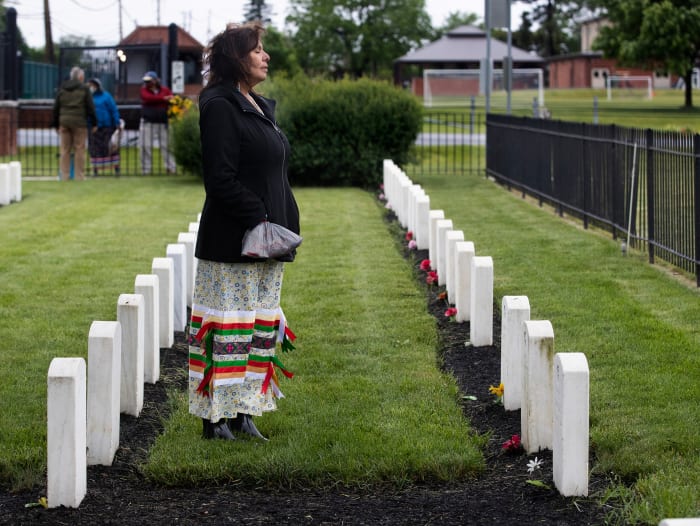
She
stood in the Indian Cemetery on a raw, rainy day with the white
gravestones laid out in front of her in perfect rows, like desks in a
classroom.
Kelley
Bova, of Pennsylvania, pays her first visit to the Indian Cemetery on
May 29, 2021, at the site where the Carlisle Indian Industrial School
operated from 1879-1918. Bova was taken from her family as an infant
and adopted out at three months old to a White Pennsylvania family. She
later reconnected with her birth family and is now a member of the
Sisseton Wahpeton Oyate. (Photo by Charles Fox, courtesy of The
Philadelphia Inquirer)
They
marked the remains of the students who had died while attending the
school but had not been returned home to their families. Most were
victims of diseases such as tuberculosis.
Her
eyes became transfixed on one particular grave. The gravestone simply
read “Rose, Sioux.” It was the name she had been given by her biological
parents.
“Just seeing that grave with her name, my name on it,” Kelley later said, “it just made me cry.”
It
was the grave of Rose Long Face, also known as Little Hawk, Rosebud
Sioux, who was among the initial group of 84 students to arrive at the
school on Oct. 6, 1879. She died 18 months later on April 29, 1881.
Their
journeys had been separated by 84 years but were nonetheless similar.
Both had made the journey from Rosebud to a Pennsylvania town, to have
their Native identities removed and be renamed in the process. Both had
been separated from their families and the land that should have been
their home by a government assimilation program.
Bova
moved a few rows over and found the graves of two other Dakota
students, Amos LaFromboise and Edward Upright. She knelt, placing
tobacco bundles on their graves, speaking softly to let them know they
were not forgotten and one day they would be home again.
Rose
Long Face made it home first, however. In the summer of 2021, she was
among nine Rosebud students repatriated from the cemetery to their
homeland in South Dakota. She had been away 140 years.
Amos and Edward
Amos
and Edward began their journeys home in September 2023, when they were
disinterred from the Carlisle cemetery in a private ceremony that
included tribal members, ancestors and others.
Their homecoming provided a chance to return the moccasins, as well, to Sisseton.
Amos
and Edward were among six Sisseton Wahpeton Oyate/Spirit Lake students,
four boys and two girls, who arrived at the Carlisle school on Nov. 6,
1879, along with seven students from other tribes. They arrived exactly
one month after the first group of students had walked through the
gates.
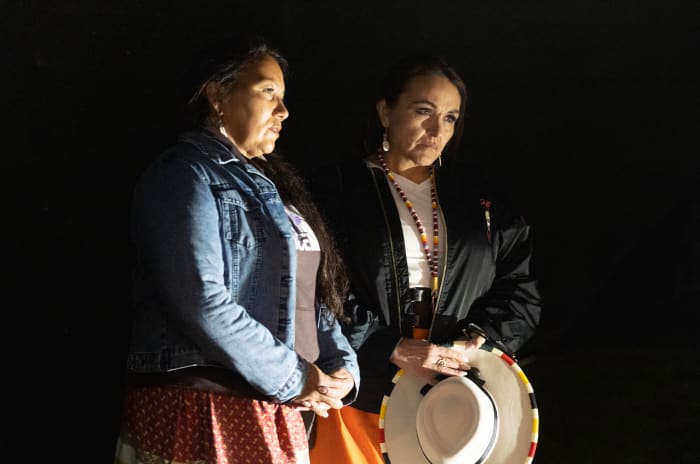
Chairperson
Lonna Street, left, Spirit Lake Tribe, and Tamara St. John, Sisseton
Wahpeton Oyate historian and a South Dakota state representative, stand
in the Indian Cemetery at the former site of the Carlisle Indian
Industrial School late in the evening of Sept. 17, 2023. Work in the
cemetery disinterring the graves of Amos LaFromboise and Edward Upright
had gone on for approximately 11 hours on a rainy day. (Photo by Charles
Fox for ICT)
In
20 days, Amos was dead — the first student to die at the school. There
is no record of the case of death, though a newspaper report at the time
suggested he was sick when he arrived at the school.
Edward,
son of Chief Waanatan II, was 12 when he arrived at the school, a year
younger than Amos. He died on May 5, 1881, of pneumonia as he was
recovering from measles.
Amos
and Edward were among four students disinterred from Carlisle in
September as part of the U.S. Army’s disinterment project at the
Carlisle Barracks. The others, Beau Neal, Northern Arapaho, and Launey
Shorty, Blackfeet, were also returned to their tribes and families.
Amos
and Edward were taken by a caravan of nine passenger vans and vehicles
that left Carlisle on the afternoon of Sept. 19 for the 22-hour drive to
Sisseton.
Along
the way, the caravan stopped in Ohio to pick up two more remains being
returned by Oberlin College. Two additional remains, believed to be
about 500 years old, were already waiting for burial in South Dakota
after being returned by a North Dakota coroner’s office.
Amos
and Edward arrived on Sept. 20 at the site of the former Sisseton
Agency, where they had last said goodbye to their parents. This time,
however, they were greeted by about 100 people gathered in celebration.
They
were then taken to the Sisseton Wahpeton Oyate repatriation grounds to
complete the traditional four days of mourning before a private ceremony
and burial at the repatriation cemetery. The other four remains were
also buried at the repatriation cemetery.
Bova
made the same journey with the moccasins tucked inside a shoebox,
boarding the caravan at Carlisle for the trip to Sisseton.
For
her, the trip was an opportunity to take part in an historic moment for
the Sisseton Wahpeton Oyate and Spirit Lake people, but also an
opportunity to continue her healing process. She had visited Sisseton
more than 10 times in the past 10 years for Sundances, powwows, and
family events.
“It's
like there's this vessel and this wound and every time [I go to
Sisseton] it gets filled a little more, then a little more and a little
more,” Bova said afterward. “That's why it helped doing this. Because
that was able to fill [the void] even more. Fill that wound up and heal
it.”
During
the final three days of mourning at Sisseton, with ceremonies at
sunrise and sunset, gatherings with food, and conversations with elders,
Bova experienced events she had missed for 50 years. This was
especially true of her time spent with the Buffalo Heart women.
“Those Buffalo Heart women allowed me to help with the remains,” she said. “That was such a gift to me.”
‘These are my people’
On
Saturday, Sept. 23, the day of burial for Amos and Edward, about 100
people of all ages stood on the hillside overlooking the open graves.
The
remains were taken down from a wooden scaffold and eventually bundled
in buffalo robes along with a star quilt, moccasins, and other
traditional items brought by relatives. They were then placed in their
graves with the love and respect that should have been afforded them as
the sons of chiefs.
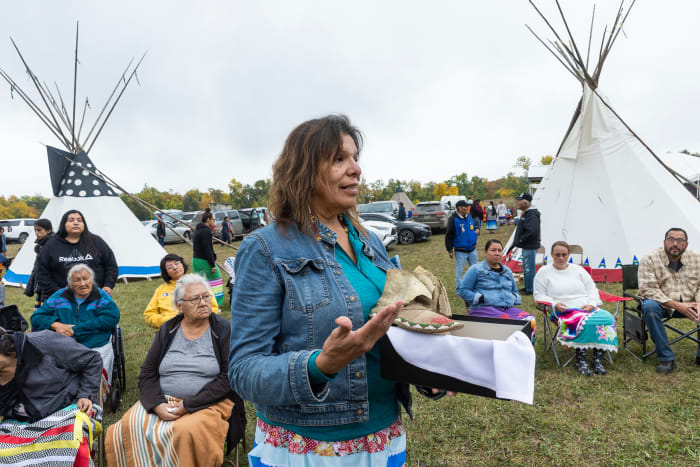
Kelley
Bova, Sisseton Wahpeton Oyate, speaks to a gathering at the Lake
Traverse Reservation in South Dakota on Sept. 23, 2023, after bringing
home a pair of moccasins confiscated from an unknown Native boy at the
Carlisle Indian Industrial School more than 100 years ago. They had been
in the possession of Pennsylvania family for more than a century.
(Photo by Charles Fox for ICT)
“Whenever
I am in the teepees, by the fire, and hearing the men drumming and
singing, it takes me back to another time,” Bova said. “It’s something
that makes me feel so special. …That’s my DNA; that’s my heritage. Not
knowing it for 50 years and finally seeing things like that, it has a
healing power inside of me that helps a lot. Seeing all of this, I come
to the realization that these are my people. This is who I am… The
biggest thing I have learned is to let go of how I was raised as opposed
to who I really am.”
Then
it was Bova’s turn to address the group. She spoke to a gathered group
of elders at the front of the crowd where they could see the moccasins
she held in her hands.
She
told the story of the moccasins and their pathway to her, and then
presented them to tribal chairpersons J. Garret Renville of the Sisseton
Wahpeton Oyate and Lonna Street of Spirit Lake, as well as historian
St. John.
“It's a privilege to be able to do this,” she told ICT.
“And it's a very spiritual thing. Because I feel like it's my journey
home, and now I can help these moccasins go home. I know they're just a
thing. But to me, there are symbols of every child that was taken,
whether it was through adoption or through the residential schools. I
think it's just so important that these go home.”
Upon
hearing the news of the moccasins' return to the Dakota people, Baker
responded from his Pennsylvania home that he felt “ relief, peace, and
closure” and “a sense of gratification that comes with complete
accomplishment.” The endeavor had taken over a century but was finally
achieved.
St. John has big plans for the moccasins.
“I
could build a museum around the moccasins to forever tell the stories
of so many — past, present, and future,” she said. “I want them to be
representative of our children and their journey home. I want them to
represent how the federal assimilation tactics of places like Carlisle
did not win.”
The moccasins can tell that story, she said.
“Our
boys will be here and laid to rest on the homelands and protected ever
on, but those moccasins will sit in their place in our collections with
their story,” St. John said.
“To
‘keep one’s moccasins’ is said to mean that a Native person did not
give up their traditional way,” she said. “Our children came home with
moccasins.”
'Their spirits are still here': Tribe, state to search for remains at North Dakota boarding school
The Turtle Mountain Band of Chippewa
and the State Historical Society of North Dakota recently agreed to
partner in a search for the remains of children around the former Fort
Totten Indian Industrial School, which lies on the Spirit Lake
Reservation in the northeastern part of the state.
Denise
Lajimodiere, author of a leading book on Native American boarding
schools, uses old photos possibly depicting the graves of soldiers to
orient herself in a forested area near the Fort Totten State Historic
Site, which formerly served as a boarding school for Native American
youth. Lajimodiere believes the bodies of former students may be buried
near the former school on the Spirit Lake Reservation in northeast North
Dakota.
Editor's note: This is the fifth story in an occasional
series on Native American boarding schools and their impact on the
region's tribes.
FORT TOTTEN, N.D. — On a cloudy October
morning, Denise Lajimodiere walked through brambles and tall grass with
her eyes to the ground.
Consulting a photo from the 1980s, the
scholar scanned the prairie terrain near the Fort Totten State Historic
Site for small, tan boulders that could mark graves long hidden from
view.
After stumbling across one, she grabbed a plastic baggie of
tobacco from her coat pocket, held a pinch tight in her left fist and
said a prayer for the bodies that may have been buried under her feet
more than a century ago.
Historic site employees believe the
boulders could be the vestiges of a cemetery for U.S. soldiers buried in
the mid-1800s. Lajimodiere thinks the gravesite may also contain the
remains of Native American children who died while attending a boarding
school at the former military post.
“We know their spirits are still here,” Lajimodiere said
solemnly while walking the site on the Spirit Lake Reservation in
northeast North Dakota.
Lajimodiere, an enrolled Turtle Mountain citizen whose father and
grandfather attended Fort Totten, found evidence that at least 13 Native
American boarding schools existed in North Dakota.
The reservation’s federal Indian agent, William Forbes, recruited the
Grey Nuns, an order of Catholic sisters from Montreal, to run a “manual
labor school,” historian James Carroll writes in the book “Fort Totten
Military Post and Indian School.”
Despite successfully turning in the
necessary paperwork this spring to have the former boarding school
students' remains exhumed, the Sisseton Wahpeton Oyate and Spirit Lake
tribes will likely have to wait another year before they can bring the
boys home.
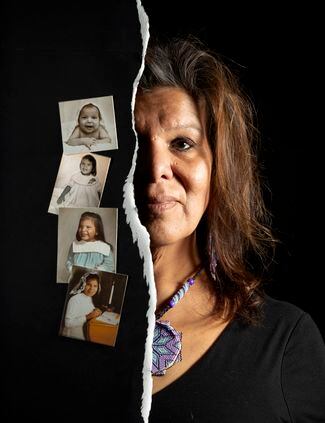
Thousands of Native children were adopted in the 1960s as a government plan of forced assimilation. This woman was one of them.
Kelley
Bashew was adopted at the age of 3 months and taken from South Dakota
to Glenside. She is shown on a hillside near her Meadowbrook home in
April 2021.CHARLES FOX / Staff Photographer
Dec 28, 2021
While visiting the Tekakwitha Nursing Home to sing for residents, 13-year-old Denise Owen was led away from the rest of her boarding school group by a nun. A special surprise awaited her.
There, in another room in the Sisseton, S.D., facility, was her newborn sister, Rose Anne. Denise got only a glimpse of the infant, lying in a bassinet in a long-sleeve shirt and a diaper, before another nun ordered her to leave. Denise was not supposed to see her sibling, soon to be adopted.
It would be 50 years before they saw each other again.
Rose Anne, who would be raised by a Glenside dentist and his wife, became a child of the country’s American Indian adoption era, a decades-long forced assimilation of Native children first established under the Indian Adoption Project, which started in 1958 and evolved to include 50 private and public placement agencies across the United States and Canada, where the so-called Sixties Scoop was coined to describe the mass removal of children from Native homes. During the next 20 years, almost 13,000 Native children would be adopted.
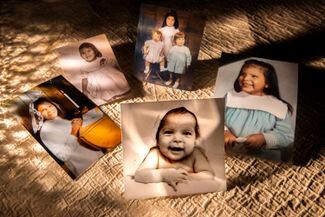
Bashew
experienced a loving childhood. But she always knew she was different,
and felt isolated in white suburbia. Here, a series of photos from those
times.CHARLES FOX / Staff Photographer
According to a 1969 report by the Association on American Indian Affairs, between 25% and 35% of all Native children were placed in adoptive homes, foster homes, or institutions; and about 90% of those children were being raised by non-Natives.
That was the case for Rose Anne, who, at the age of 3 months, was handed over to Salvatore and André Petrilli. The white couple of Italian and Irish descent had struggled to have their own biological children, and it was André's interest in American history and a phone conversation with a priest from St. Joseph’s Indian School in Chamberlain, S.D., that led her to seek a Native adoption through Catholic Charities.
Eventually, a new birth certificate reflected the new name of Kelley Elizabeth Petrilli, the child of two Caucasian parents. Her American Indian heritage was wiped away on paper. A Montgomery County Orphans Court clerk with the last name of Custer gave the final stamp of approval to the adoption.
“When I was younger, I wanted to be white. I still feel guilt about that,” said Bashew, who lives in Meadowbrook. “I just wanted to fit in and be like my sisters. … I did not like being tall and brown and different.”
Kelley
Bashew was born Rose Anne Owen in Sisseton, S.D., but was adopted by
Salvatore and André Petrilli, a suburban Philadelphia dentist and his
wife.CHARLES FOX / Staff Photographer
PLEASE SHARE THIS POST with other American Indian Adoptees... TLH
Myrna
Thompson, Sisseton Wahpeton Oyate secretary, said in a news release
issued by the tribe Friday that protection of tribal children is a duty
that’s taken very seriously.
“We
are consistent in our efforts to support the Child Protection Program
in their mission to protect children, and to reunify and strengthen
families. I can assure you that we have been revising our policies and
procedures, and updating Chapter 38 — Juvenile Code, to ensure that it
is still relevant and effective to meet our community needs,” she said
in the release.
That
is on the heels of a late August protest in Sisseton during which
Rousseau and others expressed concerns about what they see as
inconsistent procedures for cases in which children are removed from
parental custody.
Rousseau
is one of the leaders of the grassroots citizens group that organized
the protest, accused the Child Protection Program of mismanagement and
is calling for changes to the staff. She said she directed the program
for more than seven years before being fired over a dispute in her job
description.
Tribal
officials heard the group’s complaints during a council meeting,
according to the release, and there have since been more meetings to
determine the validity of the concerns, according to the statement.
“I
would know the proper protocol. I would know how to correct the
problems that are there,” said Rousseau, who added that she recently
spoke with Sisseton Wahpeton Oyate Attorney Kimberley Craven. “She asked
me what my proposed solutions would be, and I said the program manager
needs to be terminated. I asked her (Craven), ‘How are you going to
shape up the program when the program manager doesn’t have the requisite
experience to run this type of program?’”
In the release, Thompson said tribal executives have requested that the Bureau of Indian Affairs conduct an updated review.
“The
program review began on September 23 and is currently in progress,”
Thompson said. “All components of the CPP will be reviewed, including
case files to ensure all documentation is done according to the Code of
Federal Regulations and all policies and procedures are complied with.”
Rousseau said if the Bureau of Indian Affairs reviews only case files it won’t understand the problem.
“That isn’t going to tell them anything about the underlying reasons why the complaints have been filed,” she said.
“We
feel the workers are putting our children in jeopardy because they
(Child Protection Program staff members) don’t know what they’re doing.
They’re not social workers. They don’t have the necessary qualifications
nor do they have the necessary experience,” Rousseau said.
Tribal
officials said they are in the process of hiring an Indian Child
Welfare Act attorney to ensure that all ICWA cases are handled
“efficiently and effectively,” according to the release.
Rousseau
said she doesn’t get involved in political practices but added, “I’m
involved in this because of our children and how our Child Protection is
not protecting them. As a matter of fact, they’re putting them in
situations where they can be harmed.”
Rousseau
said her organization will meet later this week and will decide how to
respond to the statement from the Sisseton Wahpeton Oyate executive
offices.
Sept. 25, 2026 | Relatives walk to remember, church denounces Native beliefs & more
Bookshop
You are not alone
To Veronica Brown
Veronica, we adult adoptees are thinking of you today and every day. We will be here when you need us. Your journey in the adopted life has begun, nothing can revoke that now, the damage cannot be undone. Be courageous, you have what no adoptee before you has had; a strong group of adult adoptees who know your story, who are behind you and will always be so.
Diane Tells His Name
click photo
Lost Birds on Al Jazeera Fault Lines
click to read and listen about Trace, Diane, Julie and Suzie
NO MORE STOLEN SISTERS
click image
We conclude this series & continue the conversation by naming that adoption is genocide. This naming refers to the process of genocide that breaks kinship ties through adoption & other forms of family separation & policing 🧵#NAAM2022#AdoptionIsTraumaAND#AdopteeTwitter#FFY 1/6 pic.twitter.com/46v0mWISZ1
As the single largest unregulated industry in the United States, adoption is viewed as a benevolent action that results in the formation of “forever families.” The truth is that it is a very lucrative business with a known sales pitch. With profits last estimated at over $1.44 billion dollars a year, mothers who consider adoption for their babies need to be very aware that all of this promotion clouds the facts and only though independent research can they get an accurate account of what life might be like for both them and their child after signing the adoption paperwork.







 argusleader.com







 Posts

