BOOZHOO! We've amassed tons of information and important history on this blog since 2010. If you have a keyword, use the search box below. Also check out the reference section above. If you have a question or need help searching, use the contact form at the bottom of the blog.
We want you to use BOOKSHOP to buy books! (the editor will earn a small amount of money or commission. (we thank you) (that is our disclaimer statement)
This is a blog. It is not a peer-reviewed journal, not a sponsored publication... WE DO NOT HAVE ADS or earn MONEY from this website. The ideas, news and thoughts posted are sourced… or written by the editor or contributors.
EMAIL ME: tracelara@pm.me (outlook email is gone)
THANK YOU CHI MEGWETCH!
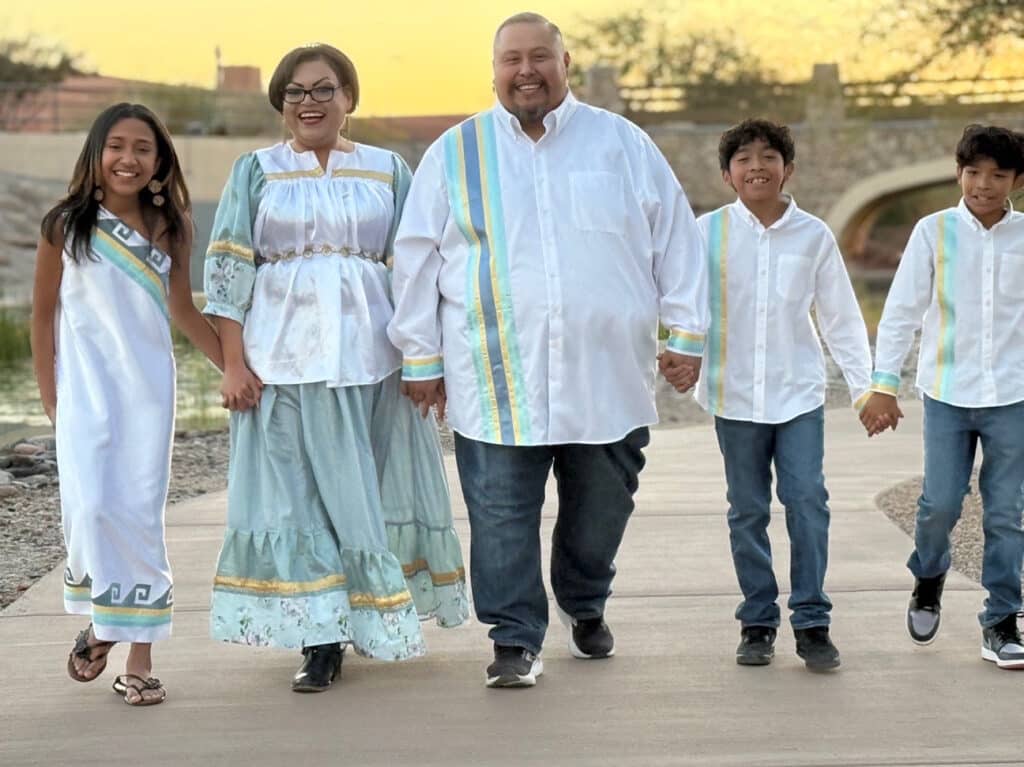
Elisia
and Tecumseh Manuel and their three children — Tecumseh, Precious and
Micah — adopted from Arizona’s foster care system. Provided photo.
..."These experiences prompted an internal question on behalf of families
like hers fostering Native youth: “Where are the resources?” Manuel
recalled asking herself.
"That wondering led to the creation of her nonprofit in 2014, Three Precious Miracles. The group’s initials correspond to those of the three Indigenous children the couple adopted from Arizona’s foster care system: Tecumseh — named after
Manuel’s spouse of 28 years — Precious and Micah. The kids were placed
with the Manuels as infants, and all are now pre-teens."
Under then-President Joe Biden, Congress passed the Inflation Reduction Act in 2022, providing nearly $2 billion to tribes to invest in renewable energy.
The Hopi were approved for a $25 million grant to install solar panels and battery storage for around 600 homes through a program called Solar for All.
Now,
the tribe will be lucky to power around 100 homes from a much smaller
pot of funding through a federal grant from the Tribal Electrification
Program. Hopi officials say they will now have to decide who gets power
and who doesn't.
"That's hard news to deliver, man," says
Nuvangyaoma, "especially when you offer somebody hope and they're
thinking, 'All right, finally we're getting somewhere' — and then the
rug gets pulled out from them."
On this episode of CounterPunch Radio, Joshua Frank and Erik
Wallenberg talk with Hadley Austin, director of the new documentary, Demon Mineral, which traces the radioactive legacy of uranium mining on the Navajo Nation.
CounterPunch, Pilsen Community Books and Science for the People are co-sponsoring a screening of the film at Socialism 2025 in Chicago on July 4th. You can also check out Demon Mineral on Kanopy.
Hadley Austin is a filmmaker/director, producer, poet, photographer,
and aerialist. Along with Yoni Goldstein, she is one-half of Formidable
Entities, a Chicago-based film production studio.
CounterPunch Radio is produced by Nathaniel St. Clair, and
co-hosted by Joshua Frank, Erik Wallenberg and Rebecca Maria
Goldschmidt.
6/6/2025: ARIZONA: The Future, MINING, Man Camps and MMIWG
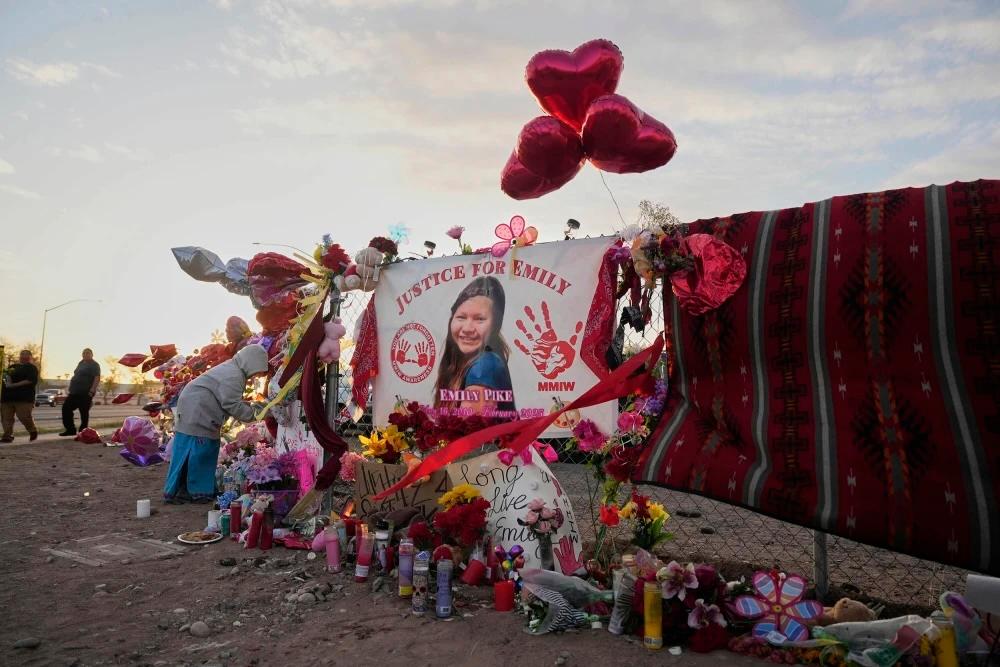
As Lian BigHorse helps her daughter prepare for her coming of age ceremony, she quietly tells the tragic story of Emily Pike, a teenage girl from her community who went missing, and was later found murdered, earlier this year.
“We’re
talking about how to start educating our community locally on what’s
happening, and the impacts of losing even one person,” said BigHorse,
the daughter of Dr. Wendsler Nosie Sr., an Elder who has been working
for decades to protect Chi’chil Biłdagoteel, a sacred site in Arizona’s
Tonto National Forest.
BigHorse
explains how extractive resources correlate directly with increased
sexual violence, exacerbating the crisis of MMIWG+. “People don’t know –
because it’s so under-reported, and rarely are perpetrators brought to
justice,” she said.
As
a director of children’s mental health at San Carlos Apache Tribe, and
professor of Native American Studies at the American University of
Sovereign Nations, she wants more people to understand what’s at stake.
“Our community doesn’t understand what’s happening across the nation.”
With minimal infrastructure surrounding them, mining “boom towns” have historically been vulnerable to crime, states
the U.S. State Department’s office to monitor and combat human
trafficking. “The link between these industries and sex trafficking is
increasingly an issue of grave concern.”
Superior Mayor Mila Besich says she supports the planned Resolution Copper Mine, but is candid about her concerns that come with an influx of workers, and the risk of increased gender-based violence.
“Mining is inherently like a frat house,” she explains, drawing comparison to gender-based violence in the military. “When workers are brought in from far away, and families are separated, that mentality takes root.”
“I’m vehemently opposed to man camps
– not going to happen,” she said, unflinching in her resolve “I do not
want to be number one in domestic violence. I do not want to be number
one in STDs.”
“Areas
where extraction activities occur are usually remote and may be
difficult to access, meaning that workers are isolated from government
oversight and community support, and may have less access to protective
services, legal advocates, and law enforcement personnel.”
"Now Arizona has created Emily's Law to immediately alert authorities and communities when Native American's go missing. Emily's Law honors Emily Pike, whose remains were found Feb. 14 more than 100 miles (161 kilometers) from a group home she left in Mesa, Arizona, in late January."
"Pike’s death spurred a resurgence of activism aimed at bringing more awareness to the disproportionate number of disappearances and violent deaths that have gripped Native American communities for decades, and prompted lawmakers to amend the bill to recognize her. A movement began in 2022 (wonder if Alaska Daily had any influence) in Washington State to quickly share information about missing Native peoples."
Lori Long Chase disappeared in 1983, and so did much of her life story.
Her body had been unknowingly found almost a month after she was last seen by family. But she remained nameless for decades and her homicide went unsolved.
Now after 41 years, Lori is able to reclaim her name, as the details of her life and death begin to unfold.
Lori was adopted out of the San Carlos Apache Reservation in about 1965 when she was only days old, her little sister, Memory Long Chase, says. Memory was also adopted 13 years later as a baby out of the Standing Rock Sioux Reservation in South Dakota. She’s now one of the last surviving people ever to know Lori.
This reporting was supported by the International Women’s Media Foundation’s Fund for Indigenous Journalists: Reporting on Missing and Murdered Indigenous Women, Girls, Two Spirit and Transgender People (MMIWG2T).
“I want to think that she knows I didn’t forget her,” says Memory, who was only 5 years old when Lori went missing. Most of what she knows is based on her childhood memory and bits of information she’s heard from their family over the years.
Lori Long Chase (Phoenix Police Department)
“Maybe I’ve invented some in my mind as I’m kind of piecing things together but I want to think that they’re real,” she says of her memories of her big sister Lori.
Lori was a distance swimmer, and a really good one, Memory says. She swam the 1500-meter butterfly and might’ve held a state record at one point. Memory remembers a detective with the Phoenix Police Department sharing a yearbook photo they found of Lori “in that Michael Phelps pose.”
One memory that stands out in Memory’s mind is the time Lori used the money she made from her first job to buy her a book about Disney’s Snow White and the Seven Dwarfs. “It was a really big book … it had all these artist drawings and storyboards. It was the coolest thing ever,” she says before becoming silent for a moment.
“It’s so unfair that those are the only memories I have of her,” Memory says, her voice quavering. “But they were pretty great, the ones I do have.”
Missing since 1983
On the first Saturday in October, about a dozen people attended a memorial service honoring Lori, even though most had never met her.
They gathered under a ramada outside the St. John the Baptist Parish on the Gila River Indian Community where a rosary and mass had just ended. Nearly everyone who showed up for Memory and Lori wore red — a color that’s come to symbolize the Missing and Murdered Indigenous People’s movement.
“I think one of the hardest parts about this was knowing that there’s so few alive that remember who she was and so I wanted to keep (Lori’s memory) alive because it mattered to me that she lived,” Memory says as everyone sat around a few folding tables to listen to her talk. “I’m sorry that her life was brief and I’m sorry it was difficult.”
Lori was just a few months shy of her 18th birthday when she went missing in Phoenix on about July 21, 1983. It was the same day she started a new job at a pizza restaurant, Memory and a spokesperson for the Phoenix Police Department told Arizona Luminaria. When her mom went to pick up Lori at the end of her shift, she was told her daughter had been fired because her boyfriend kept showing up and being disruptive.
That was the last time anyone in their family saw or heard from Lori, Memory says. At the memorial people around her quietly nibbled on slices of pizza, which Memory picked to signify the day Lori went missing.
Candles bearing the words "We love you" and "Gone too soon" at Lori Long Chase's memorial service at the St. John the Baptist Parish on the Gila River Indian Community on Oct. 5, 2024.
Until recently, most of what was known publicly about Lori was written across a missing person flyer from the Phoenix Police Department. At its center is a cropped photo of Lori that Memory says was taken outside her family’s new home on the Gila River Indian Community weeks, maybe even days, before her disappearance.
The uncropped version of the photo shows Lori sitting against the hood of a Triumph Spitfire and staring directly at the camera. Her brown hair is fluffed and feathered, like many teens her age styled it in the 1980s.
And while her smile illuminates through the old photo’s fading color, it’d likely been a tough time for Lori. Several months earlier she lost her baby boy shortly after he was born.
Reclaiming her name
Lori’s disappearance would go unsolved for the next four decades, though she wasn’t officially reported missing to the Phoenix Police Department until 2021. Memory says she doesn’t know if their mom, who died in 2016, ever tried to report Lori missing before then.
“My mom wouldn’t want to talk about it,” Memory says.
Four years ago, Memory contacted detectives because she believed an unidentified girl listed on the police department’s website could be Lori. The girl — known at the time only as Ahwatukee Jane Doe — was believed to be affiliated with the San Carlos Apache Tribe and had been found dead nearly a month after Lori disappeared.
“The first composite drawing has really tightly curly hair. I didn’t remember Lori having curly hair. But, page 2, that composite drawing is almost identical to that last picture that we have of her,” Memory says.
Because Memory wasn’t biologically related to Lori she couldn’t undergo DNA tests to help confirm the girl’s identity. Ahwatukee Jane Doe remained unnamed. Lori remained missing.
In May 2022, the department released a video with photos of Lori and a plea on National Missing and Murdered Indigenous People’s Awareness Day. They described a young woman found on the banks of a canal in Ahwatukee and asked for information to help locate potential biological relatives of Lori for DNA testing.
"Last year, a family came forward saying this might be their adopted sister, Lori Megan Long Chase, who went missing around the same time period in the early 80s," said Ryan Cody, a spokesman for the Phoenix Police Department. "Now, almost 40 years later, we are asking the public for their help again to identify this Jane Doe."
No one has yet come forward.
The department decided to find the burial place for Lori’s infant son, Bronson Hawk Long Chase. With help from the Maricopa County Office of the Medical Examiner, Lori’s baby and her only known blood relative was exhumed for DNA testing.
More than a year passed as Memory waited. And on Sept. 5 her phone rang. The DNA testing had confirmed Ahwatukee Jane Doe was indeed Lori, closing the chapter on her missing person case but opening another into her death.
“This leg of the journey is over, but Part 2 begins,” Memory says. “It’s so surreal because her being missing has been a fact in my existence for most of my existence so now it’s like I don’t even know what to do with myself.”
“It took 41 years for science to give Lori her name back and so I think we have every reason to hope that science will give her justice,” she later added.
Heurich, who helped launch the program in the early 2000s, described NamUs as “a one-stop-shop tool” that helps law enforcement, medical examiners, coroners, and the general public track missing, unidentified and unclaimed persons cases. The program can also help resolve cases by offering resources such as investigative support, training and outreach and forensic sciences similar to what investigators used to identify Lori.
Heurich has worked on hundreds of cases over the past two decades. Finding resolution in missing and unidentified person cases, he said, can bring about feelings of immense gratitude for the family and investigators involved.
Even in instances when a missing person is later discovered to have been a victim of a violent crime, he said, families may be comforted in the fact that they’re closer to justice and can lay their loved one to rest.
“It's undescribable when you have a family member come up and hug you … and they cry on your shoulder,” Heurich said. “I've cried with a lot of family members whose cases have been solved and whose cases have been unsolved and it's probably one of the most impactful experiences I have had through my career.”
NamUs is a voluntary program, meaning there is no federal law requiring agencies to enter cases into the database, he said. Sixteen states including Arizona have legislation mandating the use of NamUs for either missing and/or unidentified person cases, according to the program’s website. However, none of those state statutes include an enforcement component making it difficult to ensure agencies are complying with the law, Heurich said.
In Arizona, law enforcement agencies are required to submit information about a missing, kidnapped or runaway child to NamUs, among others, within two hours of receiving a report. No other Arizona laws specifically mention NamUs and it is not clear if any Tribal Nations in Arizona have laws related to NamUs.
“The numbers of cases in NamUs are vastly different from the numbers of cases we’re hearing out in the United States,” Heurich said, adding that the missing people in its system only represent cases reported to the program.
In order for a case to be published in the database, there has to be an active missing person report created by a law enforcement agency, he said. As part of the services the program provides, NamUS staff can work with law enforcement to create a report for a missing person at the request of families.
“We do understand there is a very large issue out there not just in the tribal communities but in the law enforcement community, in general, with actually taking missing persons reports, especially with people over the age of 18 who are considered adults,” he said.
“For lack of a better word, there’s a stigma out there that people who are over 18 are allowed to go missing for whatever reason they want to,” Heurich continued. “Sometimes those cases are taken less seriously until there is actual proof that that person is probably and most likely endangered.”
A T-shirt bearing the words "You are not forgotten" and "MMIW" at Lori Long Chase's memorial service at the St. John the Baptist Parish on the Gila River Indian Community on Oct. 5, 2024.
‘The database is only as good as the number of cases in it’
Closing gaps in state laws that would require and enforce reporting of missing people of all ages could help increase the number of successfully resolved cases. It’s especially important for Indigenous communities in Arizona, a state that was identified in a 2017 study from the Urban Indian Health Institute as having the third highest number of cases of missing and murdered Indigenous women and girls in the country.
Native Americans, particularly Native American women, rank the high rate of missing and murdered Indigenous women among the most important issues facing their communities, according to the First Nations Development Institute’s 2023 National Native American Justice survey.
Indigenous families searching for their missing loved one, or seeking justice for their murdered loved one, often face systemic failures that contribute to gaps in data and reporting. Some families wait years and many never find justice or resolution.
There are 1,072 missing person cases in Arizona entered into NamUs, almost 9% (93) of which are identified on the database as Native Americans, an Arizona Luminaria review of the website on Oct. 30 showed. Yet, Native Americans make up just more than 5% of the state’s total population, according to 2023 population estimates from the U.S. Census Bureau.
NamUs could not immediately provide Arizona Luminaria with an example of an Indigenous person's case it helped to solve in Arizona.
“We still encounter a little bit of skepticism on the science and we're trying to help bridge the mistrust with collecting DNA samples from family,” Heurich said, adding that in some Indigenous communities taking someone’s DNA can be considered taking part of their spiritual being.
“We want to convey to the communities that taking (a DNA sample) may be the only way that we can identify or find their person.”
In comparison to state and local law enforcement agencies, Heurich said there is a general lack of reporting of missing person cases to NamUs by tribal police, which he attributed to a lack of resources, trust and training. That’s why outreach and education — not only about the possible benefits of forensic sciences, but also the existence of NamUs as a resource — is a goal for the program, he said.
“We're always looking at ways to do better outreach. To let, not only families and everyone in the general public know about NamUs as a tool, but also police agencies,” he said.
“I think one of the biggest things that we could say out in the community of victims, survivors and law enforcement is: Use NamUs because the database is only as good as the number of cases in it.”
Memory Long Chase speaks to guests attending her sister Lori Long Chase's memorial service at the St. John the Baptist Parish on the Gila River Indian Community on Oct. 5, 2024.
Part 2 for Memory
Memory passed out remembrance cards with a photo of Lori wearing a hospital gown and mask while holding her baby boy in her arms. The cards also showed the photo of Lori taken outside their family’s new home at the time on the Gila River Indian Community. The same photo police used on Lori’s missing person’s flyer.
“There are not enough words to express our grief at the loss of Lori, but forever grateful she is no longer lost,” the card reads near the bottom. “Rest in Power after 41 years.”
Lori Long Chase (Phoenix Police Department)
Beyond a short explanation about Lori’s body being found in 1983, Phoenix police did not share any details with the public or Arizona Luminaria about its investigation into her death. At one point in 2018, the department tried to determine if she was Peggy Elgo, a 20-year-old San Carlos Apache woman who also went missing in 1983. The following year another unidentified person found in Pinal County was confirmed to be Peggy.
The Phoenix Police Department did not respond to multiple requests dating back to July for an interview about Lori’s case, and on Sept. 10 ultimately denied an interview saying a detective new to the case was still reviewing it.
The department instead offered to share questions with the detective. Phoenix police spokesperson Sgt. Brian Bower provided an emailed response to those questions to Arizona Luminaria on Sept. 17. Bower has not responded to follow-up questions emailed multiple times.
A public records request with the agency is also still pending.
Lori’s death was determined to be a homicide. Her body was found on Aug. 15, 1983, along a canal in the 4300 block of East Williams Field Road, according to an Arizona Republic news brief Phoenix police shared in their 2022 plea for help solving the case. It was described as a rural farming area south of Ahwatukee and within a mile of the Gila River Indian Community, where Lori’s family had just moved and Memory was raised.
Phoenix police at the time said she appeared to have been killed somewhere else before being moved to the area where she was found and possibly laid alone for days, according to the news brief.
“I was kind of wanting to focus on her life more than her death but … I think highlighting her death is equally important because she died horribly,” Memory says. “I think her official cause of death is strangulation, she was found nude, beaten and bloody in a canal where she laid for a couple of days in August.”
During the memorial service, Memory says Lori’s boyfriend is an alleged suspect in her homicide case. Responding to Arizona Luminaria’s inquiry about suspects, a Phoenix police department spokesperson said they would look into the case.
Memory also told the group that Phoenix police learned Lori had been hospitalized between the time her family last saw her and when her body was found. “Her boyfriend beat her severely enough to put her in the hospital for several days,” Memory says. “That was the last time anybody saw her alive.”
Memory Long Chase wipes away her tears during her sister Lori Long Chase's memorial service at the St. John the Baptist Parish on the Gila River Indian Community on Oct. 5, 2024.
‘She was meant to be here for a reason’
After sharing Lori’s story with the group, Memory thanked everyone for attending her sister’s memorial. “It’s an orphan’s lot to go through things by yourself,” she says. “Thank you for being here and helping me celebrate the fact that she lived because she mattered.”
Then, Memory fell silent. In the quiet, the low rumble of cars passing by on the nearby main road sounded like a roar. She cupped her face with her hands, propped her head over the table and began to cry.
“She didn’t deserve that,” Memory muffles into her hands.
Her cries hung in the air for a moment while everyone else sat in silence. Many of the guests were women working to end domestic violence. They were there to support Memory, but also to pay respects to a girl who may have fallen victim to domestic violence — the very people they aim to help.
“I had that last bit of hope that she’s off living her life somewhere,” Memory later says. “But once I saw that drawing it was over for me, I think I kind of knew without knowing.”
“I don't think it was any coincidence that I do the work that I do and it reaffirms that this is where I’m supposed to be,” she continued. “It’s heartbreaking but I love it … I believe in what we do and I believe in who we do it for.”
Memory’s journey into advocacy began in 2014 when she worked at the Arizona Coalition to End Sexual and Domestic Violence. Now, she serves as the Domestic Violence Response Director at SWIWC, formerly known as the Southwest Indigenous Women’s Coalition.
The organization helps Tribal Nations in Arizona address and respond to domestic and sexual violence in their communities through education, training, policy advocacy and more, according to its website. They also helped organize the first Missing and Murdered Indigenous Women and Girls event at the Arizona State Capitol in May 2019.
For her work, Memory was awarded a “Courage in Action” Distinguished Service Award from Arizona Attorney General Kris Mayes in 2023. The award recognizes a crime victim or survivor who creates “positive systemic change on behalf of other victims,” according to a brief from the attorney general’s website.
“Working with Indigenous communities and drawing on personal experience of being a victim herself, has given her a unique perspective on how to address and respond to all forms of violence, as well as how to educate community members on the dynamics within Native communities,” the brief states about Memory alongside a photo of her and Mayes.
October is Domestic Violence Awareness Month. It’s also Lori’s birthday month.
She would have turned 59 on Oct. 11. Rather than celebrating together, Memory is instead planning where to lay her sister and nephew to rest. She launched a GoFundMe campaign days after Lori was identified to help cover cremation costs. It had raised $3,150 of its $3,500 goal as of Oct. 30.
Memory says she might return Lori with her son to the San Carlos Apache Reservation, where she originally was from.
“She was meant to be here for a reason and maybe this was it, maybe her case helps advance science for the next family and maybe the detectives who worked her case can be a model on how investigations can go,” Memory says.
“I refuse to let it be without purpose and I’ll continue to share her story until I die.”
Correction: An earlier version of this story had an incorrect date for when Phoenix police responded to emailed questions. A spokesperson responded to Arizona Luminaria on Sept. 17.
This article first appeared on AZ Luminaria and is republished here under a Creative Commons license.
Navajo Nation expedites membership verification for Indian Child Welfare Act
KNAU News Talk - Arizona Public Radio |
By
KNAU STAFF
Published October 31, 2023
Navajo
Nation President Buu Nygren signed a memorandum of agreement to
streamline the process of determining whether a Native child is actually
Navajo on Oct. 30, 2023. Navajo Nation Attorney General Ethel Branch,
and Debbie Nez-Manuel, director of the Navajo Division of Human
Resources, also signed.
The Navajo Nation has
developed a streamlined process to determine whether a Native child who
may be adopted is actually Navajo.
The Indian Child Welfare Act
was passed in 1978 to establish basic requirements to protect Native
American children from removal from their homes and communities.
If
a child is determined to be a tribal member, the ICWA then triggers
legal protections and the right of the Navajo Nation to intervene.
However, the process to verify tribal membership can take several months.
Tribal
officials say this new agreement will significantly shorten the time to
determine membership by improving coordination and the sharing of
records between Navajo Nation divisions and the offices that work with
children in custody, adoption or foster cases.
Caseworkers will
then be able to determine if ICWA applies in a matter of weeks, which
will allow the Navajo government to intervene sooner.
President Buu Nygren signed off on the memorandum of agreement October 30, 2023.
WINDOW ROCK – Child welfare services
provided to by Arizona, New Mexico and Utah may soon be improved through
the adoption of traditional Navajo teachings and knowledge if
incorporated into their programs.
Officials with these states’ child welfare agencies were in Window
Rock recently to discuss ways to expand the capacity of their existing
partnership with the Navajo Nation.
The meeting sought ways to strengthen agreements between the Navajo
Nation Division of Social Services and states to enhance services for
Navajo children and families.
“My administration wants to encourage collaboration between child
welfare agencies and to use the Diné Action Plan to help combat the
challenges our Diné families and children face,” President Buu Nygren
told state officials.
The Diné Action Plan is considered a living document that expresses
Diné teachings. It was adopted by the 24th Navajo Nation Council in
2021. The plan was introduced in April 2018 as a blueprint to improve
the quality of life throughout the Navajo Nation.
“Unfortunately, we are seeing inter-generational cycles that occur
when a child is removed from his or her home,” said Thomas Cody,
executive director of the Navajo Division of Social Services. “The
increase of substance use, decrease of healthy parenting, and a decrease
in teachings at home causes a decrease in spiritual connection.”
According to Cody, some Navajo services aid and provide services that
focus on alleviating those generational challenges and traumas.
“Unfortunately, more is needed to combat these issues. This is why
these collaborative partnerships are so important,” Cody said.
Although the Nation has the resources to treat those in need, it
needed a plan to reflect Navajo values and principles of ntsáhákees
(thinking), nahat’á, (planning), iiná (action) and sih hasin
(reflection) that Navajos are familiar with through their traditional
teaching.
The DAP was the result. It was designed to address public safety,
violence, substance use disorder, suicide and missing and murdered Diné
relatives on the Navajo Nation, said Cody.
According to the DAP, which references traditional Navajo teachings,
in contemporary society Navajos face the “monsters” of the modern world.
“These include substance abuse, suicide and the various forms of
violence that has come onto our people. With substance abuse, our people
are attacked by the monster of addiction and lose their lives to
chemicals that draw them into a trap of irresistible cravings where they
are poisoned and die.
“With suicide, our Diné face the evil of hopelessness which results
in the taking of one’s own life,” Cody said. “With violence, there are
monsters of frustration and pain causing them to lash out on others.
Finally, there are monsters outside Navajoland and within (which) take
our people away from our families.”
The DAP states that the teachings of the Navajo deities, known to
Navajos as the Holy People, “are embedded in our culture and traditions
and the teachings provide us with the tools we need to defeat our modern
monsters. The teachings have been given to us by our Diyin Dine’é (the
Holy People).”
According to Navajo teachings, the seven monsters that have preyed
upon the Navajo people from time immemorial are laziness, sleepiness,
jealousy, hunger, poverty, lice and old age.
The DAP was established to maintain spiritual connection as the
foundational component to self-identify and to our culture, said the
president.
Nygren said the Diné Action Plan should be part of each state’s
mental health programs because most Navajos would be familiar and
comfortable with its concepts, and that would lead to better outcomes.
He said there is a need for a state-tribal cooperative approach
because so many Navajos live off the Navajo Nation and use mental health
care provided through neighboring state services.
“Mental health and wellness are so important, especially for our
young people and elders,” he said. “By working together with our state
partners, we can help ensure Navajos have access to culturally
appropriate services no matter where they live.”
The COVID-19 pandemic highlighted longstanding mental health
challenges on the Navajo Nation. These include high rates of depression,
substance abuse and suicide.
Isolation during lockdowns exacerbated these issues for many Navajos.
The agreements will aim to address barriers of lack of
transportation, shortage of Navajo-speaking providers, and the high cost
of care.
Specific programs being discussed include the development of a mobile
crisis unit, school-based telehealth services and funding for
traditional healing.
As tribes wait for investigation to conclude, debate over Indian schools continues
Nancy Marie Spears
| Gaylord News | Tuscon, AZ
Tribes across the Southwest dread the possibility that thousands of
unmarked graves might be uncovered by a federal investigation into
abandoned Native American boarding schools expected to wrap up early
this year.
The investigation, ordered by U.S. Interior Secretary Deb Haaland,
came in the wake of the discovery this year of more than 1,200 unmarked
graves at two long-shuttered boarding schools in Canada’s British
Columbia and Saskatchewan provinces.
The probe also has renewed debate over Indian boarding schools, which
were established in the 19th and 20th centuries with the primary
objective of assimilating Indigenous youth into white culture by denying
the use of their languages, dress and other cultural aspects.
Most boarding schools were closed in the 1980s and early 1990s, but
dozens of schools remain open, with 15 still boarding students as of
2020, according to the National Native American Boarding School Healing Coalition. Some are controlled by local tribes, while others are operated by the Bureau of Indian Education, a division of the Department of the Interior.
Boarding school alumni are widespread among Indigenous communities, and their thoughts about their experiences vary widely.
“She’s brought awareness for our Native people, for our children,”
retired elementary school teacher Oney M. Roubedeaux said of Haaland. “I
feel like that is opening up a box of worms. I mean, just a whole big
old span of our people that nobody paid attention to.”
Roubedeaux, who is Ponca and Otoe-Missouria, was 6 in 1971, when she
rode a Greyhound bus from Stillwater, Oklahoma, to Concho Indian
Boarding School in El Reno with her brother, who was 8. She is the
youngest of 17 siblings, many of whom attended boarding schools.
After her mother’s death in 1973, Roubedeaux was separated from her
brother when she transferred from Concho to the Seneca Boarding School.
She said one of her other brothers was beaten to death in his room in
Chilocco Indian School, 20 miles north of Ponca City, in 1980, the year
it closed down. By the time she left Concho, there had been three
student deaths, one being her best friend’s brother.
After her mother’s death, Roubedeaux was placed in foster care.
She went through 10 foster homes before one foster mother realized
Roubedeaux – who was 16 – could not read or write. The teachers at the
public and boarding schools she attended had never taken the time to
teach her, Roubedeaux said.
She caught up, she said, with help from her foster mother, and
eventually obtained a degree in special education from the University of
Central Oklahoma. Roubedeaux, who lives in Pawnee, concluded her
20-year teaching career in March 2020.
Although “not everything was good,” she said, boarding schools gave
her self-reliance, which was her biggest reclamation of agency.
“Boarding schools were a learning experience for me as a young child …
it took me through life, to be able to rely on myself,” Roubedeaux
said. “To this day, at the age of 57, I can still do that.”
According to the Boarding School Healing Coalition, 367 Indian
boarding schools operated in 29 states, from Alabama to Alaska.
Seventy-three were operating in 2020, and 15 of them still boarded
students. Oklahoma had the most, with 83 schools, some of which still
are operating. Arizona was second with 51 schools, 25 of which are open
and three of which board students; New Mexico was fourth with 26
boarding schools.
Riverside Indian School in Anadarko, Oklahoma, organized in 1871, is
the oldest of four federally operated boarding schools in the nation.
Today’s boarding schools are a good thing, said Constance Fox, who is
Cheyenne and Arapaho and graduated high school from Riverside in 1984.
“I think they’re a good thing because of the uniqueness Native
students have,” said Fox, who’s a self-determination adviser for the
Bureau of Indian Affairs in Oklahoma. “For many, it was all they had,
good and bad. I hope they continue. I know there’s been a lot of
positive strides made … I go back to Riverside and it’s a whole
different place.”
Fox said Riverside has upgraded its buildings and athletics
department over the years. When she attended Riverside, Fox said, no
advanced courses were offered, but teachers now are recruited for such
courses.
“I have friends that have kids and grandkids that go to boarding
schools and it’s because they want to … because there is still
discrimination in public schools,” Fox said. “Being around their Native
people makes them want to do better and want to succeed. So, I think
that’s a dynamic that has changed over the years.”
Fox attended Concho from grades 3 through 8 and graduated from
Riverside as valedictorian. She holds a bachelor’s degree in tourism
management from Northeastern State in Tahlequah, Oklahoma, and a
master’s degree in education from the University of Oklahoma.
Fox, who lives in Yukon, has worked for the BIA for nearly three decades, mostly in the area of self-determination.
Fox said boarding schools – specifically the adults who worked at
them, who she says practically raised her – helped shape her passion for
self-determination and her career working to better tribes.
“What at the time was negative to me ended up really being positive,”
Fox said. “I learned so much about self-responsibility, and that came
from the dorm parents, teachers, and other people who worked at both
Concho and Riverside.”
Fox said she fully supports Haaland’s efforts and thinks her
investigation shows goodwill to create an understanding of the traumas
her ancestors suffered and the impact it has in 2022. Although closure
can’t begin without acknowledging the history, she said it is hopeful to
begin the healing process for the families and tribes impacted.
Hopi journalist Patty Talahongva got her start in journalism at
Phoenix Indian High School in the 1978-79 school year. She is the
executive producer of newscasts by Indian Country Today, a national nonprofit digital news publication focusing on Indigenous issues.
Although Talahongva, who lives in Phoenix, knows about the brutal
history of her grandparents’ boarding school experiences, her year at
Phoenix Indian School was different.
“People want to cling to this idea that it was always, always bad,”
Talahongva said. “I would say there’s always good in whatever story, no
matter how bad it got.”
By the time she was in school, Talahongva said, children were allowed
to speak their languages freely, and cultural customs were celebrated,
not suppressed. The overall experience, she said, made her more
independent. The school, which opened in 1891, shut down in 1990.
Even the launch of Indian Country Today’s newscast in April 2020 has roots in boarding schools.
Talahongva said the newscast began a month after the pandemic was
declared, so studio options were few. The solution? The former grammar
building of Phoenix Indian School, built in 1935 and now used as a
visitors center. Indian Country Today used it for seven months before
moving into a studio at Arizona PBS.
“Those kids who went to school in that building were never encouraged
to go to college, get a degree, or do whatever they wanted to do,”
Talahongva said. “They were certainly never encouraged to become
(television) anchors and producers. I can hear our relatives laughing.
It’s like, ‘Take that, government. We’re using the building you put up
to hold us down, and we’re broadcasting to the world.’”
This story was originally published by Gaylord News,
a reporting project of the University of Oklahoma Gaylord College of
Journalism and Mass Communication. Nancy Marie Spears, a Gaylord News
reporter based in Washington, D.C., is an enrolled member of the
Cherokee Nation of Oklahoma. Cronkite News contributed to this story.
SACATON, ARIZONA – The Arizona Supreme Court has
granted the petition for review filed by attorneys for the Gila River
Indian Community, giving the Community the opportunity to argue before
the state’s highest court in a controversial case involving the future
of a Native American child at risk of being permanently removed from her
Community.
The case will be the first of its kind argued before the Arizona
Supreme Court focused on the transfer provisions of the Indian Child
Welfare Act. At its heart are determinations regarding the permanent
custody of a Native American child, A.D., a 2-year-old born to a Gila
River Indian Community mother who lived on the Gila River Indian
Reservation for most of her life. After A.D.’s off-Reservation birth,
she was placed into the State of Arizona foster care system. The
Community sought transfer of the state court case to its Children’s
Court under the Indian Child Welfare Act, but its motion was denied and
the Community appealed.
In their petition to the state Supreme Court, attorneys for the
Community argue that A.D.’s case is significant to Arizona’s Indian
tribes and tribal families and that the Arizona Court of Appeals’
decision was contrary to the plain language of the Indian Child Welfare
Act and would lead to “absurd and inconsistent results.”
“The Gila River Indian Community will do everything in our power
to protect our Community members and their families, every Indian child
and every Indian family,” said Gila River Governor. Stephen R. Lewis.
“We will not stand idly by when our children are at risk of losing their
tribal roots, their culture and their families, and when the Indian
Child Welfare Act is at risk.”
“Since 1978, ICWA and the tribal court system have worked as intended
to keep Indian families together. This landmark law should not be
stripped of its key role in protecting our people.”
Attorneys for the Community and the State have 20 days to file
supplemental briefs with the state Supreme Court, then the matter will
be set for oral arguments.
The
Navajo Nation (“the Nation”) appeals the juvenile court’s judgment finding good
cause to deviate from the placement preferences set forth in the Indian Child
Welfare Act of 1978 (“ICWA”), 25 U.S.C. §§ 1901 to 1963 (2006), and allowing the
child (“Z.”) to remain with his current non-relative, non-Indian adoptive
placement. We affirm. The juvenile court properly found good cause to deviate
from ICWA placement preferences because the placement family provided good care
for Z., Z. had attached and bonded with the family, Z. would suffer severe
distress if he was removed from that placement, the placement family would
expose Z. to his Navajo culture, and the placement family had been approved to
adopt Z. While the interest of the Nation and the Congressionally-presumed
interest of Z. in maintaining his heritage weighed against a finding of good
cause to deviate from ICWA’s preferences, on this record we cannot say the court
erred in weighing all these interests.
South Carolina court drops contempt charge against Dusten Brown Dusten Brown and the Cherokee Nation rea...
Bookshop
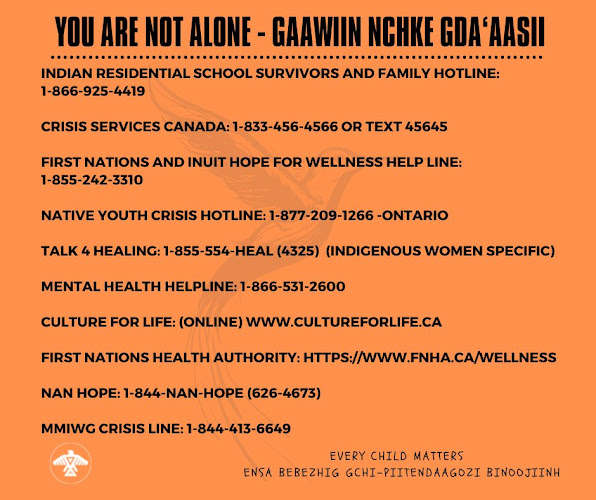
You are not alone
To Veronica Brown
Veronica, we adult adoptees are thinking of you today and every day. We will be here when you need us. Your journey in the adopted life has begun, nothing can revoke that now, the damage cannot be undone. Be courageous, you have what no adoptee before you has had; a strong group of adult adoptees who know your story, who are behind you and will always be so.
Diane Tells His Name
click photo
Lost Birds on Al Jazeera Fault Lines
click to read and listen about Trace, Diane, Julie and Suzie
NO MORE STOLEN SISTERS
click image
We conclude this series & continue the conversation by naming that adoption is genocide. This naming refers to the process of genocide that breaks kinship ties through adoption & other forms of family separation & policing 🧵#NAAM2022#AdoptionIsTraumaAND#AdopteeTwitter#FFY 1/6 pic.twitter.com/46v0mWISZ1
As the single largest unregulated industry in the United States, adoption is viewed as a benevolent action that results in the formation of “forever families.” The truth is that it is a very lucrative business with a known sales pitch. With profits last estimated at over $1.44 billion dollars a year, mothers who consider adoption for their babies need to be very aware that all of this promotion clouds the facts and only though independent research can they get an accurate account of what life might be like for both them and their child after signing the adoption paperwork.













 Posts
Posts

