Roxanne
Dunbar-Ortiz on the Roots of the NRA and the Second Amendment
FROM THE INTERCEPT PODCAST April 2018
JEREMY SKAHILL: There’s a new book that just came out that lays out a
provocative argument for getting rid of the Second Amendment in its entirety,
and the book asserts that the NRA has become a white nationalist organization.
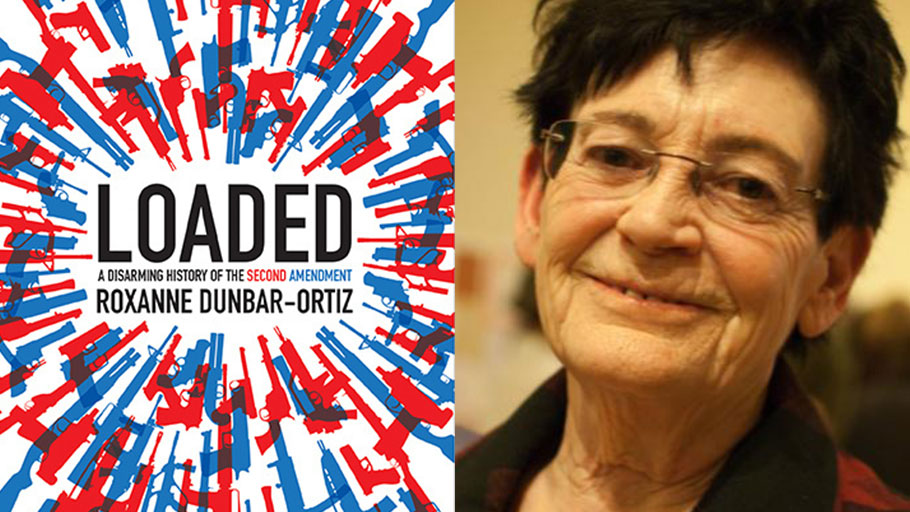
That book is titled “Loaded: A Disarming History of the Second Amendment” and
it was written by the radical historian Roxanne Dunbar-Ortiz. Her book tells a
very different tale about the so-called gun culture in the United States and
about how the Second Amendment was, at its core, a solidifying of the rights of
white people to bear arms to steal native land by force, to capture so-called
runaway slaves and to prevent rebellions from oppressed people. It wasn’t about
hunting. It wasn’t about protecting against the tyranny of government. It
wasn’t about simply protecting your property from criminals and thieves. Sure,
those arguments are made by Second Amendment enthusiasm. They’re certainly
representative of a lot of people’s motives for possessing guns.
Roxanne Dunbar-Ortiz is the author
of many books, including “An Indigenous People’s History of the United States,”
“Roots of Resistance: A History of Land Tenure in New Mexico,” and “Blood on
the Border: A Memoir of the Contra War.” Her latest book, again, is called,
“Loaded.”
Roxanne Dunbar-Ortiz joins me now.
Welcome to Intercepted.
Roxanne Dunbar-Ortiz: Thank you, Jeremy.
JS: If the United States has a gun culture, what is that gun
culture?
RDO: It’s a weapon of settler colonialism, all over the world:
Australia, New Zealand, Canada, Argentina, where settler colonialism was used.
But in the United States, by putting it in the Constitution, that sacred
document, as an individual right, it veered considerably from those other
settler colonies.
From the very beginning, guns and
ammunition were required in the colonies, in Virginia and then in Massachusetts
Bay Colony and then in Virginia first, that every man, every household had to
have firearm and a certain amount of gun powder and bullets. And if they
couldn’t afford that, the colonial government would subsidize it.
So, what were they so afraid of?
That they had to have all these guns because they were on land that they had
stolen by burning people’s villages down, by killing, raping, maiming and
driving Native people into the periphery where they fought back and tried to regain
their land and also keep them from taking more.
So, U.S. settler colonialism was
really required, the whole build-up of the United States, a white nationalist
democracy: Every man a king with land. And, of course, then, institutionalized
slavery took hold by the 1670s — out of these militias they carved slave
patrols as well.
So that dual usage: you know, the
right to own human bodies and land and to steal them, kidnap people, and kill
people — really genocide — is just written into the very cellular structure of
the United States: The Constitution, every institution.
And that, plus the militarism that
lasted from before, during and after independence, and continued until 1890,
more than 100 years of daily, moment-by-moment warfare against native people,
at the same time invading other countries: The Barbary wars in 1806 and 1809,
and then Mexico, 1846 to ’48, that just continued and continued and then jumped
over the Pacific and into the Caribbean and then into the whole world. So, the
militarism is the key component of it and only a third of the population even
own a gun, and there’s a good portion of those who are combat vets.
JS: Hmm. The exact text, “A well regulated Militia, being
necessary to the security of a free State, the right of the people to keep and
bear Arms, shall not be infringed” — now, I’m not asking you about more
recent interpretations by various courts, but at that time, in 1789, when they
were referring to a well-regulated militia being necessary to the security of a
free state, what was the historical context, and what did they refer to when
they were talking about well-regulated militia?
RDO: Well they certainly weren’t talking about state militias,
because those were provided for in the Constitution itself, that’s the
genealogy of the National Guard. But the Bill of Rights which was, came later
[than] the amendments, these were individual rights, very specifically
individual rights, so they could only have referred to the existing citizen’s
militias.
But they came to be self-organized
— they were very well organized for selfish interests, for their own
purpose — the state, the government had no authority over them whatsoever.
And this was how the whole continent was taken, was these settlers themselves
organized, that every, every settler a soldier, they’re all armed, they say,
out in their fields and everything and they’re, they’re all well-organized, so
they could in minutes call up of a militia and they knew what to do. It was in
their self-interest, so.
JS: Well, what were these militia doing?
RDO: Killing Indians! Taking their land. And, then the land was
theirs. And the slave patrols were also self-organized. It was really every
white man had an obligation to keep an eye out, even if they didn’t own slaves
to keep an eye out and turn in any stray black person that didn’t have a permit
on him, that he’s doing some errand for the owner, and if he didn’t have that
then he was considered a renegade — you know, had to be captured and
returned to the owner.
keep reading🔻









 Posts

