BOOZHOO! We've amassed tons of information and important history on this blog since 2010. If you have a keyword, use the search box below. Also check out the reference section above. If you have a question or need help searching, use the contact form at the bottom of the blog.
We want you to use BOOKSHOP to buy books! (the editor will earn a small amount of money or commission. (we thank you) (that is our disclaimer statement)
This is a blog. It is not a peer-reviewed journal, not a sponsored publication... WE DO NOT HAVE ADS or earn MONEY from this website. The ideas, news and thoughts posted are sourced… or written by the editor or contributors.
EMAIL ME: tracelara@pm.me (outlook email is gone)
THANK YOU CHI MEGWETCH!
AFN Chief Cindy Woodhouse reveals 5 of 47 First Nations items returned to Canada last December
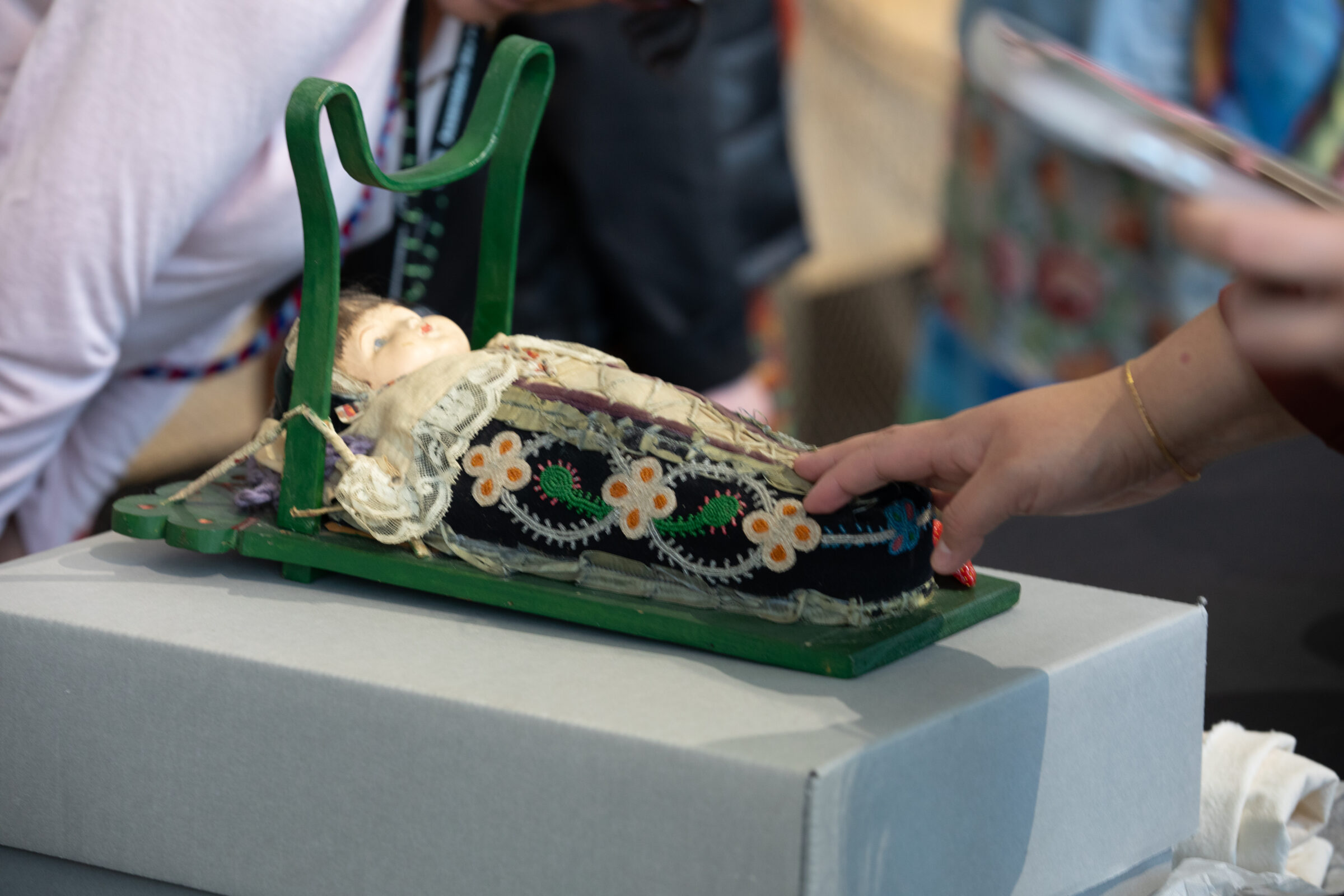
A First Nations
woman touches a doll and crib, one of the five items revealed Tuesday,
which were returned by the Vatican to the First Nations of Canada.
(Photo by Jorge Antunes)
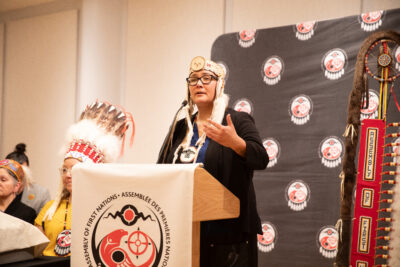
The return of Indigenous items from the Vatican is an “important and
emotional moment for many First Nations across this country,” said
Assembly of First Nations Chief Cindy Woodhouse prior to the unveiling
of five items on Tuesday.
As part of the continuing process of repatriating Indigenous items
that had been held by the Vatican, the Assembly of First Nations
uncrated First Nations’ items whose region of origin has been
determined, at the Canadian Museum of History in Gatineau, Que.
She called the items “sacred,” and not “artifacts” as some people
have referred to the items that were once held by the Roman Catholic
Church.
The items are a pair of embroidered leather gloves from Athabasca
Chipewyan First Nation, a birchbark sap collector from Akwesasne Mohawk
Nation, a baby carrier from Ontario, and a bowl and spoon from
Manitoulin Island in Lake Huron.
The exact community where the bowl and spoon came from is known. But
for the gloves, sap collector and baby carrier, only their general area
of origin is known.
The bowl and spoon were made by the “great, great, great, great,
great grand-uncle,” of Grand Chief Linda Debeassige of the Anishnabek
Nation in what’s now northern Ontario.
“He signed the bottom of it. True story,” she said with a grin when a reporter asked how she knew her relative had made them.
The majority of the First Nations’ 47 items were not revealed
publicly Tuesday, though several chiefs in attendance were invited for a
private viewing later in the day.
Grand
Chief Linda Debeassige of the Anishnabek Nation was able to determine a
bowl and spoon were made by an ancestor because he ‘signed the bottom.’
(Photo by Jorge Antunes)
Until their origins are determined, they will remain hidden, Woodhouse said.
Identification is a complicated process. Each community has its own
knowledge that varies from community to community, she added.
“We have to respect First Nations as we identify where they [belong],” Woodhouse said.
When the 62 items first made their way to Montreal from Rome last
December, 14 were deemed to be of Inuit origin, including a 100-year-old
sealskin Inuvialuit kayak.
Some of those Inuit items were shown at a small gathering of media at
a Canadian History Museum warehouse a few days after their arrival in
Canada.
Except for the kayak, Inuit Tapiriit Kanatami — the national
organization representing Inuit across Canada — said in an email last
December it could not be sure where they came from until they have been
examined further.
Inuit Tapiriit Kanatami did not return a request for comment Tuesday about the unveiling of the First Nations items.
The 62 items are just a few of, by some calculations, more than
100,000 sent to Rome a century ago by Roman Catholic missionaries for a
symposium featuring Indigenous cultural items at the Vatican.
Woodhouse said she hoped the day will inspire other institutions
across the world to consider repatriation plans for the thousands of
items still out there.
“First Nations will not rest until all of our items that were wrongfully taken are returned to us,” she said.
Sixty-two Indigenous cultural items previously held in Vatican museums and vaults for a century are being repatriated to Canada. Cynthia Wesley-Esquimaux, Chair on Truth and Reconciliation at Lakehead University in Thunder Bay, Ont., explains why she’s ‘a bit conflicted’ about the return of these cultural belongings.
VIA: Over 80 thousand artifacts – a testament of the peoples and cultures
from every part of the world – are on exhibit in the new Anima Mundi
Museum, previously known as the Ethnological Museum of the Vatican
Museums.
Pope returns 62 artifacts to Indigenous peoples from Canada
By NICOLE WINFIELD | Associated Press | November 15, 2025,
VATICAN CITY -- The Vatican on Saturday returned 62 artifacts
to Indigenous peoples from Canada as part of the Catholic Church’s
reckoning with its role in helping suppress Indigenous culture in the
Americas.
Pope
Leo XIV gave the artifacts, including an iconic Inuit kayak, and
supporting documentation to a delegation of the Canadian Conference of
Catholic Bishops during an audience. According to a joint statement from
the Vatican and Canadian church, the pieces were a gift and a “concrete
sign of dialogue, respect and fraternity.”
The
items were part of the Vatican Museum’s ethnographic collection, known
as the Anima Mundi museum. The collection has been a source of
controversy for the Vatican amid the broader museum debate over the
restitution of cultural goods taken from Indigenous peoples during
colonial periods.
Most
of the items in the Vatican collection were sent to Rome by Catholic
missionaries for a 1925 exhibition in the Vatican gardens that was a
highlight of that year’s Holy Year.
The
Vatican insists the items were “gifts” to Pope Pius XI, who wanted to
celebrate the church’s global reach, its missionaries and the lives of
the Indigenous peoples they evangelized.
But
historians, Indigenous groups and experts have long questioned whether
the items could really have been offered freely, given the power
imbalances at play in Catholic missions at the time. In those years,
Catholic religious orders were helping to enforce the Canadian
government’s forced assimilation policy of eliminating Indigenous
traditions, which Canada’s Truth and Reconciliation Commission has
called “cultural genocide.”
Part
of that policy included confiscating items used in Indigenous spiritual
and traditional rituals, such as the 1885 potlatch ban that prohibited
the integral First Nations ceremony. Those confiscated items ended up in
museums in Canada, the U.S. and Europe, as well as private collections.
Negotiations
on returning the Vatican items accelerated after Pope Francis in 2022
met with Indigenous leaders who had traveled to the Vatican to receive his apology
for the church’s role in running Canada’s disastrous residential
schools. During their visit, they were shown some objects in the
collection, including an Inuit kayak, wampum belts, war clubs and masks,
and asked for them to be returned.
Francis later said he was in favor of returning the items
and others in the Vatican collection on a case-by-case basis, saying:
“In the case where you can return things, where it’s necessary to make a
gesture, better to do it.”
The
Vatican said Saturday the items were given back during the Holy Year,
exactly 100 years after the 1925 exhibition where they were first
exhibited in Rome.
“This
is an act of ecclesial sharing, with which the Successor of Peter
entrusts to the Church in Canada these artifacts, which bear witness to
the history of the encounter between faith and the cultures of the
Indigenous peoples,” said the joint statement from the Vatican and
Canadian church.
It
added that the Canadian Catholic hierarchy committed to ensuring that
the artifacts are “properly safeguarded, respected and preserved."
Officials had previously said the Canadian bishops would receive the
artifacts with the explicit understanding that the ultimate keepers will
be the Indigenous communities themselves.
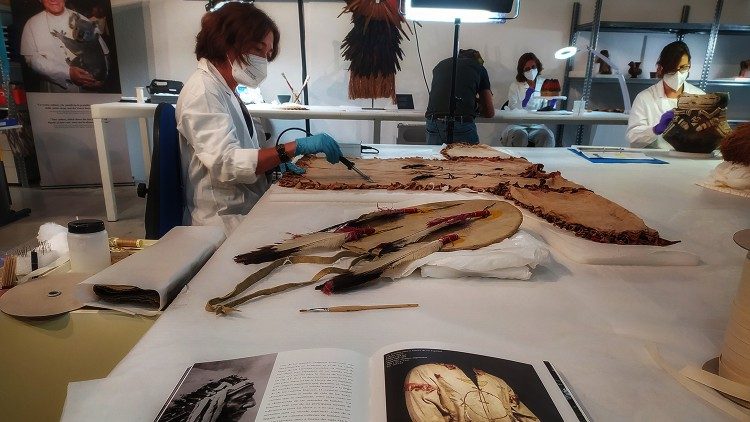
The
items are expected to be taken first to the Canadian Museum of History
in Gatineau, Quebec. There, experts and Indigenous groups will try to
identify where the items originated, down to the specific community, and
what should be done with them, officials said previously.
As
part of its broader reckoning with the Catholic Church’s colonial past,
the Vatican in 2023 formally repudiated the “Doctrine of Discovery,”
the theories backed by 15th-century “papal bulls” that legitimized the
colonial-era seizure of Native lands that form the basis of some
property laws today.
The
statement marked a historic recognition of the Vatican’s own complicity
in colonial-era abuses committed by European powers, even though it
didn't address Indigenous demands that the Vatican formally rescind the
papal bulls themselves.
The
Vatican on Saturday cited the 2023 repudiation of the Doctrine of
Discovery in its statement, saying Leo's return of the artifacts
concludes the “journey” initiated by Francis.
EDITOR NOTE: "ARTIFACT" is the wrong word... it should be an ancestral belongings and not an object to be looted, owned or on display in Rome...These belongings have a spirit... Trace
Pope voices willingness to return Indigenous loot, artifacts
Looting - that is just one of the topics I research beyond adoption. It's a pattern really: Looting, Mass Murder, Theft, Mining, Profits, Taking Land, Taking Kids... all of it. It combines into colonization and all the other terms they use to describe the "making of America" and Canada.
It is very interesting that we are finding out through press
releases what was actually looted. I am still disturbed it took so long.
What did we lose? Pretty much everything: tribes were herded onto reservations, kids taken by gunpoint to residential schools, lands were seized, graves robbed, burial mounds looted and destroyed, and on and on.
WHAT IS NAGPRA? NAGPRA is the Native America Graves Protection and Repatriation Act.
Since 1990, Federal law has provided
for the repatriation and disposition of certain Native American human
remains, funerary objects, sacred objects, and objects of cultural
patrimony. By enacting NAGPRA, Congress recognized that human remains of
any ancestry "must at all times be treated with dignity and respect."
Congress also acknowledged that human remains and other cultural items
removed from Federal or tribal lands belong, in the first
instance, to lineal descendants, Indian Tribes, and Native Hawaiian
organizations. With this law, Congress sought to encourage a continuing
dialogue between museums and Indian Tribes and Native Hawaiian
organizations and to promote a greater understanding between the groups
while at the same time recognizing the important function museums serve
in society by preserving the past. (US Senate Report 101-473).
A museum can fail to comply with the requirements of NAGPRA and may be
assessed a civil penalty by the Department of the Interior.
But there are problems, of course, explained on Native American Calling, when a Lakota elder said their tribal members cannot touch the remains - and the TVA needs to rebury them. Listen
WHAT HAPPENED:
More than three decades ago, Congress passed a law calling for
museums and other groups to return the human remains of Native Americans
in their possession. For years, two major East Tennessee institutions
reflected the failure of that law, according to a joint investigation published in March by ProPublica and NBC News.
The investigation found that institutions were failing on a massive
scale to return remains to tribes — and that half of the
still-unreturned remains are held by a small minority of these
institutions. This list is populated in part by prestigious universities like Berkeley and Harvard. But Tennessee
was the only state for which multiple institutions — the University of
Tennessee in Knoxville and the Tennessee Valley Authority — ranked among
the top 10.
Both have, however, made recent progress, well after the law in question was passed.
After years in which it returned only a small fraction of the Native
American remains in its possession, University of Tennessee (UT) has, like many other
institutions, lately returned remains at a far faster pace.
In 2019, for example, it made nearly 2,000 Native American remains
taken from what is now South Dakota available to tribal descendants,
according to data maintained by the National Park Service.
Still, these and other remains the university has made available to
tribes account for just 34% of the 6,000-plus Native American human
remains the university reported to be in its possession, according to
the database.
The university is committed to fulfilling its obligations under the
law, spokeswoman Kerry Gardner said by email, adding that it
cannot file a notice with the government listing a set of remains as
available to be returned until a tribe files claims for them.
Gardner said the school is working on the claims of several tribes.
The Tennessee Valley Authority, for its part, once reported
having the remains of more than 12,800 Native Americans — generally
found in modern day Alabama and Tennessee — in its possession.
This remained the case until recently, when TVA, like UT, made a
significant portion of these available for return: 72% in its case.
The utility said it will soon relinquish these possessions entirely. Agency spokesman Scott Fiedler said by email that TVA recently
determined that all Native American remains still in its possession
should be made available — and that they will be, whenever the Federal
Register publishes TVA’s public notice of this.
RESEARCH AND INFRASTRUCTURE
UT’s and TVA’s holdings of unrepatriated Native American
remains are uncommonly large. But they are just two among about 600
institutions that have reported possessing what still amount to well
over 100,000 unreturned Native American human remains.
In some cases, the excavated remains and other artifacts arrived via a
kind of sanctioned looting by researchers probing old burial sites. For
example, around the 1900s, archaeologists excavated burial mounds on a
widespread basis in the Southeast. As the ProPublica/NBC News
investigation noted, several of the institutions with the most
unrepatriated Native American remains in their possession — the
Universities of Alabama and Kentucky also made the top 10 list — are
based in the region.
Similar research took place in other parts of the nation as well.
“We never ceded or relinquished our dead,” one Arizona State
University professor, a member of the Pawnee Nation, told ProPublica/NBC
News reporters. “They were stolen.”
Other Native American remains, such as those generally in the
possession of TVA, were dug up amid massive infrastructure projects.
“When we constructed reservoirs in the ’30s and ’40s, a tremendous
amount of human remains and funerary objects were removed,” TVA has
quoted its archaeologist and tribal liaison, Marianne Shuler, as saying
on its website.
More than 20 federally recognized Indian tribes attach religious and cultural significance to land TVA manages, Fiedler said.
As a result of the 19th century Indian Removal Act, many — though not
all — of these tribes are now based far away. Efforts to reach
repatriation specialists at the Cherokee Nation, the Chickasaw Nation, the Muscogee Nation and the Eastern Band of Cherokee Indians by press time were unsuccessful.
CULTURAL CONNECTION
Tribal activism paved the way for the Native American Graves
Protection and Repatriation Act passed by Congress in 1990. The law
sought to make universities, museums and other institutions inventory
their artifacts and human remains and consult with Native American
groups.
The basic premise was that institutions had to publicly report their
holdings and coordinate with tribes to determine to whom the remains
should be returned. If a connection was established between the remains
and the tribe, the institution would publish a notice on the Federal
Register, making the claims available to be repatriated.
Ultimately, few of the institutions with Native American remains in
their possession relinquished their holdings in the years following the
law’s passage.
Some people resisted the law, sometimes arguing that the remains
should stay in museums and universities or that specific modern tribes
lack proof that they are the rightful stewards. UT was among those that
avoided the law in the 1990s by categorizing everything in its
collection as “culturally unidentifiable,” according to the
ProPublica/NBC News investigation.
Asked about this, Gardner, the university spokeswoman, focused on the
more recent past, in which the school hired anthropologist Ellen Lofaro
in part to spearhead its efforts, and the university’s repatriations
increased from 4% to 34% of its holdings.
“Over the last six years, the university has continued to build a
program that underscores our commitment,” Gardner said. “We are actively
building relationships with and consulting with tribal communities.
This work is important, and we are dedicated to continuing to make
progress.”
The Tennessee Valley Authority, for its part, began actively consulting
with tribes in the 2000s, Fiedler said. He said tribes prioritized the
repatriation of ancestral remains — and that the TVA hired its first
Native American Graves Protection and Repatriation specialist in 2009 to
focus on the matter.
Since then, the federally-owned utility has made remains available to 11 tribes.
There are thousands of remains left to be passed along. But
everything the utility has made available thus far, tribes have taken,
Fiedler said.
***
March 31, 2023
I was searching for a great great grandmother Sarah A Sparks
(on the Cherokee Baker Roll) and up pops Tennessee Valley Authority –
which got me very confused – why would they have her name?? – then I
googled TVA. I am SO ANGRY. I cannot find where she is buried. Maybe TVA dug her up?
She was married to CHRISTOPHER H HARLOW, a great-great granddad. TLH
Mouhamad Rachini
(2022).
Why a small British museum went out of its way to repatriate Haida
Nation artifacts Social Sharing Facebook Twitter Pinterest Reddit
LinkedIn.
CBC.
30 September.
The
Alaska Native Heritage Center says its study of church records that go back to the 1800s is not research for research’s sake, reports Rhonda McBride from our flagship station KNBA.
Researcher
Benjamin Jacuk-Dolchok (Kenaitze) says he hopes to reconstruct the
story of how early churches used schools to separate Alaska Native
peoples from their land, their culture, and their spirituality.
He says the impacts are still felt today.
“You can’t understand what you need healing from, unless you pull back the band aid and understand the wound.”
Jacuk-Dolchok says most Alaskans don’t realize how closely churches coordinated their efforts.
“While these might be different denominations, the ideology was mostly the same. And that was forced assimilation.”
Jacuk-Dolchok
says some of the research looks at the role of boarding schools — and
how Americanization and Christianity intersected to break the close
connections Alaska Natives had with their land.
He says the forced use of English took away the “heart language” of the people, which sped up the process.
“The major takeaway from what we’re doing is understanding the truth to bring healing, so that younger generations can thrive.”
Jacuk-Dolchok
has studied Native boarding schools for more than a decade and credits
his grandfather, who attended boarding school, for inspiring his work.
The
Princeton Seminary graduate says his theology studies has helped him
with his research and given him access to important documents.
Jacuk-Dolchok will share some of his research at the Alaska Native Heritage Center in Anchorage on Friday.
By ICT Newscast with Aliyah Chavez
We meet the author behind the book aiming to support young women called
'Sisterhood.' A short film explores the legacy of the Rapid City
boarding schools. The Vatican has repudiated the Doctrine of Discovery.
We discuss its influence on tribal sovereignty ... The Vatican officially repudiated the Doctrine of Discovery
on Thursday morning. This comes after Indigenous peoples across the
world demanded this action. The Doctrine of Discovery originated in the
late 1400s, as justification by the Catholic Church to seize lands that
were not inhabited by Christians. continue reading
The Pope seems to not know about the Doctrine, according to a twitter Native.
Assembly of First Nations (AFN) National Chief RoseAnne Archibald pictured in June 2019 (Christopher Katsarov/The Canadian Press)
A trip that Indigenous leaders were supposed to take to Rome later
this month for a meeting with the Pope has been postponed because of the
pandemic, said RoseAnne Archibald, National Chief for the Assembly of
First Nations, on Tuesday.
Leaders with the Assembly of First Nations (AFN) were scheduled to
meet with Pope Francis on Dec. 20 to seek an apology for the Roman
Catholic Church’s role in running residential schools. The Métis and
Inuit were supposed to meet the Pope earlier that week.
Hundreds of unmarked graves were discovered earlier this year at
former residential schools across the country. The schools — sponsored
by the government and mostly run by the Catholic Church — were set up to
assimilate Indigenous youth into Canadian culture by removing them from
their families and communities. Many Indigenous children were abused
and/or died at the schools.
Archibald told First Nations leaders who’d gathered virtually for
three days that the AFN has asked the church to: return diocese lands to
Indigenous Peoples; increase the $30 million the church announced in
September for long-term healing; and encourage the Pope to meet with
Indigenous leaders on traditional lands when he visits Canada. The Pope
has agreed to meet with Indigenous Peoples when he travels to Canada,
but no date has been set for his visit.
Archibald went on to tell attendees that the AFN plans to hold the
government to account for forcing Indigenous children to attend
residential schools.
“We continue to call for accountability,” she said. “Someone must be
charged for the deaths of our children. There must be examinations to
determine if our children were murdered. Canada must be held to account,
and they have to be held responsible for their genocidal laws and
policies.”
Archibald said Canada shouldn’t be allowed to investigate itself, and
that the AFN would be reaching out to the Special Rapporteur on the
Rights of Indigenous Peoples to file a human-rights complaint, and to
pursue remedies “for the victims of genocide.”
“We need to know the truth before we can walk the road to reconciliation,” she said.
Indigenous delegates to have private meeting with Pope Francis during Vatican visit
The Canadian Conference of Catholic Bishops says 25 to 30 Indigenous
people are to meet with Pope Francis at the Vatican in December.
The delegates are to include elders, knowledge keepers, residential
school survivors and youth. A small group of Canadian bishops is also to
attend from Dec. 17 to Dec. 20.
First Nations, Inuit and Metis delegates are to have private meetings
with the Pope, during which they will tell personal stories about the
legacy of residential schools.
CHICAGO — In a resolution with multiple requests, the American Bar Association House of Delegates, a 597-member policy body, is calling on Congress to conduct oversight hearings on Indian boarding schools. The resolution was adopted by the ABA Monday evening.
Looks like lawyers will get in on the action here in the US... Blog Editor
Canadian Bishops convey commitment to healing and reconciliation
The Permanent Council of the Canadian Conference of Catholic Bishops
(CCCB) released a statement on Friday noting its support to Bishops of
Saskatchewan who are have issued an “Appeal for Support of Healing and Reconciliation” in
favor of the Indigenous Peoples of Canada. The project aims to generate
fundraising to promote healing and reconciliation. It also foresees
cemeteries on the sites of former residential schools, as well as
educational and cultural support. The goal of the campaign, according to
the Bishops of Saskatchewan, is to "support Indian Residential School
survivors and their communities, and to engage more deeply in our own
ongoing commitment and response to the Truth and Reconciliation
process." - Source: Canadian Bishops convey commitment to healing and reconciliation - Vatican News
The world's richest church needs to ask others to pay for their actions? Blog Editor
Not just in Canada, American has a bad history problem, too...
Against Residential School Denialism
Residential school denialism
is not the outright denial of the Indian Residential School system’s
existence, but rather the rejection or misrepresentation of basic facts
about residential schooling to undermine truth and reconciliation
efforts.
Residential school denialists employ an
array of rhetorical arguments. The end game of denialism is to obscure
truth about Canada’s residential school system in ways that ultimately
protect the status quo as well as guilty parties.
"The power to commit horrible crimes against children, and others, and then absolve itself and the rapists and killers it shields within its ranks, has made the Vatican a criminal, rogue body under every international standard of law and morality."
Read about the Papal Bull and what it means to federal laws here today in the US in the article "Ending Catholicism And Related U.S. Imperialism" by Thomas Ivan Dahlheimer at http://www.towahkon.org/endofimperialism.html
Papal Bull declares the legitimacy of Christian domination over (Indian) pagans, sanctifying enslavement and expropriation of property:
Romanus Pontifex, January 8, 1455 - …We bestow suitable favors and special graces on those Catholic kings and princes, …athletes and intrepid champions of the Christian faith… to invade, search out, capture, vanquish, and subdue all Saracens and pagans whatsoever, and other enemies of Christ wheresoever placed, and… to reduce their persons to perpetual slavery, and to apply and appropriate… possessions, and goods, and to convert them to… their use and profit.* (European Treaties bearing on the history of the United States and its Dependencies to 1648, Editor Francis Gardiner Davenport, pages 20-26)
HISTORY: Papal Bulls are the fabric of United States and International law. Papal authority is the basis for United States power over Indigenous peoples, not generally understood. The Doctrine of Discovery is still being used as an active legal principle by the United States Supreme Court in the twentieth-first century, revealed in the case City of Sherrill v. Oneida Indian Nation of New York decided in March 2005. The case involved a dispute over taxation of ancestral lands of the Oneida Indian Nation. During oral arguments, it became clear that the case would hinge on whether, in the opinion of the Court, the Oneida Indian Nation “has sovereignty status” with regard to the ancestral lands the Oneida Nation had reacquired. To decide the sovereign status of the Oneida Indian Nation, the Supreme Court relied upon the Doctrine of Discovery. Revealed in footnote number one of Justice Ruth Bader Ginsbergʼs decision for the Court majority: “Under the Doctrine of Discovery,” wrote Justice Ginsberg, “... fee title to the lands occupied by Indians when the colonists arrived became vested in the sovereign — first the discovering European nation and later the original states and the United States... The Supreme Courtʼs reference to the Doctrine of Discovery places the context for the Courtʼs decision in Sherrill v. Oneida Indian Nation of New York within the Framework of Dominance, dating back to the era of the Vatican Papal Bulls.”
Empire attitudes and dominance are not dead. ----Trace
Sept. 25, 2026 | Relatives walk to remember, church denounces Native beliefs & more
Bookshop
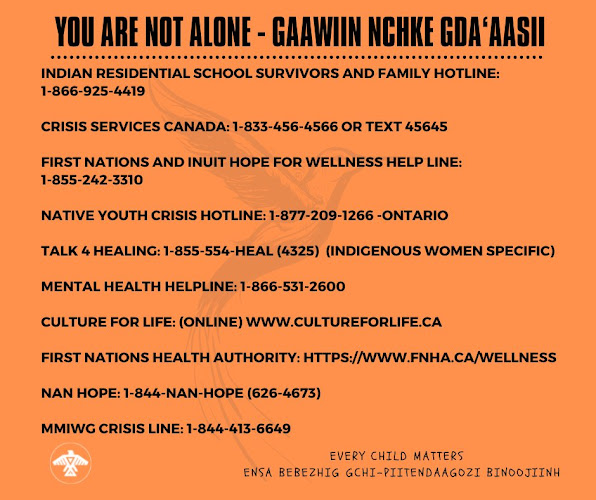
You are not alone
To Veronica Brown
Veronica, we adult adoptees are thinking of you today and every day. We will be here when you need us. Your journey in the adopted life has begun, nothing can revoke that now, the damage cannot be undone. Be courageous, you have what no adoptee before you has had; a strong group of adult adoptees who know your story, who are behind you and will always be so.
Diane Tells His Name
click photo
Lost Birds on Al Jazeera Fault Lines
click to read and listen about Trace, Diane, Julie and Suzie
NO MORE STOLEN SISTERS
click image
We conclude this series & continue the conversation by naming that adoption is genocide. This naming refers to the process of genocide that breaks kinship ties through adoption & other forms of family separation & policing 🧵#NAAM2022#AdoptionIsTraumaAND#AdopteeTwitter#FFY 1/6 pic.twitter.com/46v0mWISZ1
As the single largest unregulated industry in the United States, adoption is viewed as a benevolent action that results in the formation of “forever families.” The truth is that it is a very lucrative business with a known sales pitch. With profits last estimated at over $1.44 billion dollars a year, mothers who consider adoption for their babies need to be very aware that all of this promotion clouds the facts and only though independent research can they get an accurate account of what life might be like for both them and their child after signing the adoption paperwork.















 Posts

