BOOZHOO! We've amassed tons of information and important history on this blog since 2010. If you have a keyword, use the search box below. Also check out the reference section above. If you have a question or need help searching, use the contact form at the bottom of the blog.
We want you to use BOOKSHOP to buy books! (the editor will earn a small amount of money or commission. (we thank you) (that is our disclaimer statement)
This is a blog. It is not a peer-reviewed journal, not a sponsored publication... WE DO NOT HAVE ADS or earn MONEY from this website. The ideas, news and thoughts posted are sourced… or written by the editor or contributors.
EMAIL ME: tracelara@pm.me (outlook email is gone)
THANK YOU CHI MEGWETCH!
I've been asked why America has not issued an apology for their Indian Adoption Projects or ARENA adoptions when Canada is now openly admitting what it did, calling it cultural genocide, lawsuits have been filed and adoption records opened and repatriation services have been created for 60s Scoop adoptees... in CANADA, but not here!
Why is America in denial? Why don't we have a Truth and Reconciliation Commission (TRC) for the thousands of Native adoptees here who suffered the same fate as Canada's 60s Scoop adoptees?
First: Most Americans (including politicians) don't even know it happened here! Call it bad history...
Second: It will take many adoptees to come together - for many years we didn't know what happened either or how we were part of a devious racist corrupt government program!
Why don't we have a class action lawsuit? We could!
Years ago, I did contact NARF (sending them books) and the ACLU and inquired but no one was interested. One adoptee isn't enough to warrant suing the federal government! I wanted this to happen eventually so I worked on three four books, hoping this would pave the way for a future lawsuit, finding many adoptees who were part of these programs, having them write and document their own stories. They could be part of the lawsuit.
To my knowledge, Maine is the only state with a TRC. It's a first step.
This book is also our history and the basis for a strong lawsuit:
A Generation Removed: The Fostering and Adoption of Indigenous Children in the Postwar World
Angeline
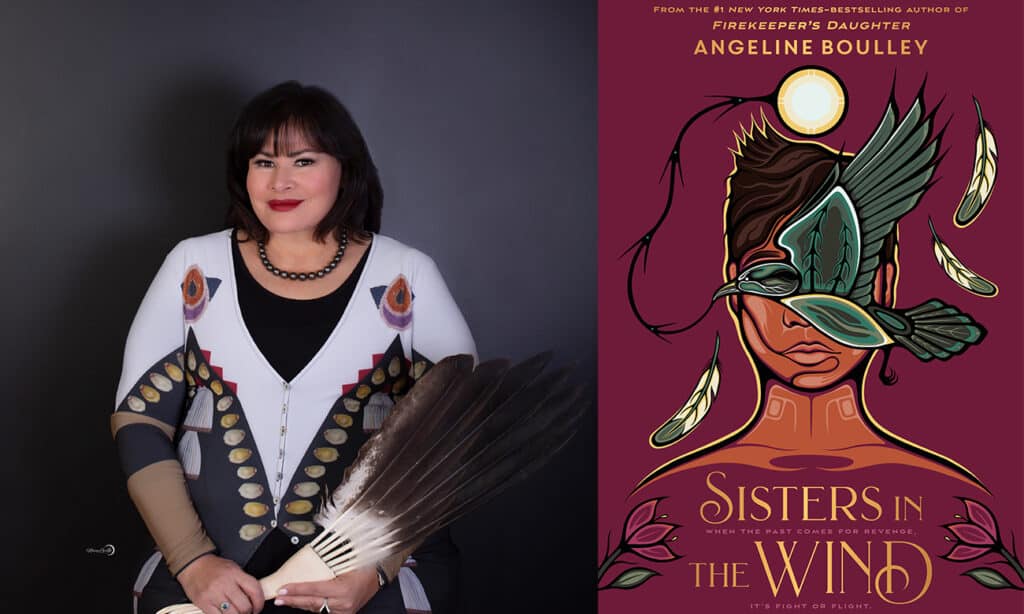
Boulley’s third novel, “Sisters in the Wind” chronicles an Ojibwe teen
girl’s experience in foster care. Provided photos.
“Native families are like onions,” fiction
author Angeline Boulley writes in her latest novel about Indigenous
families caught up in the child welfare system.
They are “rough-looking on the outside,” she goes on. “People want to
peel the outer layers and toss them away, as if they have no value. But
each layer is protecting the next, down to its innermost core. That
green center, where the onion is sweetest, that’s the Native child.
Surrounded by layers of family and community.”
Boulley’s third book, “Sisters in the Wind,”
offers a rare Indigenous-centric glimpse into the failings of the
country’s child welfare system. The young adult novel, set to publish
next month, is meant to show what can happen when a federal law meant to
ensure that Indigenous families remain intact is not followed, and how a
child’s life can be improved when it is, the Michigan author said in a
recent interview.
The thriller follows Lucy Smith, an Ojibwe teen who is running for
her life, away from traumatic figures she encountered while growing up
in foster care. As an adult she navigates a difficult childhood spent in
various placements before finding family and healing.
Publisher’s Weekly called the book a devastating, gripping tale “that
serves as a searing critique of the ways that systems can fail
vulnerable youth.”
At points in the novel, Boulley’s protagonist experiences
dehumanizing moments common to foster youth everywhere, including when
she is forced to carry her belongings in a trash bag during a move to a
new home.
Recently, states including New York and Texas
have prohibited child welfare agencies from doling out trash bags, and
now require them to provide proper suitcases to children. Such laws,
“need to be everywhere,’’ Boulley said, adding that she believes making
foster youth use garbage bags sends the clear message, “that they
themselves are trash.’’
An
insight into Angeline Boulley’s creative process: Color-coded
spreadsheets detail characters’ lives and her cat, Pietro, comforts her.
Provided photo.
As an adult, Smith eventually goes to work as a research intern for a
company that trains child welfare professionals on the workings of the
Indian Child Welfare Act. The 1978 federal law, known as ICWA, requires
state foster care agencies to take extra steps to ensure Indigenous
families stay together. The fictional company in the novel is based on
real work Indigenous people are doing to preserve families and tribal
communities in Boulley’s home state of Michigan, she said.
In the case of the novel’s protagonist, ICWA was not followed as she
moved through the foster care system. In one bleak scene, a social
worker tells Smith that identifying as Indigenous will only muddle her
situation.
“It complicates everything,’’ Smith is told. “Just say you’re Mexican.”
Later, Smith comes to believe that the abusive situations she endured
in non-Native foster homes never would have happened had she been
placed with tribal relatives.
Boulley, a member of the Sault Ste. Marie Tribe of Chippewa, hopes a
particular message in her novel will reach child welfare professionals
who might read it:
“When ICWA is followed correctly, it works,” Boulley said. “The
issues that arise primarily come when social services and court
personnel don’t understand the law. They continue with assumptions and
misconceptions, and that ends up complicating children’s lives.’’
Boulley was never in foster care herself. But she and her siblings
grew up spending summers visiting the Sault Ste. Marie reservation in
Michigan where she knew several young relatives being raised by kin
outside of the foster care system.
“Growing up, I didn’t think it was anything unusual to have cousins
that were raised by my grandma,” Boulley said. “That was just normal.”
Her work on “Sisters in the Wind’’ began years ago, but she felt an urgency to complete it following recent legal challenges to ICWA. In a United States Supreme Court case two years ago, multiple states and three foster families argued that the federal statute was unconstitutional and interfered with a non-Indigenous couple’s right to adopt an Native child.
A Supreme Court ruling upheld the law in June 2023. But, Boulley said, “We know it’s not the final assault on tribal sovereignty.’’
During the school year, Braun teaches Native cultural arts and Ojibwe
language at Anishinabe Academy. For her, teaching the summer program is
deeply personal.
Siena
Braun guides her summer students through an activity to make faceless
dolls in commemoration of missing and murdered Indigenous relatives. Credit: Aaron Nesheim | Sahan Journal
Prior to 1978, when Congress passed the Indian Child Welfare Act, three in 10 Native American children were taken from their families. One of those children was Siena Braun. She was placed in foster care and adopted. Her birth mother tracked her down when she was 27.
“They called me one of the stolen kids,” she said. “I got taken at birth.”
rawpixel.com-Gavel, court hammer. Free public domain CC0 photo.
This is the third story in a series on child welfare in New Mexico.
Attorney
Therese Yannan had represented children in state custody for many years
before she sued New Mexico in 2018. She was seeing a pattern of
resources just not being available.
“A court can’t order services
that don’t exist. It was impossible to get appropriate services,” said
Yanan, who works for the Native American Disability Law Center.
Attorneys
Bette Fleishman and Sara Crecca encountered the same obstacles. So the
three of them joined forces to go to court. Fleishman is executive
director of Pegasus Legal Services For Children, which is a plaintiff
along with Yanan’s organization. Crecca is her co-counsel.
Together
they joined 14 foster children in the class action suit seeking to
improve the child welfare system. The suit was named for one of the
children, Kevin S.
“We needed to do something bigger to change the
situation. Because kids were getting harmed then and they're getting
harmed now,” said Fleishman.
Crecca said the faults in the system have been well-documented for decades. But the Kevin S. team found three significant failures.
There
was no strong system to ensure that temporary placements or foster
homes were stable. That meant children were sleeping in state office
buildings.
Also, the state was failing to meet the medical and
mental health needs of children. And there was a complete failure to
implement any sort of trauma-informed practices for those in state care.
“Letting
them rot in the office, just sitting there, no school, no attempt to
engage them, no placement. That all felt kind of new. The outcomes we
were seeing were getting worse, more dangerous for kids, violating all
kinds of state and federal laws that existed,” Crecca said.
The 14 kids,
who were in foster care at the time, agreed to become main plaintiffs
and were chosen to represent the diversity of the state whether it was
race, sexual orientation, or even geography. Together they would also
represent the many more kids experiencing the same inhumane conditions.
Crecca said that what drove a lot of the suit was one question: Where are the foster parents?
The
Cherokee Nation’s Indian Child Welfare office, seen Sept. 17, is
located on South Muskogee Avenue in Tahlequah. To contact ICW, call
918-458-6900 or visit icw.cherokee.org. Photo by Chad Hunter /Cherokee
Phoenix
Cherokee Nation Indian Child Welfare representative investigating program
Sally
Wilson, a supervisor for Indian Child Welfare with the Cherokee Nation,
cites disagreeable examples of Cherokee or Native overrepresentation
and underrepresentation in federal and state programs.
TAHLEQUAH
– Sally Wilson, a supervisor for Indian Child Welfare with the Cherokee
Nation, can cite disagreeable examples of Cherokee or Native
overrepresentation and underrepresentation in federal and state
programs.
She can point to overrepresentation in the foster system.
“Cherokee
Nation is involved in child welfare cases all over the United States,”
Wilson said. “However, most of our cases are in Oklahoma where the
disproportionality rates are astonishing. There are reported to be
around 6,000 children in foster care across the state and according to
our data, approximately 11% of those children are Cherokee. This amount
has been consistent for the past 10 years – the amount of time I have
been heading up recruitment of foster and adoptive families for our
tribe.”
Then there is underrepresentation in some helpful
personnel enhancement programs, such as Minority Professional Leadership
Development, for which Wilson was chosen. It is administered from
within the U.S. Department of Health and Human Services.
“They’re
trying to get new leaders in the community to help with youth – minority
leaders specifically,” she said. “The Children’s Bureau oversees it,
and they help do the evaluations and they fund the project. It is
intended to grow minority leaders throughout the country, but there is
limited representation when it comes to Native people. I don’t know if
it’s because they don’t know to apply or maybe they’re just not
applying. I heard it through our director, and it was suggested that I
apply for it. I did and I was fortunate to get it.”
Today, Wilson’s work includes the gathering of data and research through the Action Research Project.
“It
can include a number of things,” she said. “Some people want to look at
reunification of children to their families, or they want to look at
what’s happening or what are we doing – maybe how can we change systems
for children that are aging out. I’m looking at what can be done to help
change systems that will positively impact our families that are
overrepresented in the child welfare system.”
The
MPLD program lasts 12 months and is intended specifically for emerging
leaders within minority child welfare. There is a selection process each
year from candidates across the U.S., many of whom are African American
or Hispanic.
“I believe this year they picked 23 out of all of
the applications,” Wilson said. “You’re exposed to a lot of experts
throughout the country, and you get mentorship opportunities, and then
you start your work on some research. You develop what’s called an
action research project. They really want you to focus on something that
you see needing improvement in your agency, in your tribe, whatever
that may be.”
With a higher chance of being placed in care away
from home, Native children are also four times more likely than other
children to be placed in a household with people of a different race.
“About
11 percent of the children that are placed in out-of-home care are
Cherokee children alone,” Wilson said. “All these rates of disproportion
are out there, and there is some implicit bias that plays into that. It
isn’t something people would say is intentional, but it is definitely
there. We’re still faced with many of the same battles they were facing
when (the Indian Child Welfare Act) was first implemented in 1978.”
The
MPLD is described as open to people from cultural, ethnic and racial
groups with a historically disproportionate number of children in care.
The program requires at least five years of experience working in U.S.
child welfare, and the fellowship is further intended for emerging
leaders. Candidates are expected to have an undergraduate degree.
Information about eligibility and application requirements is available at:
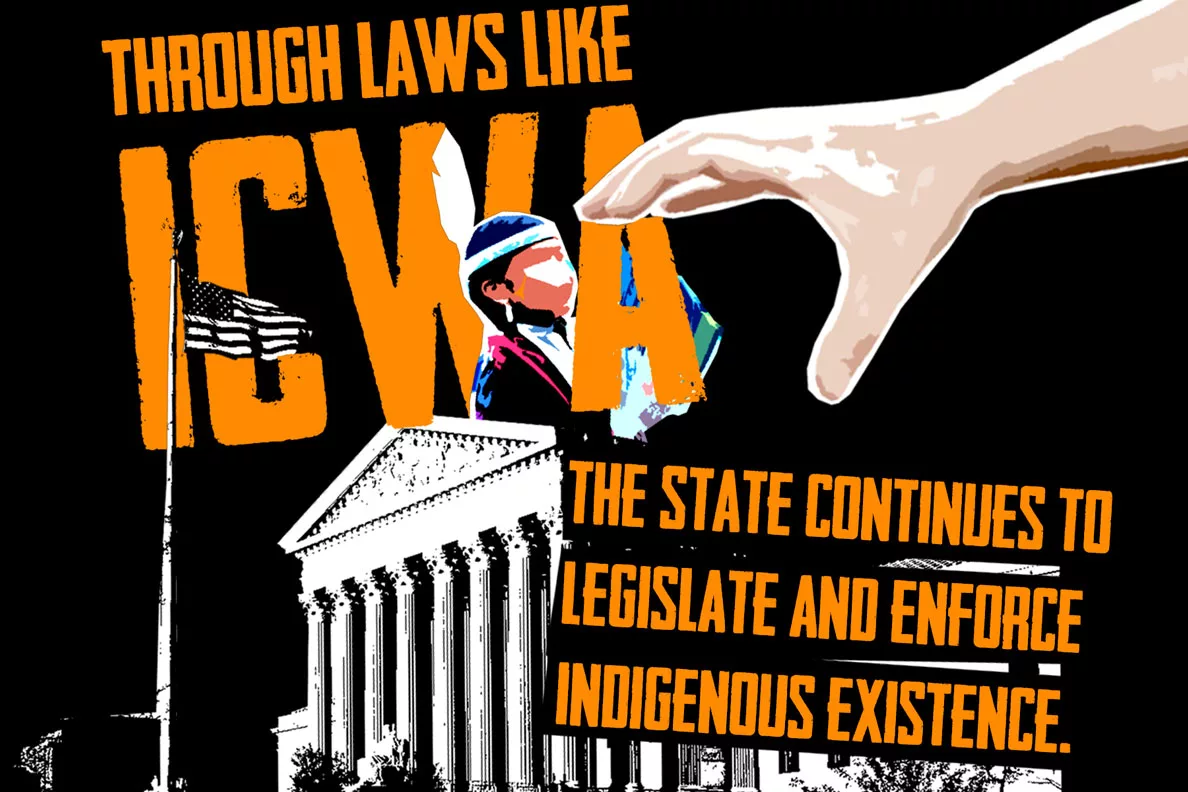
As many celebrate the defense of ICWA, we also must recognize the colonial violence that has demanded and produced it.
ICWA was passed in 1978 due to the rampant genocidal white christian
driven legal practice of taking Indigenous children from their homes and
placing them with white christian families. The law was created to
resolve a problem colonialism created. The settler colonial state didn’t
become interested in “keeping Indigenous children with their Tribes”
until it was assured that those children would be passively assimilated
into its “civilized” order.
Through laws like ICWA, the State continues to legislate and enforce Indigenous existence.
White families stealing Indigenous children should be a non-issue. That any argument for justification for keeping Indigenous children with
their peoples is occurring is part of the larger issue of white
supremacy, cis-heteronormativity, and Indigenous genocide.
Before ICWA was enacted in 1978:
– 25%–35% of all Native children were being removed from their homes;
– of these, 85% were placed outside of their families and communities—even when fit and willing relatives were available.
– Today, Native families are 4x more likely to have their children
removed and placed in foster care than their White counterparts.
Before 1492 Indigenous children weren’t stolen by colonizing predators.
While ICWA is celebrated as an affirmation of Indigenous sovereignty,
in actuality it affirms congressional power to regulate commerce (The
Commerce Clause) with Indigenous Peoples and plenary power over “Indian
affairs.” A plenary power or plenary authority is a complete and
absolute power to take action on a particular issue, with no
limitations.
The legal battle over ICWA erases Indigenous children who are not
from federally recognized tribes, border communities, & migrants
doesn’t address issues of dis-enrollment. Particularly as ICWA
specifically “sets federal requirements that apply to state child
custody proceedings involving an Indian child who is a member of or
eligible for membership in a federally recognized tribe.” ICWA
reinforces “Indian” citizenship policies that some Tribal governments
have used to exclude mixed race descendants. Regardless of ICWA, child
theft still occurs within the foster care system, where Indigenous youth
still are most likely to end up.
The discourse around ICWA is also inherently cis-heteronormative as
it doesn’t support queer & two-spirit family formations. ICWA
defines Indian child as “any unmarried person who is under age eighteen
and is either (a) a member of an Indian tribe or (b) is eligible for
membership in an Indian tribe and is the biological child of a member of
an Indian tribe…”
What justice can we expect from a colonial system that also maintains
anti-Indigenous laws sanctioning desecration of sacred lands and
attacks bodily autonomy?
Are our cultures and communities so desperate and broken that we
celebrate that colonizers can determine if our children belong with us?
The apparent “necessity” of ICWA demonstrates the fallacy of colonial
laws and the predatory white supremacist violence that constantly looms
outside our homes.
That colonial laws are required to stop white people from outright
stealing Indigenous babies is the result of a much deeper systemic
problem than laws like ICWA can address.
Many of our families & homes are broken due to colonization, more colonial laws won’t fix that.
What are culturally-rooted non-state based solutions to keeping Indigenous children with our families?
At
age nine, tragedy struck Autumn Adams’ life. Her father passed away and
her mother was deemed unfit to care for her, leaving Adams with an
uncertain future.
Adams, who is a member of the Yakama Nation,
a federally recognized Native tribe, recalls overhearing officers from
Child Protective Services discuss the possibility of moving her to a
non-Native home if they couldn’t soon find a Native family to place her
with. The idea terrified her.
“At that point in my life, I had everything I recognized as home ripped away from me," she tells Teen Vogue.
"I had to bury my father. I had to be ripped from my mother's arms. The
only thing that was left that gave me that connection was my extended
family and culture.”
Adams
was eventually placed with family in a multigenerational home that
included her maternal aunt and grandmother. Now a law student, Adams
credits this upbringing with enabling her to stay close to her culture
and achieve success. “I was directly able to learn from my aunt, my
cousins, my grandmother, my other aunts and uncles during that time —
what it means to have perseverance, what it means to have responsibility
and respect, the definition of grit,” she explains. “It's through those
lessons that I've broken every negative statistic not only about former
foster youth but about Native former foster youth.”
In November,
the Supreme Court heard arguments for a case that could forever change
the landscape of adoption for Native youth like Adams.
Emerson
Gorman (right) was one of the thousands of Navajo children taken from
their families and sent to Christian schools to erase their beliefs. His
daughter Naiyahnikai, wife Beverly, and grandchild Nizhoni are pictured
(left to right) on his Arizona property May 23, 2020.
The U.S. Supreme Court heard oral arguments on Nov. 9 in a case
questioning the legality of the Indian Child Welfare Act (ICWA),
legislation passed to prevent Native American children from being
stripped from their communities and cultures. Kendall Ciesemier, host of
the ACLU's At Liberty podcast, said that in Brackeen v. Haaland, “Texas,
together with individual plaintiffs, allege that ICWA is
unconstitutional” because “it violates the equal protection clause and
discriminates against non-Native families looking to adopt Native
children.”
“But honoring tribal sovereignty isn’t about discrimination or
race. That’s a fundamental misunderstanding of Indigenous rights,” Ciesemier said in an episode meant to draw attention to what’s at stake for Native children.
Jaimie Nelson, a Choinumni Yokuts man from Fresno, California, was
once one of those children. He detailed on the podcast abuse he
encountered at the hands of a white family who adopted him. For Nelson,
legal experts, and activists, the Supreme Court challenge is an
outgrowth of an intentional and systematic effort to whitewash Native
Americans.
"I am not a victim of some odd set of circumstances where I lost my
sister and my brother," Nelson said. "It was an intentional act built
around ‘Kill the Indian, Save the Man.’"
Nelson referenced words
uttered in 1892 by racist American Army Capt. Richard Henry Pratt.
He tried, along with the federal government, to strip Native Americans
of their beliefs, cultural histories, and traditions. And though Pratt
made the speech 130 years ago, the sentiment he championed is far from
extinguished.
Nelson said eliminating the very constitutional right that attempts
to protect Native children from such cultural atrocities is “a genocidal act.” And he would know exactly what that feels like, because it was attempted on him.
Nelson told the ACLU of his adoption:
There’s a lot of muddy water in there. I know that it happened
at a very young age in the late seventies. My biological parents, they
were, my mom was either addicted to drugs, my dad was a pretty bad dude.
But it didn’t mean that they had to take us away from our native
family. Our native family wanted to keep us, but the courts indicated,
essentially that there’s nothing you can do about it. They specifically
told my grandmother that there’s nothing that you can do about it. And
from what I understand, from what I was told, it destroyed her that she
was not able to keep us in the home. I don’t have very many memories of
my of my time in the foster care system or any of the sort of lead up to
the adoption. What I do have, I have physical reminders of my
introduction into the system. I have a tracheotomy scar on my neck and
on my sides from apparently when I was abused, like immediately after
being taken from my Native family.
Nelson said when he learned of the case that will be before the
Supreme Court, he knew he had to do something "because there cannot be
another Jamie."
"There cannot be another child that is taken away because of some
archaic, just genocidal, bigoted ideas," he said. "It’s unbelievable.
It’s unconscionable to me that we still have to go through these
hurdles, but we do."
Dr. Twyla Baker, president of the Nueta Hidatsa Sahnish College,
tweeted about the case five days before Native American Heritage Month
began today. "The thing I can’t get off my mind—it’s about to be Native
American Heritage Month, as SCOTUS is about to hear a case that has the
potential to knock down the Indian Child Welfare Act," Baker said in the
tweet. "This kind of existential dichotomy pops up way too often for
Native people here."
“My bad, actually this didn’t ‘pop up’—it was a situation
crafted, intentionally, over years with much larger implications and
intentions to follow. Superficial acknowledgments of our humanity as
other structures work to dismantle our Native Nationhood is really
pretty standard.”
Stephanie Amiotte, a member of the Oglala Lakota Tribe and legal
director for the ACLU of South Dakota, North Dakota, and Wyoming, said
when the Indian Child Welfare Act was proposed, 25 to 35% of American
Indian children were being raised in adoptive or foster homes or other
institutions. About 90% of Indigenous children were being raised by
people who were not Indigenous, Amiotte said.
She explained that, historically, the federal government’s position
and policy has been “to remove Indian children from their families in an
attempt to assimilate” them “to white dominant culture.”
“It is something that actually threatens the very existence of future
tribes and Indigenous peoples as a population,” Amiotte said.
Sept. 25, 2026 | Relatives walk to remember, church denounces Native beliefs & more
Bookshop
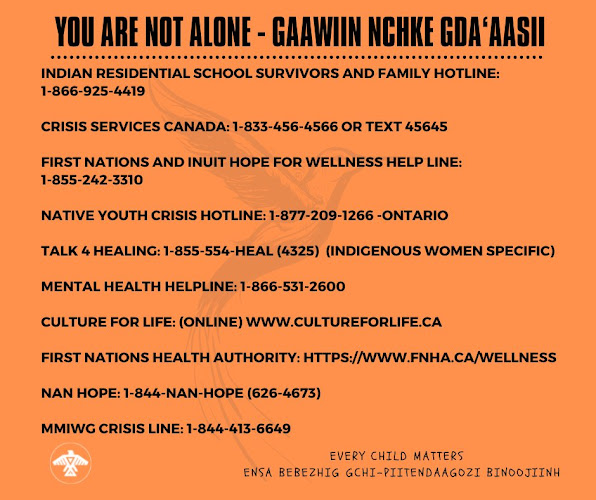
You are not alone
To Veronica Brown
Veronica, we adult adoptees are thinking of you today and every day. We will be here when you need us. Your journey in the adopted life has begun, nothing can revoke that now, the damage cannot be undone. Be courageous, you have what no adoptee before you has had; a strong group of adult adoptees who know your story, who are behind you and will always be so.
Diane Tells His Name
click photo
Lost Birds on Al Jazeera Fault Lines
click to read and listen about Trace, Diane, Julie and Suzie
NO MORE STOLEN SISTERS
click image
We conclude this series & continue the conversation by naming that adoption is genocide. This naming refers to the process of genocide that breaks kinship ties through adoption & other forms of family separation & policing 🧵#NAAM2022#AdoptionIsTraumaAND#AdopteeTwitter#FFY 1/6 pic.twitter.com/46v0mWISZ1
As the single largest unregulated industry in the United States, adoption is viewed as a benevolent action that results in the formation of “forever families.” The truth is that it is a very lucrative business with a known sales pitch. With profits last estimated at over $1.44 billion dollars a year, mothers who consider adoption for their babies need to be very aware that all of this promotion clouds the facts and only though independent research can they get an accurate account of what life might be like for both them and their child after signing the adoption paperwork.













 Posts

