


‘We’re more than reconciliation, we’re reconcili-action,’ says founder Vanessa Genier
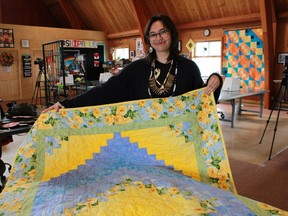
Quilts for Survivors, the nonprofit in Timmins whose mission is to ship a handmade quilt to every survivor of Indian residential and day schools, the sixties scoop, and intergenerational trauma, shipped its 8,000th quilt on Thursday, Oct. 23.
The occasion was marked by an invitation-only gathering featuring remarks and a boxing of the blue and yellow quilt which will be shipped to Angeline in Siksika, Alberta.
Founder Vanessa Genier does not share the recipients of her quilts last names, though was careful to point out the success of her nonprofit is all due to them.
“What started as a way to bring comfort to one survivor— in our case, we were going to make 18 quilts, that was our goal—has grown into a nationwide circle of love, care and healing,” she told a small invited crowd of dignitaries and supporters.
In her comments, Genier spoke of quilting as a metaphor for healing. Just like a survivor must pick up the pieces of their lives, Genier and her army of volunteer quilters sew the pieces back together.
👇Keep reading
An intergenerational survivor herself, Genier’s pain has lessened since launching the project in 2021, following the discovery of 215 probable graves on the grounds of a former residential school in Kamloops, B.C.
“I’m able to focus on the work that we’re doing and the joy that it brings. Not because we’re amazing people, but because the Creator is using this to heal our nations,” she said in her remarks.

Genier has heard testimony from recipients that their quilt validates them.
Survivors’ early experience of abuse devalued and humiliated them, to the point where they begin to think negatively of themselves, she explained.
She has heard from survivors the quilt has helped them see themselves as something other than a survivor.
Residential schools were an attempt by Christian churches and the Canadian government to educate, assimilate and convert Indigenous children and youth. Unfortunately, children were removed from their families by force, and many suffered sexual, physical and emotional abuse and neglect. It is estimated that 150,000 children attended these institutions and that 6,000 died there, though records are incomplete.
The discovery of the 215 probable graves at the Kamloops Indian Residential School in has been complicated by the fact no human remains have been confirmed or exhumed despite the government providing Tk’emlups te Secwepemc First Nation over $12 million to recover the graves.
Two-thirds of Indigenous and non-Indigenous people surveyed by Angus Reid in August said the claim should be verified with evidence.
Ground penetrating radar was used to uncover the anomalies. It works by sending an electromagnetic wave into the ground. As the wave encounters different things, it bounces back to a machine.
Rocks, metal and grave shafts all have “distant signatures,” the Canadian Press reported in 2023.
Investigation teams also use elder testimony, community knowledge, aerial photographs and church archives to confirm their findings.
However, ground-penetrating radar alone cannot completely confirm the presence of a grave, according to Kisha Supernant, director of the University of Alberta’s institute of prairie and Indigenous archaeology.
For Genier, the overwhelming evidence of mistreatment at residential schools across Canada is enough corroboration for her.
From 2007 to 2015, the Truth and Reconciliation Commission heard from over 6,500 residential school survivors and others affected by the system about the abuse they suffered.
The commission was established as one of the conditions of the 2007 Indian Residential School Settlement Agreement, a class-action lawsuit between Indigenous people, the government of Canada and involved churches.
There is also the cultural practice, highlighted by the chief and elders in the Kamloops case, of not wanting to “desecrate graves” by digging them up.
“I know what my spirit tells me,” Genier told The Daily Press following her remarks.
“Nobody benefits from knowing there were 215 bodies under there. Were they all students of the school? I personally, do not need to know that. I have enough evidence in my own family. I know what my grandparents suffered, and how my grandfather was treated, and how they were hidden in the bush.”
She thinks the onus is on the doubters to ask themselves why they need the hard evidence.

Quilts for Survivors is located in a deconsecrated Anglican Church in South Porcupine on the east side of Timmins.
The Anglican Church ran about three dozen residential schools for Indigenous children between 1820 and 1969.
Two of these were in the Diocese of Moosonee: Bishop Horden Hall (Moose Factory), and Chapleau (St. John’s).
The names of 24 students who died at Bishop Horden Hall are listed on the website of the National Centre for Truth and Reconciliation, as are the names of 31 students who died at Chapleau.
“This is a small way the Anglican Church can go about repairing the damage that we did,” said Mark Gladding, interim priest for St. Matthews Anglican Cathedral in Timmins.
As part of the terms of the Indian Residential School Settlement Agreement, the Anglican Church of Canada, as well as other church organizations, were required to pay millions in compensation to Indigenous groups.
In 1993, at the National Native Convocation in Minaki, Ont., Archbishop Michael Peers apologized for the Anglican Church’s role in inflicting abuse and suffering on children at residential schools.
The apology was accepted by the elders and participants present.
“We were the first church to walk away from it in 1969, but that doesn’t absolve us from any of the guilt that comes with our participation in it and the horrible system that was,” Gladding said.
Gladding has visited the Mowhawk Institute with survivors in Brantford, something he called a “humbling experience,” and was happy to be present at a celebration.
He said both survivors need healing form the past and non-Indigenous need healing from ongoing racism.
Vanessa admitted she had “mixed feelings,” about accepting the deconsecrated church, given the Anglican Church’s history.
Then her mother Cheryl Macumber, a quilter and Quilts for Survivors board member, pointed out it would be an act of reconciliation to accept it.
“It’s not just picking and choosing how we want to reconcile with our allies, it’s about taking what they offer, and they offered us this building,” Genier said, adding as soon as she saw the soaring space, she could visualize its walls full of hanging quilts.
The last production milestone that Genier publicly celebrated was when Quilts for Survivors reached 3,000 quilts shipped in May of 2023.
Genier thinks she’s been able to up production by 5,000 more quilts over two years because she now has so many more volunteers because she empowers supporters of reconciliation to take action.
Eighty per cent of her volunteer quilters are non-Indigenous, though she can also point to survivors who are now making quilts for other survivors.
“We gave them somewhere where they can do something. You read those 94 calls to action and you go ‘how can I do anything? What does that mean to me?’ And it’s daunting. We take all of those things and put it into what we do, and so, we’re more than reconciliation, we’re reconciliaction. We give people a safe space to do that.”
She also cited the bigger space and improved quilting skills from her core team: Macumber, and her children Kendrick Jeremiah and Katherine Jeremiah-Génier.
“Every time we send a quilt, 20 more people find out about what we’re doing, so then you get more requests, more volunteers, more sponsorships, more donations.”
More quilts are now shipped by volunteer quilters from where they are. Not all quilts are shipped through Timmins, Genier said.
It takes a full year for a survivor to get their quilt after the request is made.
First, the quilt top is made then it’s quilted, the backing is added, it is labeled, and smudged.
A letter, poem and card are sent with each quilt “so future generations will know where it came from,” Genier said.
There are no names attached, as would be the case with a quilt show, but Genier hopes people will look up her organization and learn from her origin story.
Kendrick finished the 8,000th quilt on Oct. 22. He sewed on the binding and attached the label.
Now 20 years-old, Kendrick first learned to sew by hand at age 11. He learned to use the sewing machine as soon as his mom started Quilts for Survivors.
While he didn’t enjoy sewing by machine at first, he has learned to appreciate it over his year-and-a-half in his role as studio assistant.
“I always feel happy and rewarded when I finish a quilt. This one made me feel a bit happier and a bit more hopeful and proud that we’ve managed to make 8,000.”








 Posts
Posts


No comments:
Post a Comment
Please: Share your reaction, your thoughts, and your opinions. Be passionate, be unapologetic. Offensive remarks will not be published. We are getting more and more spam. Comments will be monitored.
Use the comment form at the bottom of this website which is private and sent direct to Trace.