


November 20, 2025
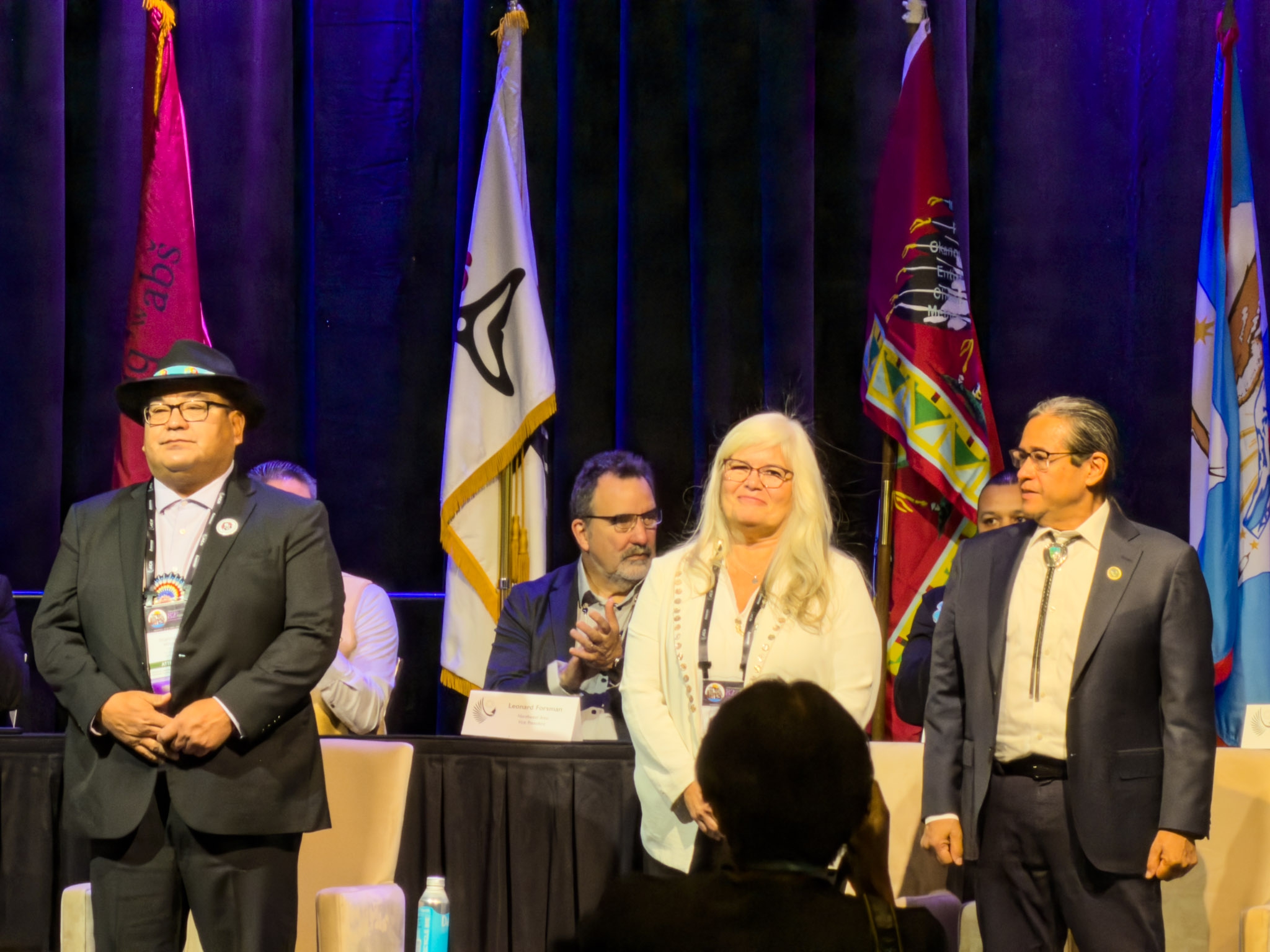
SEATTLE, Washington — Election season kicked into high gear at the largest inter-tribal conference here, with last-minute additions shaking up the race to lead the National Congress of American Indians (NCAI). Three candidates each are running for President, 1st Vice President and Recording Secretary of NCAI, along with two for Treasurer. The crowded field highlights the big turnout for the organization’s 82nd annual convention in Washington’s most populous city. And three of the four races have drawn candidates from Alaska, reflecting the potential for some major changes in NCAI’s direction. The organization has not elected a president from the 49th state since its founding in 1944. President Mark Macarro, the chair of the Pechanga Band of Indians from California, is one of two incumbents seeking re-election at NCAI. He was nominated to the post by Ben Barnes, the chief of the Shawnee Tribe in Oklahoma, as the convention resumed on Wednesday morning.
“As I stand here looking out at all of you, I am reminded of our
strength when we stand together as a unified voice on the issues and
battlefronts that we face today in the Congress, in the courts, and at
the ballot box,” said Macarro, who first won election at NCAI’s annual
convention in 2023. “We are strongest when we speak with that unified
voice.”
But in a surprise addition, Jacqueline “Jackie” Pata, the 1st Vice President of the Central Council of the Tlingit and Haida Indian Tribes
from Alaska, threw her hat into the ring. She was nominated to be
NCAI’s highest elected position by Bridgett Sorenson, a leader from the Sault Ste. Marie Tribe of Chippewa Indians in Michigan.
“I am an Alaskan,” said Pata, who previously served as Executive Director of NCAI before departing amid an investigation into workplace conditions at the organization.
“But while I’m Alaskan, I’ve spent my career working for tribes across
the country, large and small, rural and urban, from every region,”
continued Pata, who worked at NCAI for 18 years. “I know the diversity
of our nations. I also know the strength of our unity.”
Shannon Wheeler, the chair of the Nez Perce Tribe
in Idaho, rounded out the field for president and is the only candidate
from the Northwest Region where NCAI’s convention is being held this
year. He was nominated by Gary Burke, the chair of the Confederated Tribes of the Umatilla Indian Reservation in Oregon.
“If we need to be in your state capitals to talk to your governors, then
that’s where we’re going to be,” said Wheeler. “If we need to be in the
White House, that’s where we’re going to be.”
A fourth person, April Patrick from North Carolina, had been campaigning
for the president’s position at the Seattle Convention Center since
the start of the week. But no one stepped forward at the general
assembly on Wednesday to nominate Patrick, who describes herself as
being Karuk, Yurok and Waccamaw Siouan.
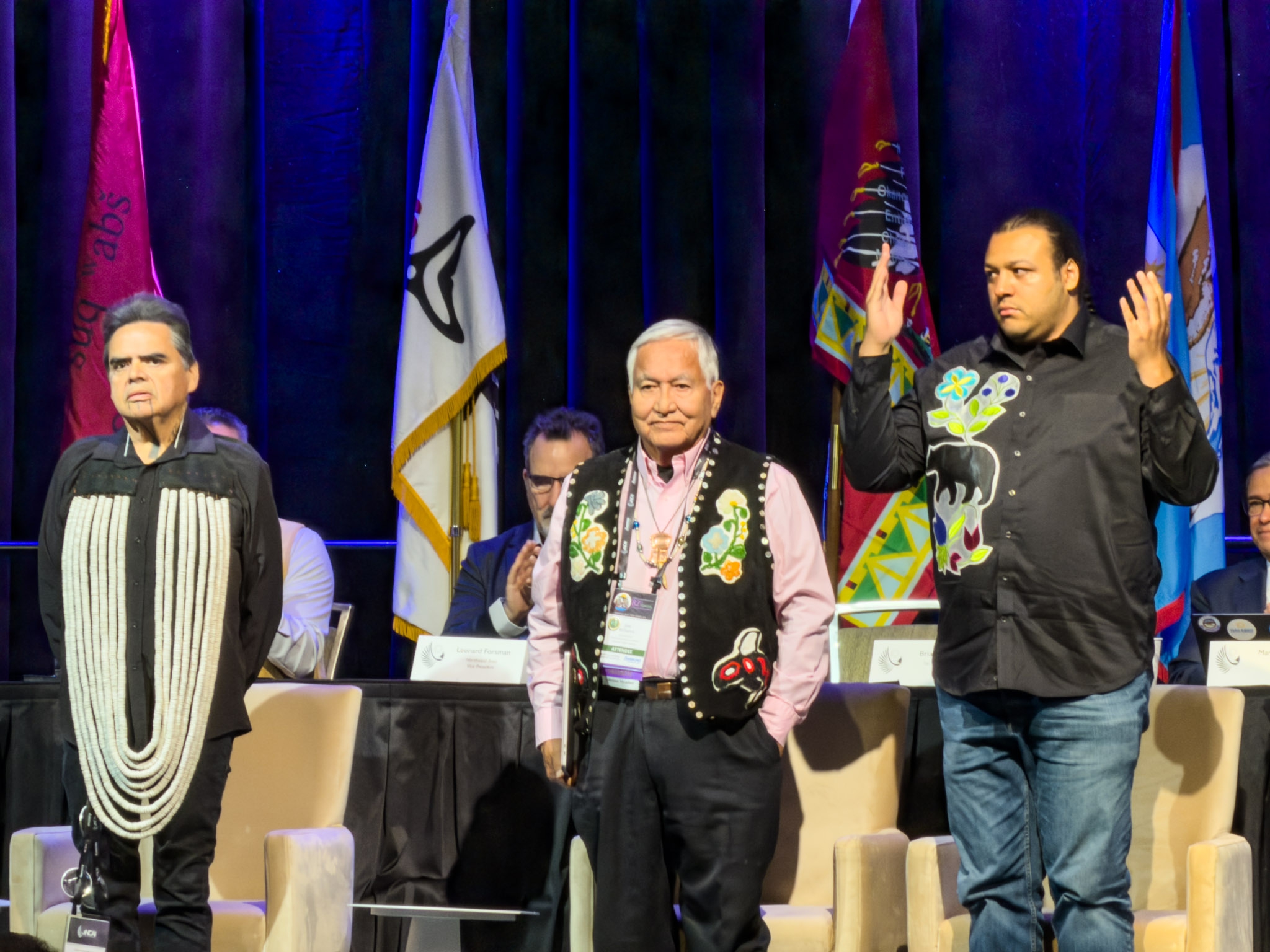
From left: Jack Potter, Joe Williams, Jr., and Brian Weeden stand on
stage after delivering campaign speeches to be 1st Vice President of the
National Congress of Americans at the organization’s 82nd annual
convention in Seattle, Washington, on November 19, 2025. Photo by
Indianz.Com (CC BY-NC-SA 4.0)
The field for 1st Vice President for NCAI is no less crowded. Incumbent
Brian Weeden, the youngest person elected as chair of the Mashpee Wampanoag Tribe in Massachusetts, was nominated to the post by Rodney Butler, the chair of the Mashantucket Pequot Tribal Nation in Connecticut.
“This organization helped me to be the leader that I am today, by
serving on NCAI’s Youth Commission, by receiving the 2015 Youth
Leadership Award for the Indian Gaming Association
at the time,” said Weeden. “And that’s why I would like to give back to
this organization, just like giving back to our tribal communities.”
Joe Williams, Jr., the president of the Saxman Tribe
in Alaska, is a first-time candidate for NCAI’s executive committee. He
was nominated as 1st Vice President by Gloria Burns, the president of
the Ketchikan Indian Community in Alaska.
“I am the first Tlingit ever to be elected mayor to Ketchikan Gateway Borough.
I state that because it’s a predominantly non-Native community,” said
Williams. “I’ve been operating a tour business for 34 years, operating
historical walking tours in Ketchikan and Saxman to the visitors that
stop in our community.”
Jack Potter, the chair of the Redding Rancheria in California, is a frequent face at NCAI. He was nominated as 1st Vice President by Antoinette Del Rio, the chair of the California Valley Miwok Tribe.
“I stand on sovereignty because that is the only thing we have and we
must use it and wield it,” said Potter, who currently serves as a vice
president for NCAI’s Pacific Region. “When you don’t use it, you’re
gonna lose it. And we must never dilute that sovereignty by allowing
other people at the table.”
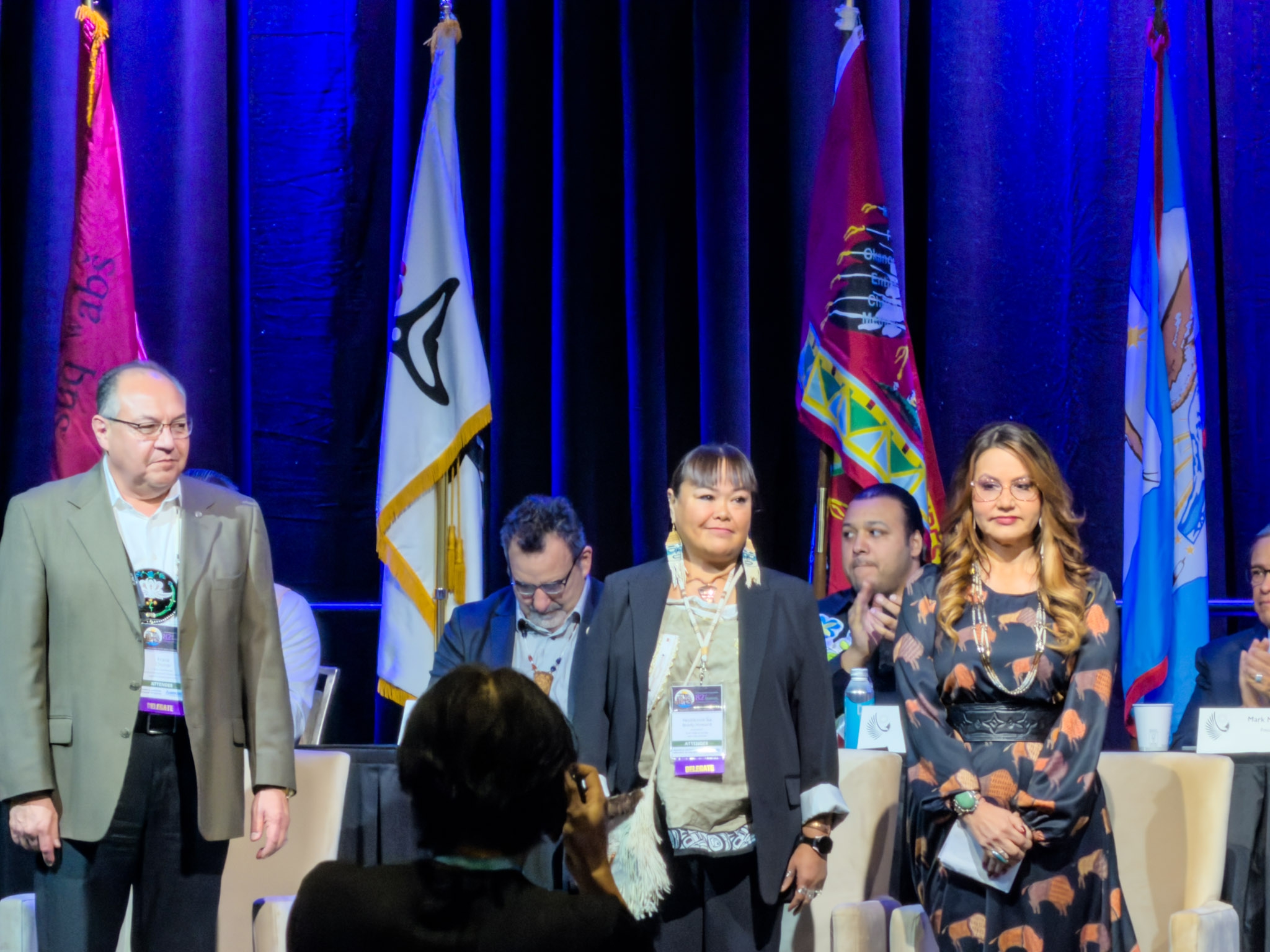
From
left: Frank Cloutier, Dionne Brady-Howard and Christie Modlin stand on
stage after delivering campaign speeches to be Recording Secretary of
the National Congress of Americans at the organization’s 82nd annual
convention in Seattle, Washington, on November 19, 2025. Photo by
Indianz.Com (CC BY-NC-SA 4.0)
For the position of Recording Secretary on NCAI’s executive committee,
no incumbents are in the running. Christie Modlin, the secretary of the Iowa Tribe in Oklahoma, was nominated by Joe Deere, a council member from the Cherokee Nation, also based in Oklahoma.
“I’m running because I believe NCAI needs strong, steady,
culturally-grounded leadership — leadership that listens, unites, and
delivers,” said Modlin, who also serves as secretary for the Indian Gaming Association.
Dionne Brady-Howard, the chair of the Sitka Tribe, represented the third NCAI executive candidate from Alaska. She was nominated to be Secretary by Burns from Ketchikan.
“I think so many of our issues really come back to that fact that we
really just need to come from a better place of common understanding,”
said Brady-Howard, whose Tlingit name is Yeidikook’áa. “We need to be able to explain who we are and where we come from, and we need to be able to listen to one another as well.”
Rounding out the field for Secretary is Frank Cloutier, a council member from the Saginaw Chippewa Tribe in Michigan. He was nominated by Shannon Holsey, the president of the Stockbridge-Munsee Band of Mohican Indians in Wisconsin.
“I come from a long line of people who are very precise and distinct,
and when I show up, I show up early and when I show up, I’m ready to
work,” said Cloutier, who also worked in public relations for his tribe.
“And that’s exactly what I can promise you for the next two years.”

From left: Aaron Payment and Ashley Cornforth stand on stage after
delivering campaign speeches to be Treasurer of the National Congress of
Americans at the organization’s 82nd annual convention in Seattle,
Washington, on November 19, 2025. Photo by Indianz.Com (CC BY-NC-SA 4.0)
No incumbents are in the running for Treasurer of NCAI and no Alaskans are running either.
Ashley Cornforth, the secretary/treasurer for the Shakopee Mdewakanton Sioux Community in Minnesota, was nominated by Michael Conners, a chief from the St. Regis Mohawk Tribe in New York.
“I think that NCAI can tap into and expand its resources for more
funding to reduce some of the financial pressures for tribes and create
more participation and engagement, which is a win for all tribal
nations,” Cornforth said in her first run for an NCAI executive
position.
Aaron Payment, a leader from the Sault Tribe
in Michigan, is another familiar face, having served as 1st Vice
President and Secretary for NCAI. He was nominated to the post by Ron
Allen, the chair of the Jamestown S’Klallam Tribe in Washington.
“We have prepaid for every penny we receive,” said Payment, who has
frequently represented NCAI in Washington, D.C. “It’s not welfare. It’s
not reparations. It’s not because we are poor Indians.”
“To the contrary, we prepaid for this debt with the blood sweat, and
tears of our ancestors, and nearly 2 billion acres of Indian ceded
land,” added Payment.
Elections for President, 1st Vice President, Secretary and Treasurer
are taking place Thursday morning at the Seattle Convention Center.
NCAI sent out an early reminder — at 6am Pacific Time — to be in line
by 10am to cast a ballot.
With three candidates each in three of the four races, it is possible
that no candidate will receive 50 percent plus one of the vote as
required by NCAI. Macarro, during a campaign reception on Tuesday
evening, urged attendees to stay close to the convention floor in case
they need to cast another ballot.
Winners of the executive board seats will be formally sworn in on Friday. Each position is a two-year term.
Since its founding in 1944, NCAI has only seen three women serve as President
— the late Veronica Murdock from the Colorado River Indian Tribes; Sue
Masten from the Yurok Tribe, who is in attendance this week; and Fawn
Sharp from the Quinault Nation. Sharp served two terms — from 2019
through 2023.
And while Alaska Natives tend to represent the largest contingent of
attendees at NCAI’s meetings, they have never run a slate of candidates
as large as the one here in Seattle. Pata hadn’t been seen campaigning
publicly up until she started distributing materials on Wednesday
morning so many attendees found out for the first time as they were
entering the convention center.
NCAI’s 82nd annual convention concludes on Friday.







 Posts
Posts


No comments:
Post a Comment
Please: Share your reaction, your thoughts, and your opinions. Be passionate, be unapologetic. Offensive remarks will not be published. We are getting more and more spam. Comments will be monitored.
Use the comment form at the bottom of this website which is private and sent direct to Trace.