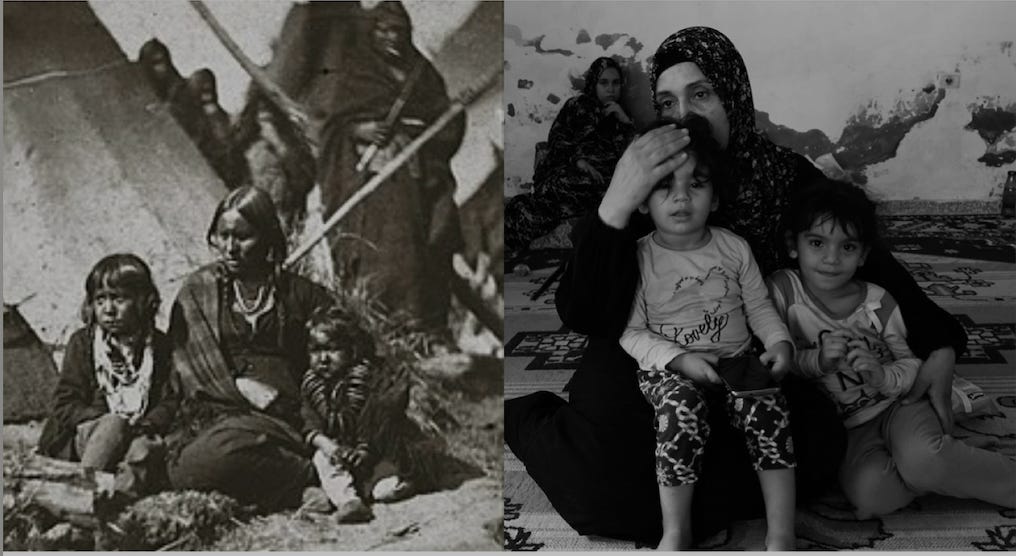
a blog for and by American Indian and First Nations adoptees who are called a STOLEN GENERATION #WhoTellsTheStoryMatters #WhyICWAMatters
it's free
Reference Material
- How to Search (adoptees) (2025)
- NEW! Help for First Nations Adoptees (Canada)
- How to Open Closed Adoption Records for Native American Children (updated 2021)
- LOST CHILDREN BOOK SERIES
- Split Feathers Study
- The reunification of First Nations adoptees (2016)
- You're Breaking Up: Adoptive Couple v. Baby Girl #ICWA
- Indian Child Welfare Act organizations
- About the Indian Adoption Projects
- THE PLACEMENT OF AMERICAN INDIAN CHILDREN - THE NEED FOR CHANGE (1974)
- NEW: Study by Jeannine Carriere (First Nations) (2007)
- NEW STUDY: Post Adoption (Australia)
- Dr. Raven Sinclair
- Laura Briggs: Feminists and the Baby Veronica Case...
- Bibliography (updated)
- Adopt an Elder: CHERYL Locke (Oglala Lakota)
- TWO NATIONS: Navajo (Boarding School)
- GOLDWATER
- Survivor Not Victim (my interview with Von)
- GS Search Angel Site 2024
- OBC ACCESS 2023
- FREE REGISTRY (sign up at ISRR)
- Genealogy\Indian Affairs 2021
- What is ICWA (2023)
- #MMIWG MAY 2019
- Adoption History
- Native American Banks
- MEDIA
- About Trace
How to Use this Blog
SEARCH
Friday, April 10, 2026
Wednesday, December 31, 2025
Some stories start in the present and pull you into the past
Stories we loved to tell | Baker Lake woman’s journey through her family’s history a stirring moment to write about
![]() |
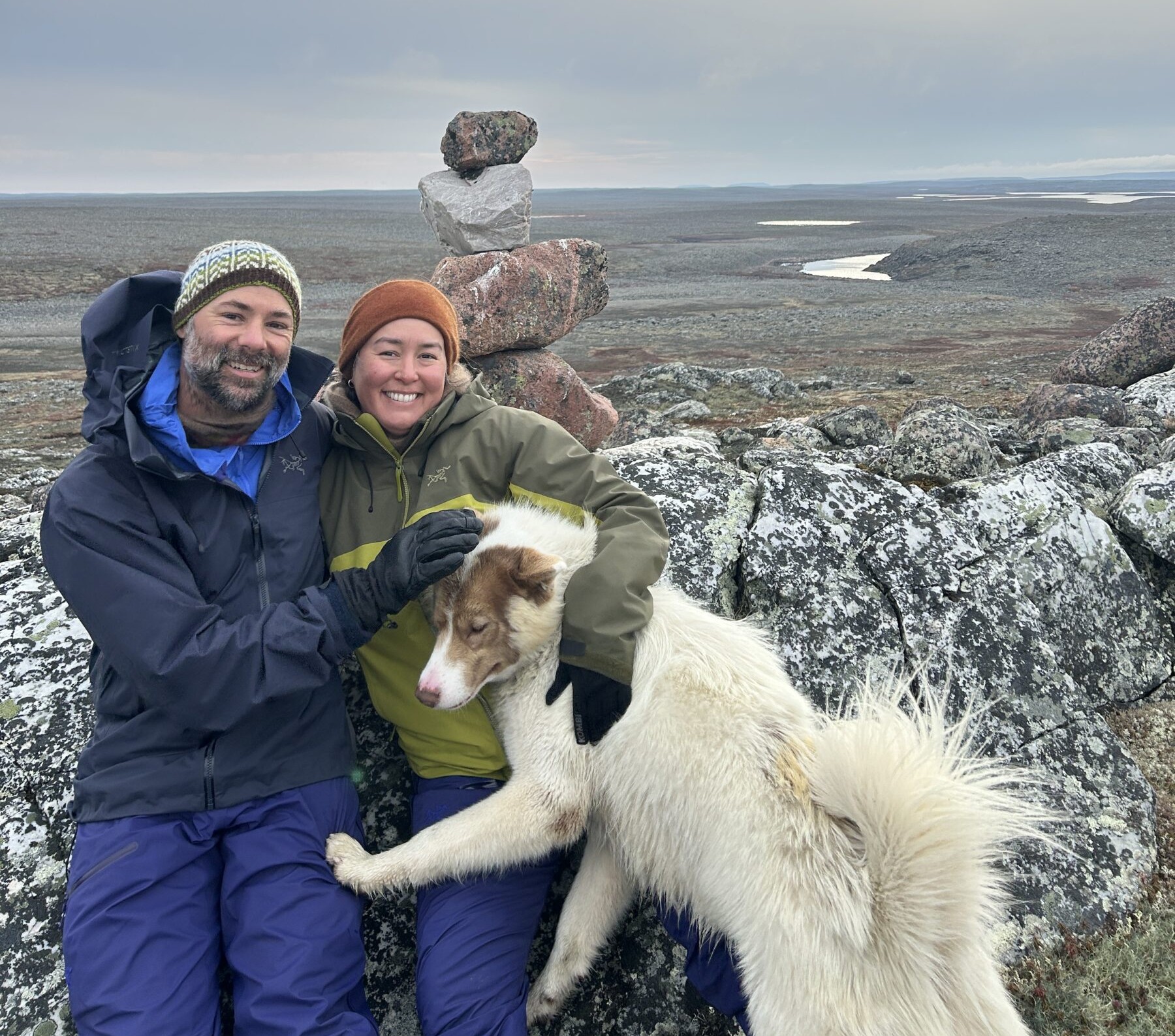
| Erik Reid and Gayle Uyagaqi Kabloona pose for a photo with their dog Tempe in front of one of many inuksuit the group used to guide their journey. (Photo courtesy of Gayle Uyagaqi Kabloona) |
In this year-end series, Nunatsiaq News reporters look back on their most memorable stories from 2025.
Working as a reporter, you often find yourself telling unhappy stories but every once in a while you get one that leaves you feeling inspired.
That’s where I found myself in October while writing about a woman who was trying to reconnect with her Inuit roots.
Starting in the 1930s, Inuit were displaced from their traditional lands by the federal government and moved to permanent settlements. They were forced to abandon their way of life of that involved migrating between winter and summer camps.
For Gayle Uyagaqi Kabloona, who now lives in Ottawa, this displacement is still within living memory. Her father, Thomas Kabloona, now in his 70s, shared stories with her about his family’s last migration to winter caribou hunting grounds in the 1950s before they moved to Baker Lake permanently.
“I’ve always loved my dad’s stories,” she told me in August when she was still planning the trip.
![]() |
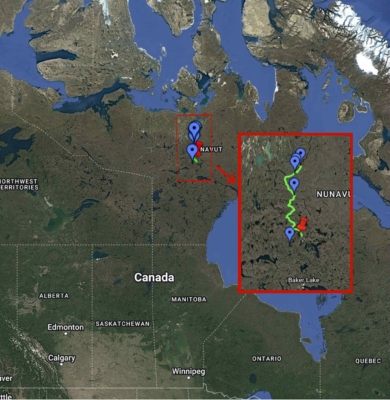
| A map showing the approximate route the group took from Back River south to a place called Amarulik, which means “the place where there are wolves.” |
Her father described the family’s traditional migration while poring over maps and describing what living on the land was like back then.
In August, Uyagaqi Kabloona, her partner, her sister and a couple of friends embarked on the 200-kilometre journey. They followed the same route her family had taken for generations before colonization. It had been nearly 75 years since her father had last completed the trek, when he was five years old.
The route started in Back River, approximately 200 kilometres north of Agnico Eagle Mines Ltd.’s Meadowbank Mine. They proceeded south for 23 days and reached the family’s traditional winter caribou hunting spot called Amarulik, which means “the place where there are wolves.”
It isn’t often that you get to cover a story that is so neatly and sweetly bookended. I was lucky enough to speak to her at the beginning of her journey and at the end.
She described finding numerous inuksuit along the route. At times, she said, it felt like she was being guided by her ancestors.
With help from relatives and the inuksuit, she located the graves of some of her ancestors.
“If you lined them up, you were pointed directly at where the graves were,” she said in October, referring to the inuksuit.
It’s a privilege to be a journalist. Sometimes, we are lucky enough to connect to a story that’s so deeply important to someone.
For Uyagaqi Kabloona, making the journey was a way to experience what life was like for her family in Inuit Nunangat before colonization.
SOURCE: https://nunatsiaq.com/stories/article/some-stories-start-in-the-present-and-pull-you-into-the-past/
Tuesday, December 23, 2025
Forced Adoptions: Denmark/Greenland
Thursday, December 18, 2025 — Amid Greenland’s independence push, Denmark accounts for colonial blunders
NATIVE AMERICA CALLING
The prime minister of Denmark apologized for the forced contraception of thousands of Indigenous women in Greenland dating back to the 1960s. The Danish government is also ending problematic parent competency tests associated with disproportionately high numbers of babies being taken away from Indigenous mothers. Both milestones come as Greenland — an autonomous territory of Danish rule — is making strides toward independence. The Trump administration has also made public comments about exerting U.S. control over the mineral-rich territory occupied almost entirely by Indigenous Inuit residents. We’ll talk with Greenlanders about how these developments address Denmark’s complicated past and what remains to be done.
More about Greenland: https://visitgreenland.com/local-experiences/nuuk-local-museum/
Monday, September 29, 2025
Colonization is Always War: A War for LAND and Territory (repost from 2014)
By Zig-Zag, WarriorPublications.wordpress.com
(Originally pub. 1999 as Colonization is Always War, Revised 2012)

“If anyone is trying to destroy you, STOP HIM!” Karoniaktajeh – Louis Hall, Warrior’s Handbook p. 1
War & Colonization
Just slightly over 500 years ago, in 1492, three European ships under the command of Christopher Columbus arrived on the shores of what has come to be known as the Americas. With this began a genocidal war aimed at destroying Indigenous nations, occupying our ancestral territories, and plundering the natural wealth of the earth. How many tens of millions of Indigenous people were killed in this war will never be known, although the methods of massacres, biological warfare, executions, torture, and the enslavement of entire nations, has been well documented by historians.
Similar invasions were being carried out in Africa and parts of Asia during this same period. This systematic campaign of genocide and colonization was a total war waged against Indigenous nations by European colonialist nations. No one can deny this historical fact.
Colonization can be defined as the practise of invading other lands for the purpose(s) of settlement and/or resource exploitation. When the land is already occupied by another people, the result is usually war. In fact, colonialism occurs in a similar manner to many military conflicts between nations: there is a reconnaissance, an invasion, occupation, and then assimilation (the same methods can be seen in Iraq and Afghanistan).
War can be defined as, “a state of hostilities that exists between or among nations, characterized by the use of military force… a violent clash between two hostile, independent, and irreconcilable wills, each trying to impose itself on the other. “The means to that end is the organized application or threat of violence by military force.” Warfighting, p. 3Here in North America, military violence can be said to have characterized the imposition of colonialism & the establishment of settler-nations up to 1890. That year, 300 Indigenous men, women and children were massacred by US military forces at Wounded Knee, South Dakota. By the late 1880s, the use of gun-boats to destroy villages had ended along the Northwest Coast. In the southwest, Apache guerrillas had also been defeated. At this time, the military domination of Indigenous peoples was virtually complete. This was only slightly over 100 years ago.
![]() |
| Mass grave at Wounded Knee, 1890; the massacre was carried out by the reformed 7th Cavalry |
Is There A War Against Indigenous Peoples Today?
Today, there are some who believe that military force and violence does not characterize our present-day reality here in N. America. But this is not entirely correct: The selective use of military/police violence can be clearly seen in recent examples from the last 30 year period.
Thousands of soldiers and police, using military equipment, weapons and tactics, have been deployed against Indigenous movements and communities.
The most notable examples being:
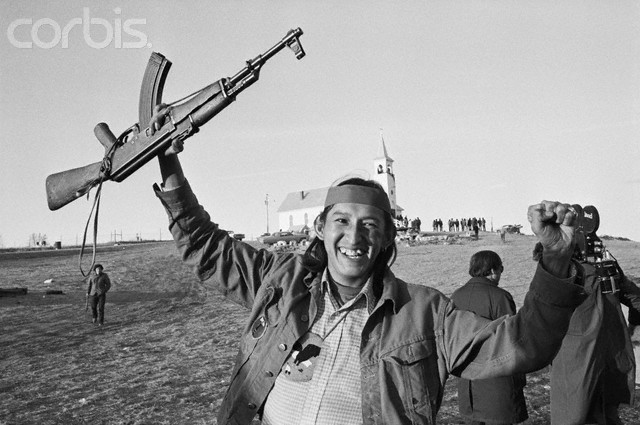
• the 71-day siege at Wounded Knee, S. Dakota, in 1973. Hundreds of police, FBI and paramilitaries, with military assistance including armoured personnel carriers, weapons, ammunition, etc., engaged in fire-fights with warriors in bunkers and trenches. 2 warriors were shot & killed.
• the re-occupation of Ganienkah by Mohawks in New York state in 1974. Hundreds of state police laid siege, and gunfire was exchanged with white vigilantes. NY state eventually retreated & negotiated a parcel of land still occupied today.
• the blockade at Cache Creek, BC, in 1974.
• the re-occupation of Anicinabe Park near Kenora, Ontario, in 1974.
• the 1975 shoot-out at Oglala, S. Dakota (two FBI agents and one warrior killed). Hundreds of FBI agents were deployed to Pine Ridge in a massive search for AIM members.
• Restigouche, 1981: over 500 Quebec police raid the Mi’kmaq community of Restigouche, carrying out assaults & searches for ‘illegal’ fishing.
• the 77-day standoff at Kanehsatake (Oka) and Kahnawake, near Montreal, Quebec, in 1990. Over 4,500 Canadian soldiers were deployed. One SQ police officer was killed in an initial raid by a heavily-armed police tactical unit on Mohawk road-block, July 11.
![]() |
| Kanehsatake/Oka 1990: a 77-day armed standoff between warriors and military. |
• the re-occupation at Ipperwash (Aazhoodeena), Ontario, 1995. A police tactical unit opened fire on unarmed protesters, killing Dudley George and shooting a 15-year old youth in back (1 dog killed).
• Burnt Church 2000-01. Hundreds of heavily armed DFO & RCMP officers (inc. ERT units) in boats, helicopters, & planes were used against Mi’kmaq lobster fishermen & security escorts (inc. Westcoast Warrior Society).
• July, 2001: over sixty RCMP were used to dismantle a road block at the Sutikalh re-occupation camp near Mt. Currie, BC. Along with a helicopter & dog teams, heavily-armed ERT members were used to arrest 7 (unarmed) people. The blockade had shut down all commercial traffic on Highway 99, a vital link between Vancouver & the southern interior.
![]() |
| Wounded Knee, 1973 |
• September 21, 2002: RCMP from the Integrated Security Enforcement Team (INSET)—an anti-terrorist unit created after 9-11— along with ERT, raided homes of Westcoast Warrior Society members on Vancouver Island (BC).
• April 8, 2003: RCMP with ERT & helicopter raided NYM member homes in Bella Coola & Neskonlith (BC). They seized computers, discs, address books, & printed materials.
• October, 2003: a convoy of approx. 100 RCMP in over 30 large vehicles & vans, with ERT units, riot cops, and dog teams, rolled through Cheam as a show of force (Cheam had blockaded a CN railway cutting through their reserve in protest against logging in Elk Creek).
• June 27, 2005: over 30 Vancouver Police & RCMP (including ERT & INSET members) arrest 2 members of the Westcoast Warrior Society in Vancouver. They confiscate 10 rifles that had been legally purchased at Lever Arms. No charges are laid and the weapons kept as part of an ongoing investigation (shortly after, the WWS announces its disbandment).
• Spring, 2006: hundreds of Ontario Provincial Police are deployed against the Six Nations reserve near Caledonia, Ontario, after a housing development & highway are blockaded as part of a land reclamation. On April 20, police attempt to remove people from the reclamation site using batons & pepper spray but are forced back. This begins months of blockades and sabotage.
During these incidents & the time periods in which they occurred, hundreds of people were assaulted, arrested, and jailed. At least six Indigenous people died during these incidents; in S. Dakota, between 1973-1976, nearly 70 members/associates of the American Indian Movement (AIM) were killed by paramilitary groups & BIA police, acting under the direction of a corrupt tribal president, with the complicity of local, state, and US federal law enforcement agencies. FBI agents supplied training and equipment to these paramilitary & tribal police forces.👇
Monday, August 18, 2025
A Used Book from 1896 Yields a Fascinating Find
Some History and a Challenging Question by Steven Newcomb
A Used Book from 1896 Yields a Fascinating Find
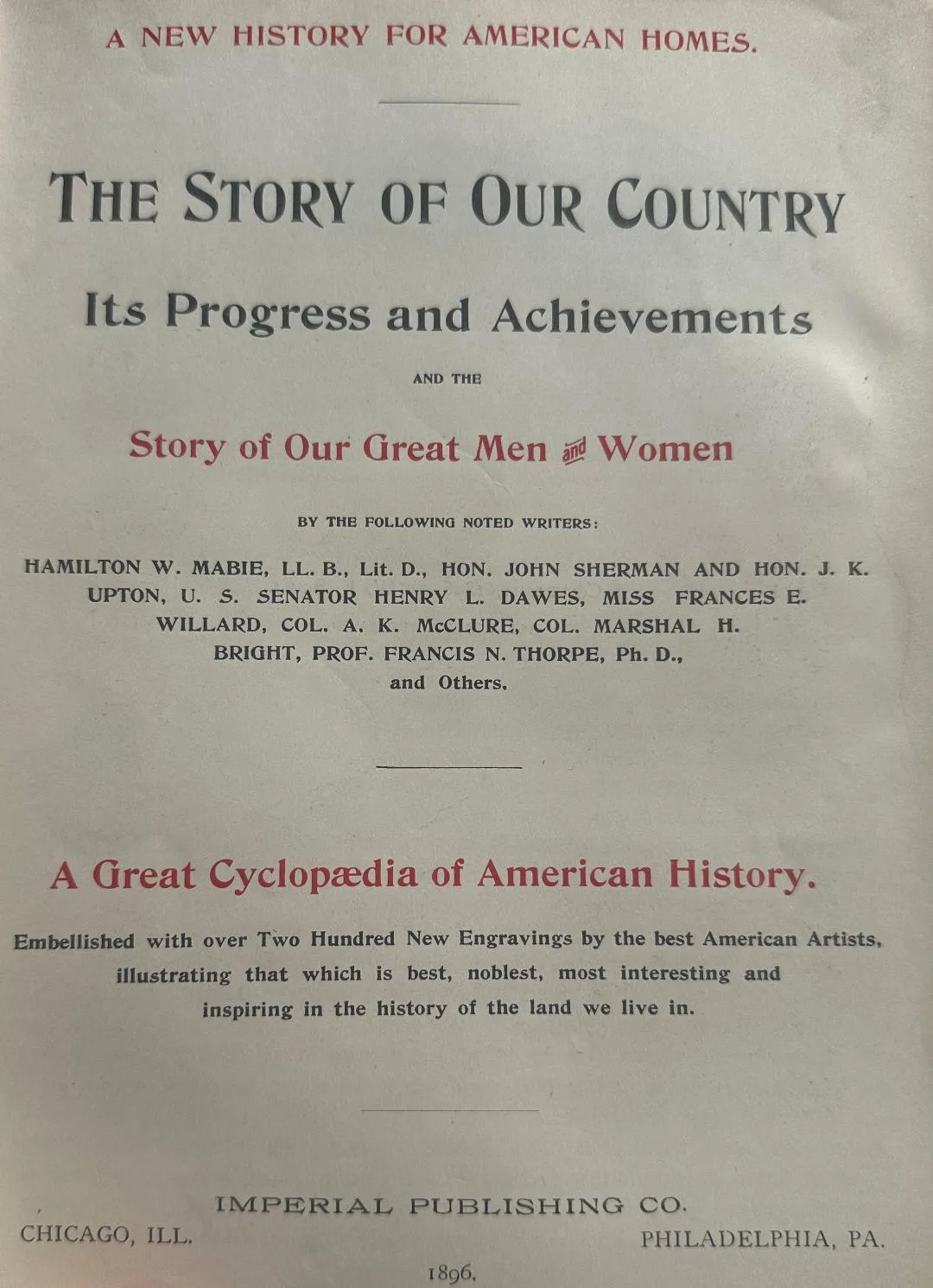
Read on SubstackTwo of the contributors to the book were U.S. Senator Henry L. Dawes from Massachusetts, and his wife Anna L. Dawes. She wrote Chapter XIII of the book, titled “The Story of the Indian.” An excerpt of Ms. Dawes’s chapter (with edits based on my Domination Translator added), reads:
“At the time when our forefathers first landed on these shores, they found the Indian here [living free and independent]. Whether at Plymouth or Jamestown, at the mouth of the Hudson [River] or in Florida, their first welcome was from the red man. . . [T]he white settler coveted the land and pushed the Indian off it that he might dwell there in peace. And it must be said that in the seventeenth century [the 1600s] he [the Christian European] violated no tradition, set himself against no law, human or divine, when he did this [pushed the Indian off the land by establishing domination over it].
“Possession [domination] was still the right of the stronger, the world over, and the conquest [domination] of new countries the chief glory of king and commons alike. To flee away from oppression [domination] was the only refuge, and to the oppressor [dominator] as well as oppressed [dominated] it seemed a natural resort. The country was broad enough for both, thought the white man. If the red man could not live with the new comers on the coast, let him fly to the fresh wilderness of the interior; and so he did, year after year, until one day there was no more wilderness [where the Native peoples could live free].”
Anna Dawes’s explanation acknowledges that the Original Nations and Peoples of the continent had been living perfectly free for countless generations when the Christian Europeans arrived and “coveted the land,” meaning “to desire what belonged to someone else.” She goes on to describe a centuries-long process whereby, for generations, the free Nations and Peoples were forced by foreign and invading colonizers and their descendants to live under the invading People’s claim of a right of domination, which she calls “oppression.”
As question arises: Will it be possible for the Original Nations and Peoples which have been living under the invading claim of a right of domination for so long, to one day free themselves from that claim?
CLICK LINK:
Monday, August 11, 2025
Erase the People and Sell The land
PLEASE CLICK THE LINK AND READ ON SUBSTACK... very important story! ... Trace
Erase the People and Sell the Land by Sean Sherman
Live Streaming Genocide and Famine... Thoughts from 1863 Minnesota to 2025 Gaza
Read on SubstackSunday, October 13, 2024
Indigenous People's Day or Columbus Day


A graphic of a Christopher Columbus statue flipped upside down against a beige and orange background.
Christopher Columbus is not the famed explorer we learned about in school. His travels here sparked the rapid colonization of the Americas as we know them today. He enslaved and mutilated Indigenous peoples as soon as he arrived and was financially incentivized to reap as much value from the lands he visited as possible – economizing the harm (Biography). He wasn’t even the first European to “discover” America; the Vikings had already visited five centuries earlier (Britannica). He didn’t even step foot into the continental United States (Washington Post). Y’all, even the names of the ships are likely false.
But let’s take a step further and dismantle the “discoverer” part of his story altogether: Indigenous people were already living here, so there was nothing to find. The idea that a place needed to be “discovered” by white people for its validation is part of the colonization and oppression that continues to influence our thinking. This thought pattern has been used to validate the domination of Indigenous people around the world to this very day.
Efforts to change Columbus Day into Indigenous Peoples’ Day is a small step towards justice. But know that it is not new, even if it’s new to you. Activists have pushed for an alternative to Columbus Day since the 1970s. Berkeley, California, was the first city in the U.S. to adopt this holiday in the early 90s (Time). Important to note: South Dakota started referring to Columbus Day as “Native American Day” in 1989 (Washington Post).

UW-Chicano Students carry a banner that reads “Columbus didn’t discover America, He Invaded It! UW-Chicano Students”. Photo Source: MADE Magazine.
As of now, only 16 states and the territory of American Samoa still observe the second Monday in October as an official public holiday exclusively called Columbus Day (Pew Research). In 2021, the Biden administration formally recognized Indigenous Peoples’ Day as a holiday. It is not federally recognized, as Congress must pass legislation to make it a federal holiday. However, it is a step forward, thanks to the efforts by Native and Indigenous people campaigning to establish the holiday. You can dive into more about the process and any opposition for various locations in this NYTimes article.
After centuries of erasure and oppression, Indigenous people deserve to be celebrated more than one day a year. This initiative shouldn’t be considered merely a replacement for Columbus Day. But as we advocate for the change, we must remember that Columbus Day itself is incredibly harmful, and disavowing it is a distinct issue. We need to reject the whitewashed and glorified story of Columbus as a famed discoverer and acknowledge the harm he created to native communities through his colonization.
TAKE ACTION
Learn how Diné architect Tamarah Begay is in charge of the “Reimagining Columbus” project, which is developing recommendations for the Christopher Columbus statue removed from their City Hall’s campus in 2020.
Use these resources from Zinn Education Project to encourage schools to contextualize their curriculum.
Donate to a Native land trust near you. If you can’t find one, consider supporting the Sogorea Te’ Land Trust, led by urban Indigenous women.
Sunday, September 29, 2024
Sixties Scoop survivor Honouring Truth at CNC event
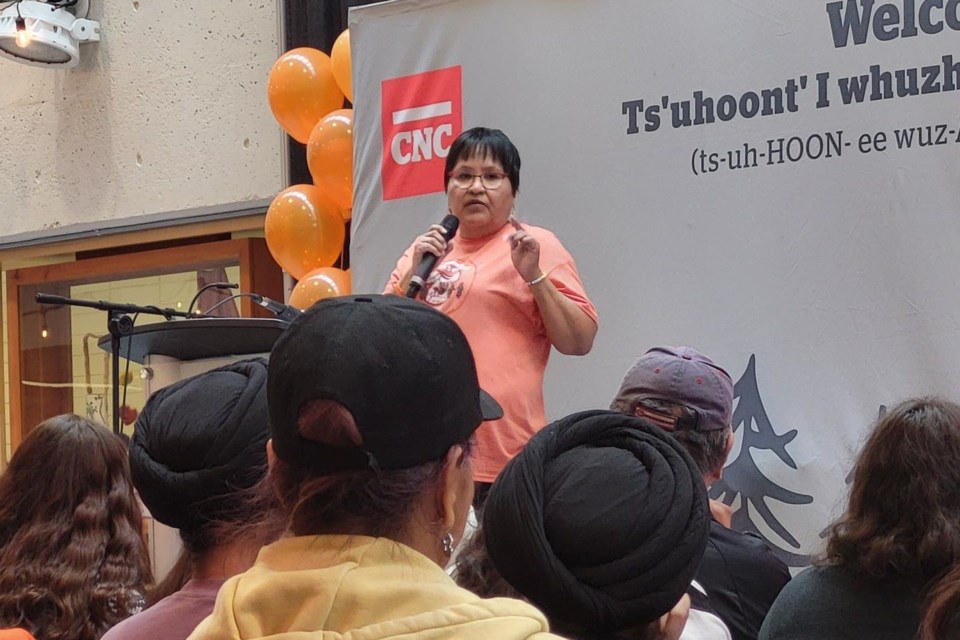
Sixties Scoop survivor, Sherry Hunter, shared her story during the College of New Caledonia’s Calling for Action: Honouring Truth event held Sept. 25.

Sixties Scoop survivor Sherry Hunter shared her story during the College of New Caledonia’s Calling for Action: Honouring Truth event.
“Truth and Reconciliation means to me as a First Nations person that we are finally being recognized and acknowledged for the horrific atrocities that are happening to our First Nations people across Canada,” said Hunter, a CNC social worker diploma program student heading for a social work bachelor’s degree.
She talked about her experiences at the event, held Wednesday, Sept. 25 ahead of the National Day for Truth and Reconciliation Day that will be celebrated at Lheidli T’enneh Memorial Park on Monday, Sept. 30 from 2 to 4 p.m.
“I have learned so much here at CNC,” Hunter said.
During her learning she discovered the nature of colonialism, which is part of her own personal story as a '60s Scoop survivor, and has acknowledged the injustices she has experienced because of it.
Between about 1951 and 1984, an estimated 20,000 or more First Nations, Métis and Inuit infants and children were taken from their families by child welfare authorities and placed for adoption or in foster care in mostly non-Indigenous households. This mass removal of Indigenous children from their homes, supported by a series of government policies, became known as the Sixties Scoop, according to the Indian Residential School History and Dialogue Centre website at UBC.
“Some of the injustices include my loss of my language, my culture and my heritage,” Hunter said. “Most importantly I feel my loss of connection to my family and my homeland.”
Besides the loss of her First Nations roots, she also felt like she did not belong with the new white family, she added.
“I was stuck in the middle trying to find a sense of belonging,” Hunter said. “My story is sad but typical that we all hear too often from First Nations across Canada that should never have happened to me and to many, many others.”
Hunter said her experience had a profound impact on her life that she carries with her to this day.
“I know what it’s like to be abused,” Hunter said. “I was taken as a young child and put into two different foster homes. I arrived in the second foster home when I was three. Little did I know what would happen to me there. I was physically, mentally and sexually assaulted from the time I was seven years old until I was 13. These years are important for all our development and if we are not nurtured in a positive environment our later years are a hot mess.”
Because of what Hunter experienced as a young child she said she fell into drug misuse and alcoholism.
During her healing journey she has learned to overcome these addictions and learned a new way in order to become successful, she added.
“My healing journey has been bittersweet,” Hunter said. “The bitter is I am 61 years old getting an education, trying to make a difference. I should’ve had this life when I was 20. The sweet is I am here. I am healthy. I’m getting a good education and I will make a difference.”
Thursday, July 4, 2024
Almost Dead Indians (excerpt)
What did tribes make of the INVASION?
“Try as he might to comprehend the life on the far side of the ocean that the white man described, the brown man was unable. Such a life was beyond belief. He could not envision one man or a small group of men and women owning all the land, all the animals, all who dwelt upon it, all the produce, man’s labor and his harvest, and men’s lives. But he felt sorry for his friend.” – Basil Johnston, THE MANITOUS (1995), Chapter 11, AUTTISSOOKAUNUK, describing the strangers with light complexions who landed on the brown man’s land and described Europe. Tribes had no concept for what he described, which was colonization and slavery.
(👆this is my favorite quote)
What has been written about the European’s arrival is for the most part sinister. In rock art, scrolls and oral history, tribes recorded, understood and remembered the events of early colonial contact by means of symbolic images: Manitous (or spirits), floating islands, flying and underwater ships, giant birds, thunder and lighting, sounds of music in the air, a strange white whale, dreams, premonitions and warnings. Early tribes viewed Puritan disregard for ritual to mean earthly disaster and punishment. The tribes believed these aliens were Manitous possessing a powerful spirit. (This is according to missionaries who knew the tribes here in the northeast. And of course, this was written from their perspective…) (I use “Indian” in this text, as they did.)
Anishinaabe say: After the French came the Zhaaganaash (“Off-shore ones”) of Great Britain. But out of the Zhaaganaash came the Gichi-ookomaan (“Big-Knives”)—the Virginians (i.e. pre-Americans) via WIKI Wonder if the Anishinaabe have a word for serial killers?
The Indians lack of material wealth and simple lifestyle was viewed as a character flaw; Puritans could not comprehend their apparent lack of interest in wealth. (The “Indian” had no concept of being owned or owning land.)
**
You and me: we are not supposed to know.
President Thomas Jefferson
The Papers of Thomas Jefferson, December 29, 1813
“This unfortunate race, whom we had been taking so much pains to save and to civilize, have by their unexpected desertion and ferocious barbarities justified extermination and now await our decision on their fate.”
Jefferson
owned many slaves, had offspring with slaves, and had a fancy plantation, of
course. (In Virginia)
These are real crimes and real atrocities against Indigenous First Nations People yet no one involved has been charged or put in prison? Their goal?
When details of the Indian Adoption Projects were sealed and files were closed after adoptions, a child would not have his/her name or tribal identity anymore, with their birth certificate altered and falsified. Tribal membership might exist for some adoptees on paper but with secrecy and sealed files, the adult adoptee would never know or be able to find out.
It appears that was the plan.
Happy Visitors!
NEW WEB ADDRESS
WRITTEN BY HUMANS!
Blog Archive
-
▼
2026
(234)
-
▼
October
(29)
- Worth a Sunday morning listen:
- Say Their Names
- First Nation community using its own data center t...
- Braids
- Krystle Silverfox's work, Apprehension, speaks to ...
- ICT News | October 23, 2026
- Compensatory Payments for Historical Wrongs (Canada)
- Red Lake failed its kids
- Book highlighting missing and murdered Indigenous ...
- I’m like the Indigenous Kool-Aid man
- Beyond Narratives of Loss
- 12th Buffalo Treaty Anniversary Gathering 🦬 🦬 ...
- BIA BACKLOG of Missing and Murdered
- The Declaration of Independence lists twenty-seven...
- Joey Clift's Not-so-Sacred Guide to Native America
- CHANGE IS COMING!? Or is it? (update)
- ICT News October 16, 2026
- PBS will celebrate Native American Heritage Month ...
- We are naming the foundation this country was buil...
- ‘Bringing Della Home’: Army Returns Children’s Rem...
- What do you know about Columbus who sailed the oce...
- ICT NEWS - October 9 2026
- Words from the Ancestors
- Mullin’s message was clear: We want to work with y...
- Many will celebrate Indigenous Peoples Day today: ...
- Voices: The story of Noojimo’waning, Detroit’s fir...
- You Were Never Supposed to Know We Were Still Here
- Chefs Against Fascism Everywhere (C.A.F.E.) Octobe...
- ICT NEWS: October 2, 2026
-
▼
October
(29)
Featured Post
Your History Class Was a F*cking Lie | #NOMOAR
Your History Class Was a F*cking Lie by Sean Sherman (Or: How the American Educational System Has Always Been a Racist Propaganda Program...
Most READ Posts
-
Editor NOTE: This is one of our most popular posts so we are reblogging it. If you do know where Michael Schwartz is, please leave a com...
-
By Trace Hentz 2024: I have read new comments on this case. If you have information, please email me: tracelara@pm.me It will be kept conf...
-
Eric Schweig Born: Ray Dean Thrasher on 19 June 1967 Inuvik , Northwest Territories , Canada Occupation Actor/Artisan/...
-
Using DNA tests, Dean Lerat has created a massive family tree for the Treaty 4 territory in Saskatchewan... By day, Dean Lerat is an RCMP st...
-
Greenland says findings on genocide allegation not final Patrick Jackson Inuit Ataqatigiit | Greenlandic Justice Minister Marianne Pavia...
-
My sibling Ronnie Chappelle By Trace L Hentz, Blog Editor I just had a birthday. I wasn't expecting a call from Alabama where my brothe...
-
Check your local listings in the US for NOVA - airs WEDNESDAY, Sept, 23, 2026 Nova: Knowledge Keepers Watch Wednesday, Sept. 23 at 9 p.m. ...
-
A Call to ACTION Sean Sherman A CALL TO ACTION for Chefs, Restaurants ...
-
You Were Never Supposed to Know We Were Still Here by Paax Erasure didn't require Native people to disappear. It only required everyon...
Bookshop
You are not alone
To Veronica Brown
Veronica, we adult adoptees are thinking of you today and every day. We will be here when you need us. Your journey in the adopted life has begun, nothing can revoke that now, the damage cannot be undone. Be courageous, you have what no adoptee before you has had; a strong group of adult adoptees who know your story, who are behind you and will always be so.
Diane Tells His Name
We conclude this series & continue the conversation by naming that adoption is genocide. This naming refers to the process of genocide that breaks kinship ties through adoption & other forms of family separation & policing 🧵#NAAM2022 #AdoptionIsTraumaAND #AdopteeTwitter #FFY 1/6 pic.twitter.com/46v0mWISZ1
— Adoptee Futures CIC (@AdopteeFutures) November 29, 2022
ADOPTION TRUTH
The truth is that it is a very lucrative business with a known sales pitch. With profits last estimated at over $1.44 billion dollars a year, mothers who consider adoption for their babies need to be very aware that all of this promotion clouds the facts and only though independent research can they get an accurate account of what life might be like for both them and their child after signing the adoption paperwork.
.png)


.jpg)