BOOZHOO! We've amassed tons of information and important history on this blog since 2010. If you have a keyword, use the search box below. Also check out the reference section above. If you have a question or need help searching, use the contact form at the bottom of the blog.
We want you to use BOOKSHOP to buy books! (the editor will earn a small amount of money or commission. (we thank you) (that is our disclaimer statement)
This is a blog. It is not a peer-reviewed journal, not a sponsored publication... WE DO NOT HAVE ADS or earn MONEY from this website. The ideas, news and thoughts posted are sourced… or written by the editor or contributors.
EMAIL ME: tracelara@pm.me (outlook email is gone)
THANK YOU CHI MEGWETCH!
The Canadian flag on the Peace Tower on
Parliament Hill in Ottawa on Wednesday, June 2, 2021. THE CANADIAN
PRESS/Sean Kilpatrick
By The Canadian Press| Jul 10, 2026
An Innu community in the Côte-Nord region of Quebec has signed a
deal with the federal and provincial governments to officially
recognize its jurisdiction over child and family services.
The agreement signed today allows for the implementation of a new law
establishing a governance framework designed by and for the Uashat mak
Mani utenam community.
The law will go into effect in September, replacing the provincial Youth Protection Act in the community’s jurisdiction.
The federal government said in a news release that the law will
ensure that decisions about children’s welfare are made by the community
in accordance with their customs, language and values.
Today’s signing marks the first Indigenous community in Quebec to
enter into a three-party agreement under the federal framework of the
Act respecting First Nations, Inuit and Métis children, youth and
families.
Ottawa has also committed to investing funds through 2030 to support
the Innu community’s assumption of responsibility for child and family
services.
This report by The Canadian Press was first published July 10, 2026.
Viviane
Echaquan-Niquay was 12 years old when her sister Lauréanna died of
pneumonia at the Saint-Eusèbe Hospital in Joliette, Que., in 1973.
At least, that’s what she says her family was told by the health care officials in charge at the time.
“My
mother told me when she arrived in Joliette, she went to the funeral
home,” Echaquan-Niquay recalls, adding that, to facilitate her parents’
journey, she was tasked with caring for her younger siblings at their
home in Manawan, an Atikamekw First Nations community in Quebec’s
Lanaudière region.
She continues, “She says
she saw a baby in a styrofoam box. She said, ‘That baby is too big. They
look like they’re 10 or 11 months old. Are you sure that’s my baby?’”
Lauréanna was two-and-a-half months old.
Echaquan-Niquay
says the funeral director waved her mother’s concerns away, closed the
box and explained that Lauréanna would be buried in a nearby cornfield.
“My
mother and my father said, ‘Can we put a cross?’ They told them, ‘no,’”
Echaquan-Niquay tells CTV News. “‘A plaque, at least?’ ‘No, not if the
child isn’t baptized.’”
She insists her sister was baptized the August prior.
“When
my parents said they were going to get my sister, if it really was her,
they said, ‘we’ll bring her to the cemetery here in Manawan, and we’ll
put a cross for her,’” said Echaquan-Niquay.
Lauréanna’s body was never released to her family.
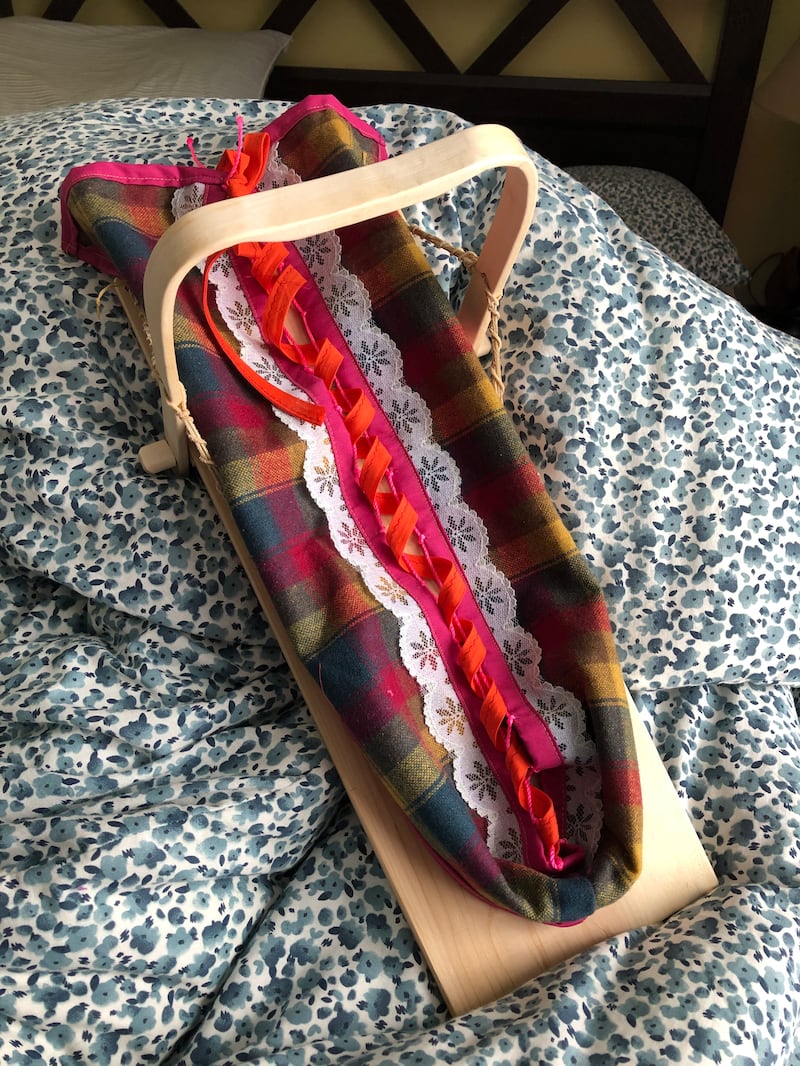
An empty tikinagan, a baby carrier. (Echaquan family)
Ghost babies
Lauréanna Echaquan was born on July 20, 1973.
To this day, Echaquan-Niquay says she still has “flashes” of her sister’s short existence.
“I
remember my sister was in a tikinagan, [baby carrier] and my mother was
doing the laundry,” she said, looking off into the distance. “We didn’t
have a laundry machine, so she was doing it by hand.”
Echaquan-Niquay repines she’s always felt disturbed about what happened to her family.
She
says she understands now that historically, Lauréanna is just one of
Quebec’s many “ghost babies,” Indigenous children who went missing or
died after being admitted to hospital to receive medical care, mostly
between the 1940s and 1980s.
In many cases,
parents were later informed that their child had died, but were never
given death certificates, access to their bodies or told the exact
location of where they would be buried.
Rumours have pervaded that some babies may have been swapped and later offered up for adoption or sent to residential schools.
The
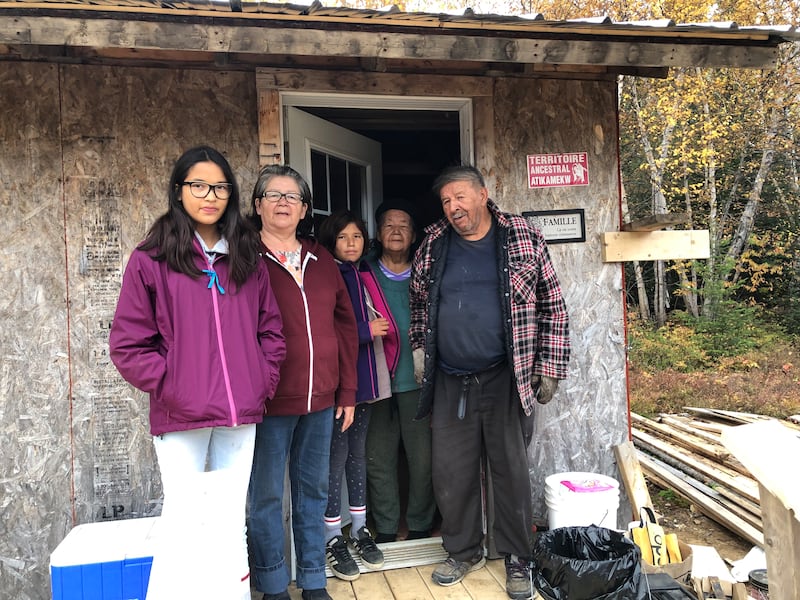
Echaquan family in 2019, including Vivian Echaquan-Niquay and her
parents, Armand Echaquan and Madeleine Dubé. (Echaquan family)
Uncovering the truth
The
Echaquans are one of 130 families taking part in investigations to find
more than 220 children following the passing of Bill 79, An Act to
authorize the communication of personal information to the families of
Indigenous children who went missing or died after being admitted to an
institution.
The bill was introduced in
the National Assembly in 2021 by Ian Lafrenière, Quebec Minister of
Domestic Security and First Nations Relations.
“This
is a dark side of our Quebec history,” he tells CTV News. “We’re
talking about families who have been looking for their children for
years, some as much as 40, 50 years.”
The
government is working with Awacak, an Indigenous organization dedicated
to finding missing Indigenous children across the province.
Part of the search, Lafrenière explains, involves unlocking decades-old documentation.
As
such, the Echaquan family says they have been able to access
Lauréanna’s birth and death certificates, as well as some medical
records.
However, Echaquan-Niquay says she questions whether the records are a truthful recollection of what happened to her baby sister.
She explains that the registry in Manawan lists Lauréanna’s death as Oct. 27, but the provincial civil registry states Oct. 28.
Additionally, the autopsy report from the hospital has Lauréanna’s death on Oct. 30.
Some
families, like the Echaquans, Lafrenière adds, have told him that they
were unsure whether the bodies they were shown were of their children at
all.
“In some cases, kids were sent to
adoption without notifying the families, so you can imagine how hard it
is,” he said. “They have been living without knowing what exactly
happened.”
Since Bill 79’s passage, four exhumations have taken place in Quebec.
Lauréanna’s would be the fifth.
Awacak is an Indigenous organization dedicated to finding missing children. (Echaquan family)
Searching for Lauréanna
On May 1, Quebec’s Superior Court authorized the exhumation of Lauréanna’s presumed resting place.
Four sites were identified, including a soccer field near the Joliette cemetery, where a cornfield once stood.
“I felt light,” said Echaquan-Niquay of the court decision. “But I also felt pain because my parents weren’t there.”
Her
parents, Armand Echaquan and Madeleine Dubé, both died within weeks of
each other in the spring of 2021, never knowing what truly happened to
their baby girl.
“I have hope that we will
find my sister,” she said, adding that her wish is to bring her home to
Manawan and offer her a proper burial.
If the
exhumation process doesn’t lead to little Lauréanna’s body, buried in
her styrofoam box, Echaquan-Niquay insists that she will continue
looking - even if it takes forever.
The exhumation is set to begin on June 8 and last three weeks.
As First Nations in Quebec plan possible searches of former residential school sites, documents that could help that process have still not been turned over by the Quebec government and the Missionary Oblates of Mary Immaculate.
"Recent events have definitely given some urgency to the
situation," he said, adding the oblates seem willing to work on
releasing more records and that a meeting has already been set up.
The central repository of oblate records on Quebec's
residential schools is the Archives Deschâtelets in Richelieu, about 35
kilometres east of Montreal.
Students and staff of the Fort George Roman Catholic Indian Residential School, Fort George Que., Aug. 8, 1948. (National Centre for Truth and Reconciliation / Deschatelets-NDC Archives )
Across the country, more than 150,000 First Nations, Métis and Inuit children were forced to attend the government-run school system between the 1870s and 1997.
The final report by the Truth and Reconciliation Commission in 2015 identified 3,200 children who died as a result of residential schools, including 38 in Quebec. But Indigenous leaders and other experts believe the true figure could be far higher.
In her testimony before the TRC, Marthe Basile-Coocoo recalled the grey day when, as a six-year-old, she first saw the school at Pointe-Bleue.
"The
nuns separated us, my brothers, and then my uncles, then I no longer
understood," she said. "That was a period of suffering, nights of
crying. We all gathered in a corner … and there we cried."
The Roman Catholic school in Fort George was the first residential school in Quebec. It opened in 1931. (Truth and Reconciliation Commission/Deschâtelets Archives)
The Grand Council of the Crees (Eeyou Istchee) and the Cree Nation Government (GCC(EI)/CNG)
are pleased with the initiative of the Québec government, and
particularly the Minister of Justice, to have legal effects of customary
adoptions clearly reflected in the Civil Code of Quebecthrough Bill 113 ("AnAct to amend the Civil Code and other legislative provisions as regards adoption and the disclosure of information") (Bill 113), tabled in the National Assembly on October 6, 2016.
The
Cree Nation welcomes the presentation of this legislation in the
National Assembly. This Bill follows the tabling of similar legislation
in 2012 and in 2013, both of which "died on the order paper" with the
calling of the provincial elections.
For
the Cree of Eeyou Istchee, customary adoption has been practiced for
generations and continues to be practiced today. It remains an integral
part of Cree culture and identity.
As stated by Dr. Matthew Coon Come,
Grand Chief of the GCC(EI) and Chairman of the CNG, the Cree have
sought changes to provincial legislation regarding customary adoption
since the early 1980s and for almost as long, Québec has committed to
doing so in the Civil Code of Québec.
"Now, with this Bill, the Québec government is taking an important step to fulfill that commitment," said Dr. Coon Come.
"The creation of the Working Group on Customary Adoption in Aboriginal communities (Working Group),
made up of representatives from Québec, the Inuit and First Nations
organizations, including those of the Cree Nation, helped to facilitate
important discussions regarding customary adoption. It was also an
opportunity to collaboratively consider how its effects could be
reflected in the Civil Code of Québec," he said.
The
Cree Nation wishes to underline its support for the collaborative
approach among the Indigenous stakeholders, the Québec Ministry of
Justice and the Ministry of Health and Social Services in the
development of Bill 113.
"We
see Bill 113 as a positive first step in creating a bridge between
Indigenous customary adoptions and the provincial adoption regime in
order to clarify the legal effects of these adoptions, which have always
been recognized in our communities and by our community members,"
stated the Grand Chief.
"Bill
113 begins to harmonize provincial adoption legislation with Cree
Aboriginal and treaty rights in relation to adoption matters and
reflects the right of Indigenous Nations and communities to govern
affairs regarding their children", continued the Grand Chief.
Ultimately,
this legislation will benefit the children and families involved in
customary adoptions by helping to facilitate the exercise of parental
authorities and responsibilities.
In
the words of the Grand Chief, "it is a continuation of the on-going
development of the Nation-to-Nation relationship between the Cree Nation
of Eeyou Istchee and Québec. This Bill represents another positive and
important step forward in the relationship between Quebec and Indigenous peoples, including the Cree Nation."
About the Grand Council of the Crees (Eeyou Istchee):The Grand Council of the Crees (Eeyou Istchee) is the political body that represents the approximately 18,000 Crees of Quebec
or "Eeyouch" ("Eenouch" – inland dialect). The Council is constituted
of twenty (20) members including: a Grand Chief and Deputy-Grand Chief
elected at large by the Eeyouch, the chiefs elected by each of the nine
(9) recognized Cree communities, and one (1) other representative
elected by each community.
About the Cree Nation Government:The Cree Nation Government (CNG), previously the Cree Regional Authority, was set up by virtue of the signing of the James Bay and Northern Quebec Agreement
as the administrative arm of the Cree Nation. It has responsibilities
in respect to environmental protection, the hunting, fishing and
trapping regime, economic and community development, Cree governance and
other matters as decided by the Board of Directors. The Board of
Directors of the CNG is the same joint governing body that manages the
GCC(EI) and is referred to as "Council/Board".
SOURCE Grand Council of the Crees (Eeyou Istchee)
For further information: Ms. Melissa Saganash, Director of Quebec Relations, Tel.: (418) 691-1111
RELATED LINKS www.gcc.ca
By Terrence Duff, Lynne Robson, CBC News Oct 08, 2014
It took 53 years for Abel Bosum, right, to find his birth father, Cyprien Caron (left). (Abel Bosum)
Abel Bosum grew up with a Dad-sized hole in his life. He remembers being a boy who envied his friends when they talked about their dads — going hunting or fishing with their fathers, even doing ordinary things. Abel pretended to not care. But in truth, he cared a lot. The story of Abel Bosum starts with a clash of cultures and language. In the 1950s, a young Cree woman named Lucy Busom lived in a settlement near Chibougamau, Que. She met and fell in love with a French-Canadian who hailed from Quebec City, more than 500 kilometres away. They wanted to marry, but her parents refused. Instead, following tradition, the elders arranged a marriage between Lucy and Sam Neepoosh. No one talked much about Abel's biological father, so he grew
up full of questions and feelings, but not even certain of the name of
the man he missed. And that's how it remained — for 53 years. It's not that Abel didn't have a father. He did; Sam adopted
and raised Lucy's son, and Abel will always be grateful for that. Still,
even a kind, adoptive parent couldn't fill the void where Abel pictured
a "real dad."
'I did not know how to react, I did not know what I would say, and I certainly did not know what I would do when I met him.'- Abel Bosum
Then on a lovely summer day in 2008, the spectre of his father reappeared and shook Abel's life to the core. By this time, Abel was was married with children and grandchildren. A family friend reported seeing Abel's missing father in a
shopping mall. That led to an intense search for a man whose name no one
remembered. Abel spoke to all the elders and, bit by bit, pieced together enough information for a computer search. His dad's name: CypienCaron. Try to imagine Abel at this point: He was 53 years old, a successful Cree negotiator
who has his own consulting firm. He was sitting in his car in front of a
suburban home, "stalking" a man he thought might be his father. "These were very unsettling moments," said Abel. "[It] made me feel like a young boy again. I was experiencing
strange feelings that I had never had before, and I was in turmoil. I
did not know how to react, I did not know what I would say, and I
certainly did not know what I would do when I met him. " On Aug. 19, 2008, father and son finally met in Saint-Joseph-du-Lac, Que. After years of wondering what that moment would be like, Abel
describes it like this: "He reached out to me, hugged me and whispered,
'My son, I am so happy. I love you!'" It is the fantasy of many adopted children. For Abel it was a reality — CypienCaron was happy to connect with the child he was never allowed to father.
For the next six years, father and son spent a lot of time doing the
things dads and boys might do — hunting and fishing. Abel's family was
suddenly included in much larger family reunions. Six years is a long time in some ways. It was far too short a time for Abel when he learned Caron was mortally ill. He was, however, able to spend the last days of his dad's life at his bedside, with enough time to both of them to say everything that was in their hearts. When his dad died, Abel wrote, “Cyprien, it broke
my heart to lose you but you did not go alone, a part of me went with
you the day God took you home. In life I love you dad, and in death I
love you still, in my heart you will hold a place no one could ever
fill!” Abel Bosum is currently writing a book about Cyprien Caron
and the way their lives connected. It will be published in the near
future.
Sept. 25, 2026 | Relatives walk to remember, church denounces Native beliefs & more
Bookshop
You are not alone
To Veronica Brown
Veronica, we adult adoptees are thinking of you today and every day. We will be here when you need us. Your journey in the adopted life has begun, nothing can revoke that now, the damage cannot be undone. Be courageous, you have what no adoptee before you has had; a strong group of adult adoptees who know your story, who are behind you and will always be so.
Diane Tells His Name
click photo
Lost Birds on Al Jazeera Fault Lines
click to read and listen about Trace, Diane, Julie and Suzie
NO MORE STOLEN SISTERS
click image
We conclude this series & continue the conversation by naming that adoption is genocide. This naming refers to the process of genocide that breaks kinship ties through adoption & other forms of family separation & policing 🧵#NAAM2022#AdoptionIsTraumaAND#AdopteeTwitter#FFY 1/6 pic.twitter.com/46v0mWISZ1
As the single largest unregulated industry in the United States, adoption is viewed as a benevolent action that results in the formation of “forever families.” The truth is that it is a very lucrative business with a known sales pitch. With profits last estimated at over $1.44 billion dollars a year, mothers who consider adoption for their babies need to be very aware that all of this promotion clouds the facts and only though independent research can they get an accurate account of what life might be like for both them and their child after signing the adoption paperwork.











 Posts

