BOOZHOO! We've amassed tons of information and important history on this blog since 2010. If you have a keyword, use the search box below. Also check out the reference section above. If you have a question or need help searching, use the contact form at the bottom of the blog.
We want you to use BOOKSHOP to buy books! (the editor will earn a small amount of money or commission. (we thank you) (that is our disclaimer statement)
This is a blog. It is not a peer-reviewed journal, not a sponsored publication... WE DO NOT HAVE ADS or earn MONEY from this website. The ideas, news and thoughts posted are sourced… or written by the editor or contributors.
EMAIL ME: tracelara@pm.me (outlook email is gone)
THANK YOU CHI MEGWETCH!
Danny Wilber, 44, an Afro-Indigenous man enrolled at the Oneida Nation of Wisconsin, fought for post-conviction relief after spending nearly 18 years in Wisconsin prison for first-degree intentional homicide, a crime he was able to prove he didn’t commit. A federal judge granted his petition for habeas corpus, and he was released from prison on Dec. 22, 2021, pending the state’s appeal, with his case being dismissed on May 27, 2022. His claim for wrongful conviction was denied by the Wisconsin Claims Board in July 2024, but his federal civil rights claim was settled by the Milwaukee Common Council on May 13, 2025 for $7 million, the second largest in Milwaukee’s history. Photo of Danny Wilber at the Wisconsin State Capitol on December 4, 2022 courtesy of Lacey Kinnart.
By Darren Thompson
MILWAUKEE—On May 13, the Milwaukee Common Council approved a $6.96 million settlement for the wrongful conviction of an Afro-Indigenous man who spent 18 years in prison.
Danny Wilber, an Oneida Nation of Wisconsin citizen, was convicted for first-degree intentional murder in Milwaukee County for an incident that occurred in Jan. 2004. The wrongful conviction settlement is the second largest in Milwaukee’s history, and is the result of a federal lawsuit against the City of Milwaukee and nine former Milwaukee police officers alleged to have violated Wilber’s constitutional rights.
“The Milwaukee Police Department knew Danny Wilber was innocent—and they framed him anyway," said Lacey Kinnart, Wilber’s partner for more than a decade, in an interview with the LRI Native News Desk. “The Wisconsin Attorney General’s Office had physical evidence proving his innocence and still spent years fighting to keep him in a cage. This wasn’t a failure of justice—it was a full-scale, intentional cover-up.”
It not only upholds Oneida’s vision of protecting families and
preserving our core values and traditional beliefs – it has promoted the
best interest of Oneida children for more than 40 years.
Pallbearers
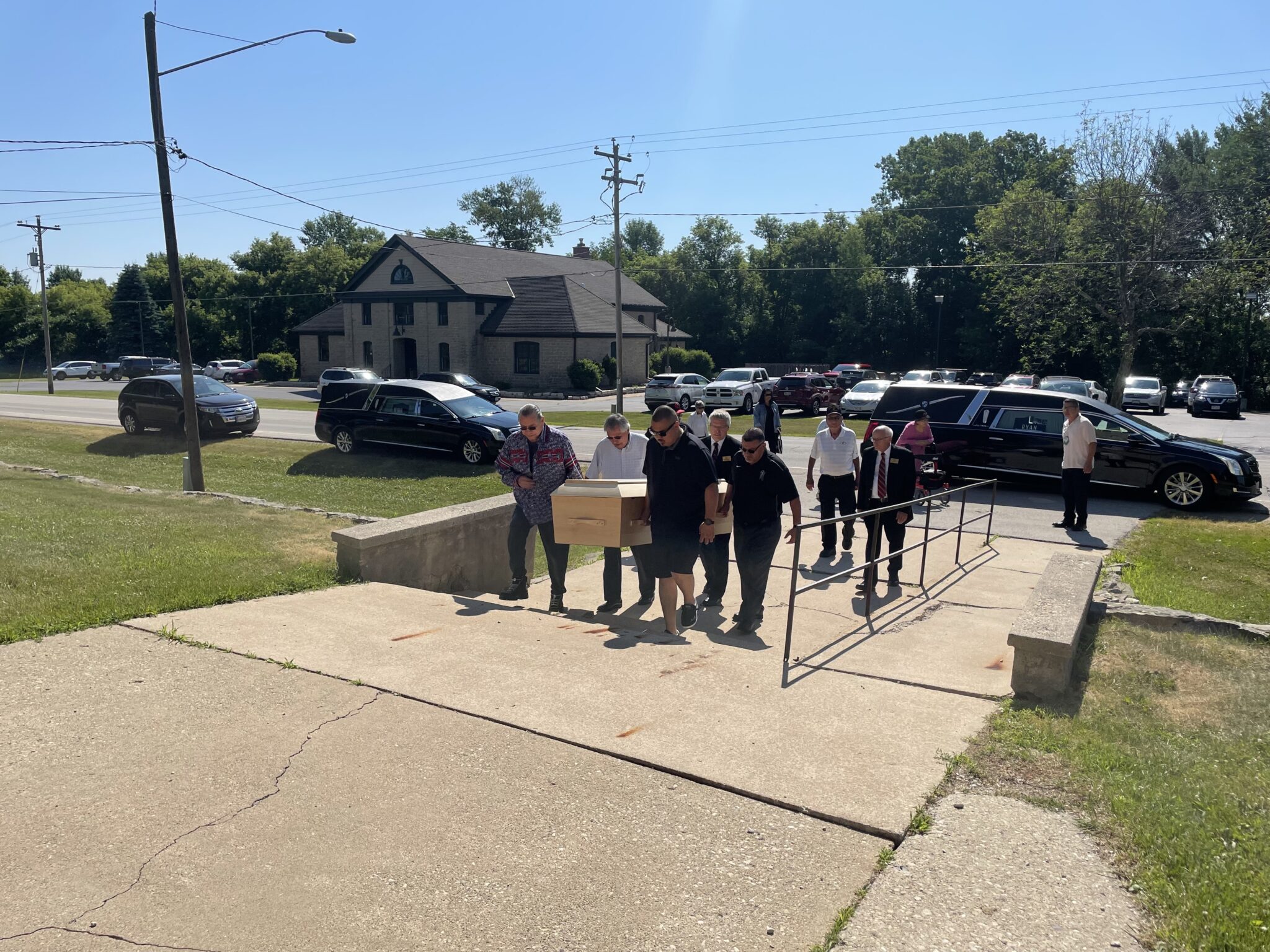
carry the casket of one of the children returned from the cemetery at
the Carlisle Indian School in Pennsylvania up the stairs to the Church
of the Holy Apostles in Hobart, Wisconsin. Photo by Andrew Kennard
By Andrew Kennard |
“I feel like
traveling home,” the Oneida singers sang, their voices filling the
Church of the Holy Apostles in Hobart, Wisconsin. “My heavenly home is
right ahead, I feel like traveling home.”
After a memorial service on June 27, the families of Paul
Wheelock and Frank Green buried the remains of the two Oneida children
in the church’s cemetery. Over 120 years ago, Wheelock and Green were
buried at Carlisle Indian School in Pennsylvania.
“Well, he always wanted to come home,” said Mary Jane Doxtator, Green’s niece. “He ran away [from the boarding school] about four or five times, maybe more.”
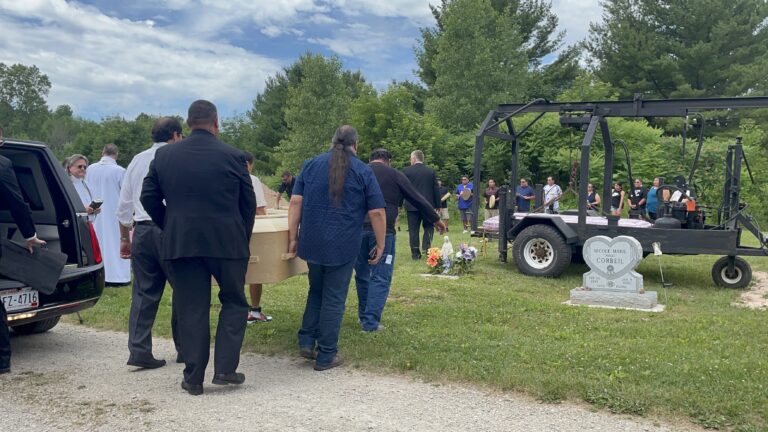
Pallbearers
approach the grave sites of Frank Green and Paul Wheelock. Drummers and
singers watch from close to the treeline. | Photo by Andrew Kennard
After
a memorial service, the congregation gathered by two open graves.
Drumming and singing rang out from a group of mourners standing deeper
in the cemetery. After the caskets were lowered into the ground,
mourners came forward with offerings of tobacco or earth for the
graves.
“…I just wondered why I wasn’t told about him,” Doxtator said.
An Interior department report released
in May estimates that the “approximate number of Indian children who
died at Federal Indian boarding schools to be in the thousands or tens
of thousands,” and that many were buried in unmarked or poorly
maintained graves far away from their communities and families. A bill introduced in Congress later that month aims to create a Truth and Healing Commission that would investigate the impacts and ongoing effects of the boarding school system.
“And when I think about these children, we all know the
stories of the boarding schools,” Oneida councilman Kirby Metoxen said
to the mourners assembled in Hobart, speaking on behalf of one of the
families. “And I just can’t imagine being taken so far away from home
and getting sick and knowing that you’re getting ready to go to that
other side alone.”
‘I see our last names’
Frank
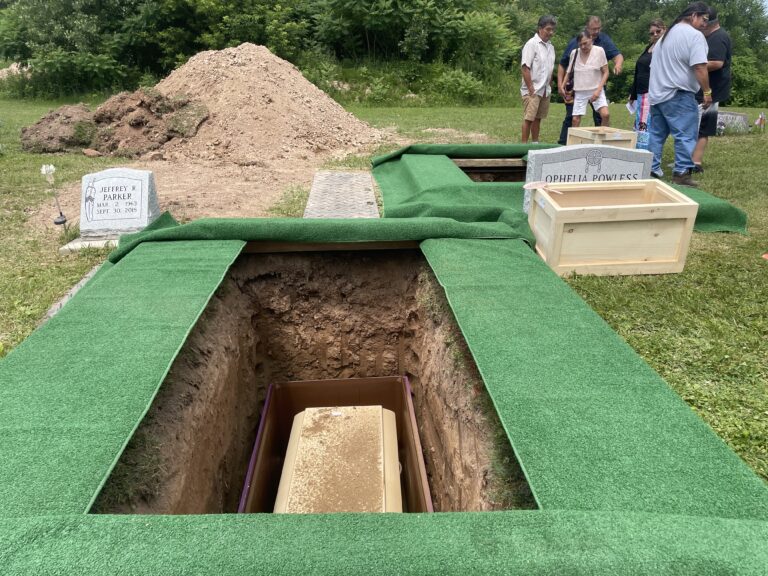
Green and Paul Wheelock were laid to rest in the church’s cemetery,
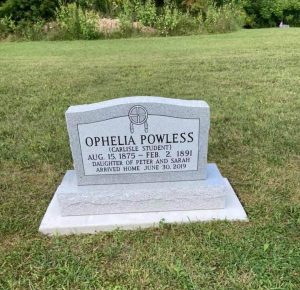
near the graves of Ophelia Powless, David Doxtater and Jeffrey Parker.Wheelock and Green were buried next to Ophelia Powless, whose remains were reclaimed from Carlisle in 2019 along with the remains of two other teenage Oneida students.
“We still have two up there,” Metoxen said. “Jemima John and Melissa Metoxen are still out there, and those families still have to decide what they want to do with the remains of those children.”
In a statement on Thursday, the Office of Army Cemeteries
said that it has finalized its fifth disinterment project in returning
seven Native American or Alaska Native children to their families, and
that many have already been buried on their native lands. When an eighth
grave was disinterred, the Army found remains that did not match the
child that records said had been buried there.
“The combined Army team was privileged to support families
and return seven more children this summer, totaling 28 over the past
six years,” Renea Yates, director of the Office of Army Cemeteries, said
in the statement. “We are committed to caring for the graves of
children who remain buried at the Carlisle Barracks Post Cemetery and
will continue to support the disinterment of those requested to be
returned.”
Over ten thousand children from about 50 tribes across the
nation attended Carlisle, according to the Army; about 190 children
were buried at the school, according to Dickinson College, which houses
the Carlisle Indian School Digital Research Center.
Metoxen said that when he visited Carlisle, he was expecting to see the graves of children from tribes other than his own.
“And as I’m walking through that cemetery, I see our last
names,” Metoxen said. “Coulon. Powless. Green. Wheelock. John. And about
the fourth or fifth headstone I came upon was a Melissa Metoxen. And I
have a niece, Melissa Metoxen. It stopped me in my tracks. My thought
immediately was, how come nobody came to get these kids?”
What happened to Frank Green and Paul Wheelock?
Paul Wheelock was ten months old when he died of a “severe cold,” according to a
Carlisle school newspaper. During a brief sermon at the memorial
service, the Rev. Rodger Patience said that Paul was the son of Dennison
Wheelock, a band leader at Carlisle. Dennison, a former Carlisle
student, had graduated from the school about ten years before his infant
son’s death in 1900, the Carlisle Digital Research Center found.
Frank Green was a teenager when he died on June 25, 1898.
He was killed by a train while running away from the school a week
before he was set to go home, according to documents from the time gathered by the Carlisle Digital Research Center.
“The letters back from the hired hands at Carlisle only
describe him as a juvenile delinquent,” Patience told the mourners.
“They don’t describe him as a child who was traumatized. They don’t
describe him as a child who was taken from his home by force and made to
submit to an institution that he didn’t want to be part of.”
‘Welcoming that spirit back to this place called home’
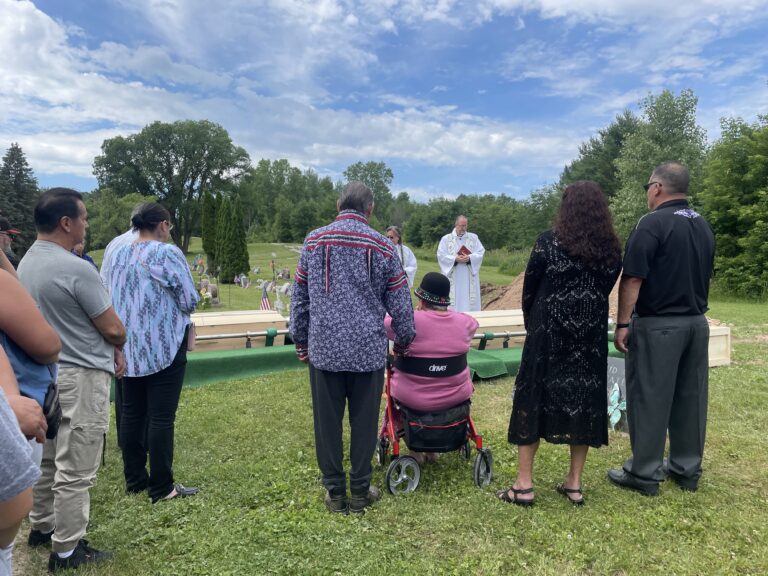
Mourners watched the caskets sink into the ground. | Photo by Andrew KennardThe
Oneida Nation said in 2019 that 109 community members had been
identified as descendants of tribal members who passed away while
attending Carlisle over 100 years ago. During the memorial service,
Metoxen said that his grandparents could speak the Oneida language, but
his parents could not.
“So I heard my grandparents speaking the language, but
none of my parents,” Metoxen told the mourners. “In that generation, I
didn’t hear the language too much. Because of the boarding school era.”
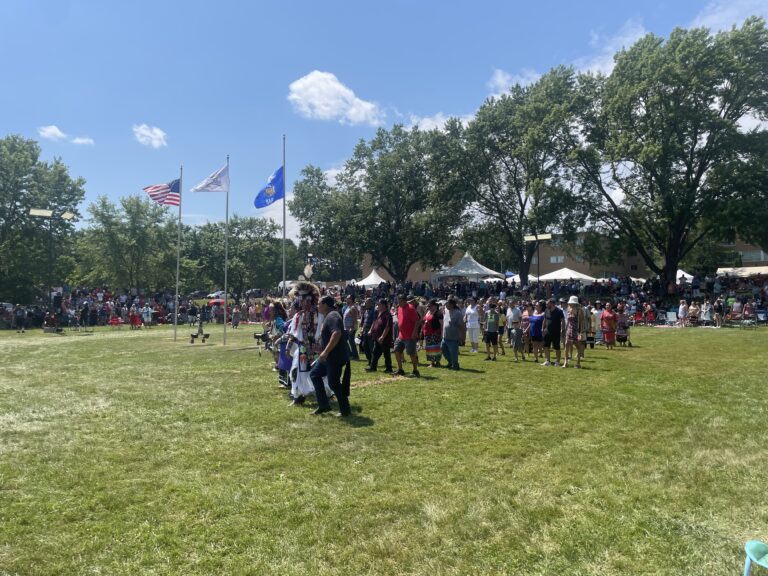
The
Oneida Nation Pow Wow landed on the same weekend as the memorial
service, and the community recognized the two children with an honor
song. | Photo by Andrew Kennard“One day, [a relative] was
in the dining room and everyone was visiting,” Doxtator said. “And he
started speaking Oneida and they made him stand on a chair all during
the meal.”
Later, “when they started the Oneida language program to teach Oneida to the Oneidas, he was one of the teachers,” she added.
The day before the memorial service, community members
marched around the Oneida Nation’s powwow grounds for an honor song that
recognized Green and Wheelock.
“But today is really a day of celebration,” the powwow’s
announcer said before the dance began. “And when we start out this song,
this is a song of welcoming that spirit back to this place called home.
Our elders always had a story that wherever we travel, we’ll always
come home.”
Growing up in Milwaukee, Wisconsin,
Kirby Metoxen knew that many of his family members had been removed from
their families in the Oneida Nation and sent to boarding schools. These
schools were founded and run by both the United States Government and
Christian churches. The purpose was forced assimilation: to strip Native
American children of their language, dress, food and rituals. It is
estimated that by 1926, around 83% of Native children were attending
these schools.
Pupils at the Carlisle Indian Industrial School in Pennsylvania, circa 1900.
As an adult Kirby was on a road trip
with friends to Pennsylvania from Wisconsin. While driving, he was
recounting the personal history of his family’s experience at one of
these schools in particular, the Carlisle School in Pennsylvania. On a
whim, they decided to take a detour and visit the school.
She is home now.
The Grave of Ophelia Powless at the Holy Apostles Cemetery in Oneida, WI. Courtesy of Rodger Patience.
Unbeknownst to Kirby, there were
Oneida children buried in a cemetery on the school grounds, now a
military base. This revelation led him on an unexpected journey to
return those children to the Oneida Nation once and for all.
Top Photo: Rodger Patience and Kirby Metoxen at their StoryCorps interview in Green Bay, Wisconsin on January 27, 2022.By Carl Romey for StoryCorps.
Sept. 25, 2026 | Relatives walk to remember, church denounces Native beliefs & more
Bookshop
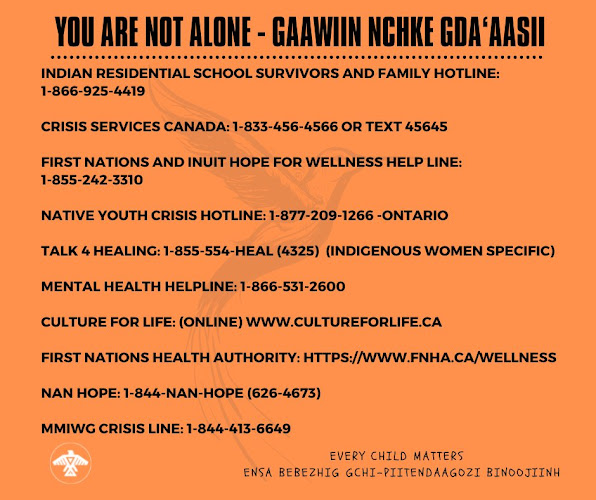
You are not alone
To Veronica Brown
Veronica, we adult adoptees are thinking of you today and every day. We will be here when you need us. Your journey in the adopted life has begun, nothing can revoke that now, the damage cannot be undone. Be courageous, you have what no adoptee before you has had; a strong group of adult adoptees who know your story, who are behind you and will always be so.
Diane Tells His Name
click photo
Lost Birds on Al Jazeera Fault Lines
click to read and listen about Trace, Diane, Julie and Suzie
NO MORE STOLEN SISTERS
click image
We conclude this series & continue the conversation by naming that adoption is genocide. This naming refers to the process of genocide that breaks kinship ties through adoption & other forms of family separation & policing 🧵#NAAM2022#AdoptionIsTraumaAND#AdopteeTwitter#FFY 1/6 pic.twitter.com/46v0mWISZ1
As the single largest unregulated industry in the United States, adoption is viewed as a benevolent action that results in the formation of “forever families.” The truth is that it is a very lucrative business with a known sales pitch. With profits last estimated at over $1.44 billion dollars a year, mothers who consider adoption for their babies need to be very aware that all of this promotion clouds the facts and only though independent research can they get an accurate account of what life might be like for both them and their child after signing the adoption paperwork.












 Posts

