


By Zig-Zag, WarriorPublications.wordpress.com
(Originally pub. 1999 as Colonization is Always War, Revised 2012)

“If anyone is trying to destroy you, STOP HIM!” Karoniaktajeh – Louis Hall, Warrior’s Handbook p. 1
War & Colonization
Just slightly over 500 years ago, in 1492, three European ships under the command of Christopher Columbus arrived on the shores of what has come to be known as the Americas. With this began a genocidal war aimed at destroying Indigenous nations, occupying our ancestral territories, and plundering the natural wealth of the earth. How many tens of millions of Indigenous people were killed in this war will never be known, although the methods of massacres, biological warfare, executions, torture, and the enslavement of entire nations, has been well documented by historians.
Similar invasions were being carried out in Africa and parts of Asia during this same period. This systematic campaign of genocide and colonization was a total war waged against Indigenous nations by European colonialist nations. No one can deny this historical fact.
Colonization can be defined as the practise of invading other lands for the purpose(s) of settlement and/or resource exploitation. When the land is already occupied by another people, the result is usually war. In fact, colonialism occurs in a similar manner to many military conflicts between nations: there is a reconnaissance, an invasion, occupation, and then assimilation (the same methods can be seen in Iraq and Afghanistan).
War can be defined as, “a state of hostilities that exists between or among nations, characterized by the use of military force… a violent clash between two hostile, independent, and irreconcilable wills, each trying to impose itself on the other. “The means to that end is the organized application or threat of violence by military force.” Warfighting, p. 3Here in North America, military violence can be said to have characterized the imposition of colonialism & the establishment of settler-nations up to 1890. That year, 300 Indigenous men, women and children were massacred by US military forces at Wounded Knee, South Dakota. By the late 1880s, the use of gun-boats to destroy villages had ended along the Northwest Coast. In the southwest, Apache guerrillas had also been defeated. At this time, the military domination of Indigenous peoples was virtually complete. This was only slightly over 100 years ago.
 |
| Mass grave at Wounded Knee, 1890; the massacre was carried out by the reformed 7th Cavalry |
Is There A War Against Indigenous Peoples Today?
Today, there are some who believe that military force and violence does not characterize our present-day reality here in N. America. But this is not entirely correct: The selective use of military/police violence can be clearly seen in recent examples from the last 30 year period.
Thousands of soldiers and police, using military equipment, weapons and tactics, have been deployed against Indigenous movements and communities.
The most notable examples being:
• the 71-day siege at Wounded Knee, S. Dakota, in 1973. Hundreds of police, FBI and paramilitaries, with military assistance including armoured personnel carriers, weapons, ammunition, etc., engaged in fire-fights with warriors in bunkers and trenches. 2 warriors were shot & killed.
• the re-occupation of Ganienkah by Mohawks in New York state in 1974. Hundreds of state police laid siege, and gunfire was exchanged with white vigilantes. NY state eventually retreated & negotiated a parcel of land still occupied today.
• the blockade at Cache Creek, BC, in 1974.
• the re-occupation of Anicinabe Park near Kenora, Ontario, in 1974.
• the 1975 shoot-out at Oglala, S. Dakota (two FBI agents and one warrior killed). Hundreds of FBI agents were deployed to Pine Ridge in a massive search for AIM members.
• Restigouche, 1981: over 500 Quebec police raid the Mi’kmaq community of Restigouche, carrying out assaults & searches for ‘illegal’ fishing.
• the 77-day standoff at Kanehsatake (Oka) and Kahnawake, near Montreal, Quebec, in 1990. Over 4,500 Canadian soldiers were deployed. One SQ police officer was killed in an initial raid by a heavily-armed police tactical unit on Mohawk road-block, July 11.
 |
| Kanehsatake/Oka 1990: a 77-day armed standoff between warriors and military. |
• the re-occupation at Ipperwash (Aazhoodeena), Ontario, 1995. A police tactical unit opened fire on unarmed protesters, killing Dudley George and shooting a 15-year old youth in back (1 dog killed).
• Burnt Church 2000-01. Hundreds of heavily armed DFO & RCMP officers (inc. ERT units) in boats, helicopters, & planes were used against Mi’kmaq lobster fishermen & security escorts (inc. Westcoast Warrior Society).
• July, 2001: over sixty RCMP were used to dismantle a road block at the Sutikalh re-occupation camp near Mt. Currie, BC. Along with a helicopter & dog teams, heavily-armed ERT members were used to arrest 7 (unarmed) people. The blockade had shut down all commercial traffic on Highway 99, a vital link between Vancouver & the southern interior.
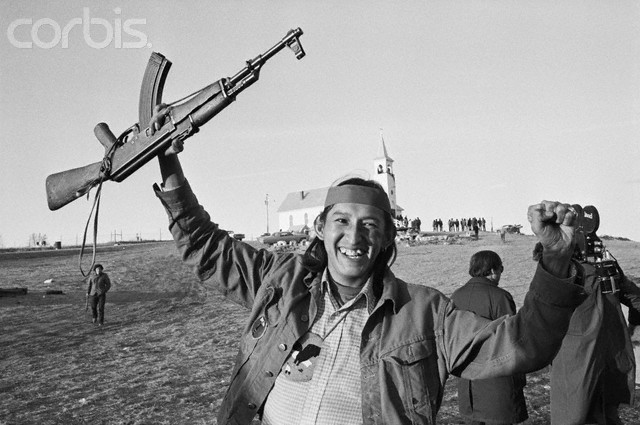 |
| Wounded Knee, 1973 |
• September 21, 2002: RCMP from the Integrated Security Enforcement Team (INSET)—an anti-terrorist unit created after 9-11— along with ERT, raided homes of Westcoast Warrior Society members on Vancouver Island (BC).
• April 8, 2003: RCMP with ERT & helicopter raided NYM member homes in Bella Coola & Neskonlith (BC). They seized computers, discs, address books, & printed materials.
• October, 2003: a convoy of approx. 100 RCMP in over 30 large vehicles & vans, with ERT units, riot cops, and dog teams, rolled through Cheam as a show of force (Cheam had blockaded a CN railway cutting through their reserve in protest against logging in Elk Creek).
• June 27, 2005: over 30 Vancouver Police & RCMP (including ERT & INSET members) arrest 2 members of the Westcoast Warrior Society in Vancouver. They confiscate 10 rifles that had been legally purchased at Lever Arms. No charges are laid and the weapons kept as part of an ongoing investigation (shortly after, the WWS announces its disbandment).
• Spring, 2006: hundreds of Ontario Provincial Police are deployed against the Six Nations reserve near Caledonia, Ontario, after a housing development & highway are blockaded as part of a land reclamation. On April 20, police attempt to remove people from the reclamation site using batons & pepper spray but are forced back. This begins months of blockades and sabotage.
During these incidents & the time periods in which they occurred, hundreds of people were assaulted, arrested, and jailed. At least six Indigenous people died during these incidents; in S. Dakota, between 1973-1976, nearly 70 members/associates of the American Indian Movement (AIM) were killed by paramilitary groups & BIA police, acting under the direction of a corrupt tribal president, with the complicity of local, state, and US federal law enforcement agencies. FBI agents supplied training and equipment to these paramilitary & tribal police forces.👇







 Posts
Posts

