BOOZHOO! We've amassed tons of information and important history on this blog since 2010. If you have a keyword, use the search box below. Also check out the reference section above. If you have a question or need help searching, use the contact form at the bottom of the blog.
We want you to use BOOKSHOP to buy books! (the editor will earn a small amount of money or commission. (we thank you) (that is our disclaimer statement)
This is a blog. It is not a peer-reviewed journal, not a sponsored publication... WE DO NOT HAVE ADS or earn MONEY from this website. The ideas, news and thoughts posted are sourced… or written by the editor or contributors.
EMAIL ME: tracelara@pm.me (outlook email is gone)
THANK YOU CHI MEGWETCH!
Jaelyn
Jarrett and her aunt Leah Ford. Jarrett, a woman originally from Nain,
N.L., has Inuit and Guyanese roots. She's embarking on a journey to
trace the history of Black settlers in the North. (Submitted by Jaelyn Jarrett)
Jaelyn Jarrett remembers moving from Nain, N.L., to Ontario as an eight-year-old when she started being called a ‘Puatugi’.
“I
didn't really understand what that term meant at the time, but I knew
people would reference my hair, and so I figured that it meant black,”
she said.
After conversations with her grandmother, Jarrett
discovered that word meant Portuguese. She wondered why she — a
Black-Inuk woman with Guyanese roots — was being referred to as
Portuguese.
Thatmemory led the Carleton
University master’s student on a journey to trace the origin of the
word, where she came across Canadian historian Kenn Harper’s Names We Call Each Other.
The bookexplains
many of the whalers in the Arctic were Black men from Cape Verde —
islands located off the west coast of Africa once colonized by
Portugal.
Many Cape Verdeans emigrated to the United States
starting in the 1800s, particularly to coastal towns with thriving
whaling ports like New Bedford, Massachusetts. From there, some Cape
Verdean men joined whaling ships travelling to the Hudson’s Bay and
Cumberland Sound.
A
photo by Captain George Comer, estimated between 1897 and 1899, showing
the crew on deck of a whaling schooner. Brass Lopes is believed to be
in the far right of this photograph. (Mystic Seaport Museum)
Those
Black whalers were then referred to by Inuit as ‘Puatugi’, which was
adapted from the word Portuguese to flow better in Inuktitut.
While
Black whalers did head North for economic pursuits, Jarrett believes
those men had very different experiences than their white counterparts.
"They
were able to get opportunities to come to the North and make money, but
they were still under the confines of racism and colonialism," she
said.
She thinks many people don't realize that part of Nunavut’s
history, which she believes could offer answers to the racial divide
that exists to this day.
Rescue and recovery efforts began Sunday in western Alaska as a major
storm caused by remnants of Typhoon Halong hit coastal communities with
massive storm surge, flooding and hurricane-force winds up to 100 mph. The
storm bore down on the lower Kuskokwim River delta region early Sunday
morning with the most significant damage reported in Kipnuk,
Kwigillingok, and Napakiak. The U.S. Coast Guard and Alaska Air
National Guard, and Alaska Army National Guard dispatched rescue
aircraft to conduct search and rescue efforts, and begin delivering
needed supplies. “Search and rescue is the
priority at this time,” said division spokesperson Jeremy Zidek by
email. He said rescue teams searched the multiple homes that were torn
up and floating in nearby waters. On Sunday, the Alaska State
Troopers reported at least 18 people were rescued in Kwigillingok and at
least 16 people were rescued in Kipnuk. Gov. Mike Dunleavy extended a
disaster declaration first issued on Oct. 8 to coordinate disaster
response and recovery resources for communities in the Yupitt, Pribilof
Island and Lower Kuskokwim Regional Education Attendance Areas. “Every effort will be made to help those hit by this storm. Help is on the way,” Dunleavy said. Representatives
of coastal villages reported on an afternoon call hosted by the
nonprofit Association of Village Council Presidents that residents were
sheltering in place, many in local schools, and were assessing the
damage. The storm caused major erosion, damaging boardwalks, roads
and bridges. It sank boats and damaged homes with high winds. Some homes
were blown off foundations and turned over. Some communities reported
power outages and a loss of cell service, and were relying on backup
generators and Starlink satellites for wifi connection.
Winds gusted up to 100 miles per hour
in Tooksook Bay, 91 mph in St George Island, and up to 76 mph in Bethel
and St Mary’s, according to the National Weather Service Alaska Region.
Washington, DC – During a U.S. Senate Commerce,
Justice, Science, and Related Agencies Appropriations Subcommittee
hearing this week, U.S. Senator Lisa Murkowski (R-AK) secured
commitments from the Director of the Federal Bureau of Investigations
(FBI) to work with her on critical public safety issues for Alaska. As
Alaska struggles with Missing and Murdered Indigenous Women and Girls
cases and fentanyl-related deaths, Director Kash Patel pledged to make
Alaska a priority as the Bureau addresses these life-and-death matters. READ: https://alaska-native-news.com/murkowski-working-with-fbi-director-to-address-mmiwg-and-fentanyl-in-alaska/78708/
Evan Erickson KYUK | A
wooden cross with the words "Four Yupiit Ancestors" marks the spot
where the remains of four Yup'ik inhabitants taken from the region in
1907 were buried in November 2024 after being returned to the
Orutsararmiut Traditional Native Council.
At the Bethel Memorial
Cemetery at the edge of the tundra, a large wooden cross protruding from
a single gravesite bears only the words “Four Yupiit Ancestors.”
In
November 2024, the partial remains of four Yup’ik inhabitants of the
Bethel area were finally laid to rest by Bethel’s tribe, the
Orutsararmiut Traditional Native Council (ONC). They’d been stored at
the University of Pennsylvania Museum of Archaeology and Anthropology
(Penn Museum) for more than a century.
The repatriation is the
product of a yearslong process under the federal Native American Graves
Protection and Repatriation Act (NAGPRA). The law has facilitated the
transfer of the remains of tens of thousands of Native Americans stored
in museum collections and laboratories back to federally recognized
tribes since its passage in 1990.
Nevertheless, hundredsof
thousands of remains and sacred objects still remain in the possession
of museums, universities, and federal agencies across the United States.
At
the request of ONC in November 2024, the City of Bethel agreed to dig a
gravesite for the remains at the Bethel Memorial Cemetery. In a meeting
of the Bethel City Council shortly after the burial, Bethel City Clerk
Kevin Morgan shared an email sent to the city by the tribe describing
the remains.
"It was an adult male, the cranium and mandible,
mandible of a female, mandible and part of the skull of a female, and
the cranium and cranial bones of … about a 15-year-old female," Morgan
said.
Notice of the ancestral remains as required under NAGRA was
first made by the National Park Service in late 2022, though it is
unclear when Bethel’s tribe received the remains. ONC did not respond to
multiple requests for comment.
Little is known about the four recently buried Yupiit ancestors, but according to the federal register,
the remains were removed from a site near Bethel in September 1907 as
part of a Western Alaska expedition led by Penn Museum’s general curator
of American archaeology, George Byron Gordon.
That same year, Gordon collected and removed hundreds of cultural items from the region as part of a canoe expedition of the Kuskokwim River that brought the anthropologist to Bethel.
According to The Repatriation Database,
a project by nonprofit investigative journalism organization
ProPublica, the remains of at least one person of interest to Bethel’s
tribe are still being held by the Alaska State Medical Examiner's
Office, but have not been made available for repatriation.
The
Penn Museum did not respond to multiple requests for comment about the
history of the remains while in the museum’s possession.
Cases in new AK missing persons report go back to 1960
A first-of-its-kind report on missing persons in Alaska,
which maps out hundreds of cases going back to 1960, has been released
by state's Department of Public Safety and the Anchorage Police
Department, as Rhonda McBride from our flagship station KNBA reports.
The State Department of Public Safety and the Anchorage Police Department collaborated to collect this data.
Austin McDaniel, a spokesman for the Public Safety Department, says the report maps out hundreds of cases going back to 1960.
“We think this is a good first effort, and we’re definitely interested in adding additional data points.”
McDaniel
says the work, which is an outgrowth of Gov. Mike Dunleavy (R-AK)’s
People First Initiative, will be updated every quarter and can be found
online.
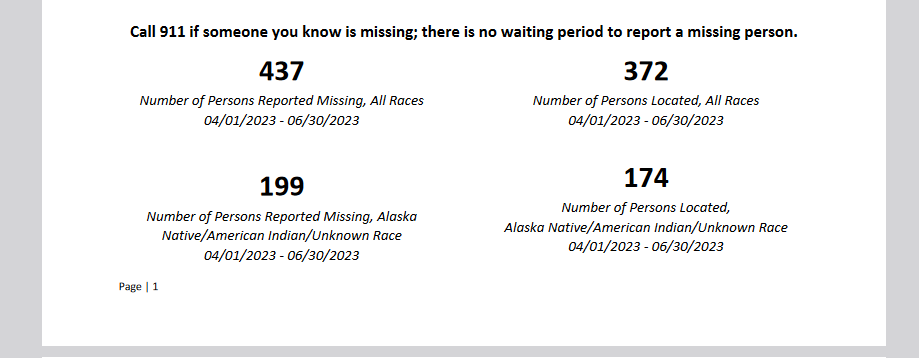
In the last quarter, from April to June, 200 Alaska Native
or American Indian people went missing in the state. Most of those have
been found, except for 25.
The database has an important new feature.
It categorizes the circumstances surrounding the disappearances, identifying those which are suspicious.
As
director of the Data for Indigenous Justice group, Charlene Apok
welcomes the new report and says it’s what advocates for missing
Indigenous people have been asking for – for years.
She worked on an earlier attempt to track their numbers.
“Sadly,
I think what this really illustrates is a systemic issue of violence
that’s being perpetrated in our community in the state of Alaska. And
that should raise flags and alarms, and really start igniting justice.”
Apok
hopes the database will continue to improve and provide more
information about those missing, including their hometowns and Native
cultural identities, so they become more than just points of data, but
reminders of loved ones, lost to their families.
my screenshot from the new report👆
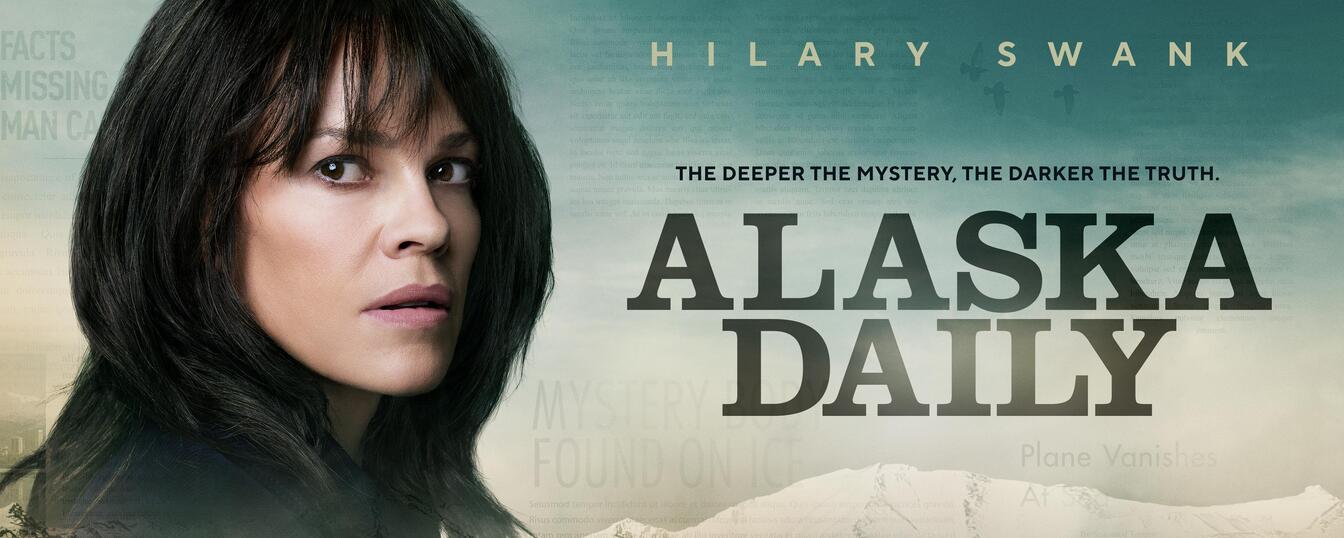
**Maybe this TV show helped?👇👇
only one season, sadly
Yesterday I watched the last two episodes of Alaska Daily who had made a similar map and report... Devastating to watch... Trace
As Arlene Ballot prepares to finally pick up her murdered daughter’s
child from the couple who have had her for most of her 4 years of life,
she can be forgiven for being cautiously optimistic about actually
bringing Chanel home.
The July 17 decision to award Ballot custody is the second time the
Selawik Tribal Court in Alaska has ordered Chanel, an indigenous child,
to be returned to her grandmother. Nikki Richman, who is not related to
Chanel, gained temporary custody through the child’s father, Eric
Rustad, who murdered Chanel’s mother Kristen Huntington in January 2020.
"This is three years too long. They shouldn't be allowed to keep
dragging it on, abusing the court system to keep this child from her
grandmother," Antonia Commack, Huntington’s friend since childhood who
is also involved in the legal battle, tells PEOPLE. "I knew in my heart
that being quiet was wrong and it was time to speak up."
And a recent Supreme Court decision might add some extra weight going forward.
The week before the latest Selawik Tribal Court ruling, The Supreme Court upheld
the 1978 Indian Child Welfare Act, which says the first priority is to
put the child in the care of a member of their extended family. If that
is not possible, the child should be placed with a member of their
tribe. The third option is to look for "other Indian families." Only
after those three options have been exhausted will they be eligible to
be placed with a non-Native family.
In their December ruling, the Selawik Tribal Court found tribal elder
Ballot able to meet the child’s needs and, in addition, "can better
connect her to her Native culture."
A new state law that took effect August 5 in
Alaska aims to “address and improve deep structural inequities” in the
state’s child welfare system — protecting residents should broader
federal protections be overturned by a pending Supreme Court case.
Specifically, HB 184
solidifies the state’s intergovernmental relationship with the tribes
and codifies the protections of the Indian Child Welfare Act, the 1978
federal law providing Indigenous communities enhanced protections from
foster care separation. The law known as ICWA faces a Nov. 9 challenge before the nation’s highest court.
But theAlaska Tribal Child Welfare Compact
will protect Alaska Native families, even when there are shifts in
state administrations. It became law earlier this month without the
sitting governor’s formal approval, following a bill signed by Alaska’s
former Gov. Bill Walker, an independent, Department of Health and Social
Services Commissioner Valerie Nurr’araaluk Davidson, and 18 tribal
co-signers representing 161 federally-recognized tribes.
The Act ensures that tribes and tribal organizations can utilize
foster care prevention programs that integrate the traditional, cultural
beliefs of Indigenous communities in Alaska, paving the way for a more
relevant and culturally appropriate child welfare system in the state.
According to an Alaska House Coalition press release, signatories are
now empowered “to provide quality children and family services as close
to home as possible. The model is lauded nationally and has been
replicated in other states.
“Children are the most vulnerable members of our communities;
protecting them and helping them to thrive is the most important work we
can do,” Association of Village Council Presidents CEO Vivian Korthuis
stated in the press release. “We all have the responsibility to take
care of all our children. Tribes have the same goal as the State —
better outcomes for Alaskan children, and as partners we can transform
child welfare together.”
The makes Alaska one of many states now finding ways
to protect state residents in the event that the landmark ICWA law is
struck down by the Supreme Court. To date California, Oregon,
Washington, Iowa, Minnesota, Michigan, Nebraska, New Mexico, Wisconsin
and Oklahoma have similar local laws in place.
States are either strengthening their versions of the federal law, or
are entering into government-to-government agreements — like this
recent Alaska legislation —between state child welfare agencies and one
or more tribes.
“Tribal compacting is the way out of Alaska’s child welfare crisis,”
said Alaska Federation of Natives Executive Vice President and General
Counsel Nicole Borromeo.
The landmark state-tribal compact Borromeo helped facilitate began in
2017, “to address and improve deep structural inequities in Alaska’s
child welfare system,” according to the press statement.
State leaders also praised the agreement. “The Tribal Child Welfare
Compact is an excellent example of the State capitalizing on the
excellent work of Alaska Tribes and working together to improve the way
we are meeting the needs of Alaska families,” stated Rep. Tiffany
Zulkosky (D), who served as prime sponsor of HB 184. “Healthy
communities begin with healthy families. When our children succeed, so
does Alaska.”
U.S. Catholic and Protestant denominations operated more than 150
boarding schools between the 19th and 20th centuries. Some U.S. churches have been reckoning with this activity for years
through ceremonies, apologies and archival investigations, while others
are just getting started. Some advocates say churches have more work to
do in opening their archives, educating the public about what was done
in the name of their faith and helping former students and their
relatives tell their stories of family trauma.
“We all need to work together on this,” said the Rev. Bradley Hauff, a
Minnesota-based Episcopal priest and missioner for Indigenous Ministries
with the Episcopal Church. “What’s happening in Canada, that’s a wakeup call to us,” said Hauff, who is enrolled with the Oglala Sioux Tribe.
This photo made available by the Presbyterian Historical Society,
Philadelphia shows students at a Presbyterian boarding school in Sitka,
Alaska in the summer of 1883. U.S. Catholic and Protestant denominations
operated more than 150 boarding schools between the 19th and 20th
centuries. Native American and Alaskan Native children were regularly
severed from their tribal families, customs, language and religion and
brought to the schools in a push to assimilate and Christianize them. (AP)
The Indian Child Welfare
Act, or ICWA, basically provides Tribes with an opportunity to intervene
when state child welfare and adoption agencies consider whether or not
to remove a Native child from a home. The children can be enrolled
citizens of the Tribe or be eligible for membership status.
A
lawsuit filed in federal court aims to stop the rollback of rules that
monitor American Indian and Alaska Native children foster care.
"I
was 12 years-old and there was reoccurring abuse in my house, as well
as neglect that resulted in us being taken away," said 22-year-old
Natilia Edwards of Anchorage, Alaska.
Edwards and her four sisters, all Alaskan Natives, were placed in foster care outside of their tribal community.
"So, I was in care for a total of seven years and then I was in a total of 14 different placements," said Edwards.
Tribes say an end to hostilities with the state of Alaska is long overdue.
A
bill that would require state acknowledgement of federally-recognized
tribes had its second hearing Tuesday and was approved and moved out of
the Alaska House Special Committee on Tribal Affairs.
At the hearing questions were raised and addressed about the impact of the legislation on state jurisdiction and sovereignty.
Two
witnesses gave legislators a look at what could be a national model for
a state-tribal partnership, in 2017 the state of Alaska and a dozen
tribes signed an Alaska Tribal Child Welfare Compact.
Nicole
Borromeo, Athabascan, general counsel for the Alaska Federation of
Natives, said a compact is like a modern-day treaty. "[This one]
specifically defines the services and supports that are going to be
carried out by our tribes and tribal organizations on behalf of the
state as well as the funding streams required," she said.
“I
want to call the committee’s attention to the fact that this is the
first ever compact that has been negotiated at the state level. And that
is something for all of us to be proud of,” Borromeo said. “We
[Alaskans] tend to be at the top of the list of undesirables and at the
bottom of the good list. In this case we are truly breaking ground and
we're on the cutting edge of law and policy. It's just something that
all Alaskans should know about and be able to celebrate.”
Francine
Eddy Jones, director of tribal family and youth services, Central
Council of Tlingit and Haida Indian Tribes of Alaska. (Photo courtesy of
Central Council of Tlingit and Haida Indian Tribes of Alaska)
Francine
Eddy Jones, Tlingit, is director of tribal family and youth services at
the Central Council of Tlingit and Haida Indian Tribes of Alaska.
🔻
WASILLA
— The first of a handful of “Share Your OCS Story” meetings hosted by
Alaska House Representative Tammie Wilson, of North Pole, was held at
the Mat-Su Legislative Offices in Wasilla on Saturday.
Wilson
said the six meetings, which are being held throughout the state, are a
way of documenting people’s experiences with the Alaska Office of
Children’s Services (OCS) for the Alaska State Legislature and the Governor’s
office.
Wilson
said the meetings are follow-ups on previous work her office has done in
trying to address what some see as systemic problems with OCS. She said
her office had previously documented more than 100 cases with gaps in
proper documentation that occurred during family reunification efforts.
“I
started this panel, I figure the best way to go is I ask parents if
they want a public setting to be able to share their stories,” Wilson
said, “That way we could then share with the legislature and governor
and anyone else who could help us get this straightened out.”
Wilson
said she’s concerned that family reunification efforts fall short,
especially when compared to foster and adoption efforts, once children
are in the system.
Twenty-two
people showed up at the Saturday meeting, and shared stories of
following case plans and doing everything necessary to get their kids
back, only to have items indefinitely added to their case plans before
they could see their children again. Others said they were shuttled
through a revolving door of high-turnover caseworkers, who missed doing
their part to provide needed pieces for reunification.
Former state legislator Lynn Gattis of Wasilla also testified at the meeting.
“I
as a legislator, I got call after call after call,” Gattis said. “They
don’t’ know where else to go. They call us. They cry. Many times I’ve
had grandparents who wanted to be involved, where they weren’t being
challenged. And no one called them back.”
Wilson
said she understands it can be difficult for people to come forward and
talk about their experiences with OCS; some might be afraid that
speaking out could affect their own cases, and for others, it may just
be difficult to speak about something painful in a public forum.
But
she hopes the meetings across the state will shed some light on the
experiences that Alaskans have had with the office, and that documenting
what works and what doesn’t might lead to solutions.
One of those solutions may already be forthcoming.
Currently,
Alaska Native children have stronger protections in place that prevent
them from being adopted out to non-family members when a safe home with a
relative is available. Those laws also require consultation with
tribes.
That’s because they have federal protections under the Indian Child Welfare Act.
Wilson
said she thinks all Alaskan families should have more the more
stringent protections required by ICWA, with family members such as
grandparents having to be consulted before a child is fostered or
adopted outside of the family.
To that end, she said, she’s co-sponsored House Bill 10, short title, “Child In Need of Aid/Protection; Duties.”
Gabrielle LeDoux of Anchorage and George Rauscher of Sutton are co-sponsors on the bill.
“What
it does, is change everything to the ICWA standard,” Wilson said. “They
have to have active participation, make sure the parents do have the
resources necessary to get children back, and a higher standard making
sure the family is contacted in putting them in a home with the family.”
The Office of Children’s Services did not immediately return comment for this story.
A
“Share Your OCS Story” meeting was held in Juneau on Thursday, and
another is scheduled to be held in Kenai on Saturday. For more
information about the meetings, call Rep. Wilson’s office at
907-465-4797.
Rep.
Tammie Wilson, R-North Pole, addresses the Alaska House of
Representatives, April 8, 2015. She is calling for an investigation into
the Office of Children’s Services. (Photo by Skip Gray/360 North)
State Representative Tammie Wilson of North Pole continues to press
for reform of the State Office of Children’s Services. Wilson cited a 30
percent growth in the number of reportedly endangered kids being
removed from parents in recent years, and some constituents unhappy with
how the system has treated them.
Wilson wants the Office of Children’s Services to refocus on parental
treatment and assistance, instead of removing kids from homes. Wilson
has resubmitted a bill that would adopt a uniform standard for when and
how children can be removed, based on federal law.
”And that would be the Indian Child Welfare Act,” Wilson said.
Wilson said the federal ICWA standard, which currently only applies
to Alaska Native and American Indian children, is a better formula for
addressing parental behavior, and keeping kids home or with extended
family.
”It also doesn’t allow as much hearsay as it does now,” Wilson said.
“You actually have to have proof that something is happening within the
family unit. And it also encourages more of keeping the child in the
home and putting the resources there – working with the parents versus
taking the children out. ICWA is largely known as the gold standard when
it comes to best practices.”
Alaska OCS Director Christy Lawton said the department is officially
neutral on Wilson’s bill, but acknowledged that ICWA policy mandates
beneficial services.
”We have to demonstrate that we’ve provided active efforts to prevent
removal or active efforts to promote reunification,” Lawton said.
That means actually taking family members to substance abuse
treatment, counseling or other help, not just recommending they get it.
Lawton said it would be great to do that for all families, but notes
ICWA was established to address systematic racism.
”It’s almost as if you’re saying that ICWA isn’t really needed
anymore because the playing field is level, which unfortunately is still
not the case in Alaska, or in many other parts of the country,” Lawton
said.
Lawton also pointed to potential loss of federal support for cases
involving Alaska Native families, funds contingent on meeting strict
ICWA requirements the financially strapped state may struggle to achieve
if applied in all child welfare cases. Representative Wilson maintained
the state has enough money and just needs to do a better job.
"My aspect is if we weren’t taking children that we should not be
taking, we would be able to use the resources into families that really
do need those resources,” Wilson said. “Cause, it’s much cheaper and
it’s better for the family to be able to keep the children in the home.
And then if you need the parents to do certain types of classes, then
you have those worked out at the same time”
Wilson’s take is based on case records obtained through constituents
critical of OCS practices.
Wilson is awaiting response from the State
Department of Law on a request for a grand jury investigation of OCS,
and is holding three public hearings on the agency in coming weeks. OCS
Director Lawton said she’ll continue to work with Wilson to improve
agency practices.
UPDATE Submitted by mbowen on 01/20/2017
The state office of children's services is being investigated.
State Representative Tammie Wilson said last week that she had
requested a grand jury investigation, but had heard nothing back from
the state.
The Department of Law now says that recommendations from a grand
jury have been unsealed, and will be looked at by the Alaska citizen
review panel and the state ombudsman.
The Citizen Review Panel meets four times a year, and its next meeting is in March.
Representative Wilson, who started the process that led to the
investigation, has also introduced legislation concerning the office of
children's services: "We have draft legislation to see what's going on
with OCS by bringing the standards up. We have the Indian Child Welfare
Act right now for Native children, not for those other children. We've
got to make sure that the higher standards are for everyone. The facts
are [that] we're taking more children out of the homes, and parents
never get their children back. That's just wrong."
Gov. Bill Walker has signed into law bills intended to help foster youths and ease adoption in Alaska.
Among other elements, House Bill 200 implements portions of the
Indian Child Welfare Act that ease the adoption process for tribal
members adopting a child of the same tribe. The bill also allows up to
four legal proceedings involved in adoption cases to be combined under
the purview of one judge.
House Bill 27, sponsored by Rep. Les Gara, D-Anchorage, is a foster
care reform bill that requires the state Office of Children’s Services
to make greater efforts to work with tribal and Alaska Native
organizations, and perform more in-depth searches to determine whether a
relative may be able to care for a child.
Children may stay in the foster care system through age 21 (instead
of 18) in order to avoid homelessness, according to one provision in the
bill.
The bill calls for children to stay in their current schools (if
possible), and it states that one of the duties of the Alaska Department
of Health and Social Services is to recruit foster parents and adoptive
parents.
Walker added both bills to the agenda of the first special session when they failed to pass the Legislature in regular session.
The signing of HB 200 took place at the Anchorage offices of Bristol
Bay Native Corporation, while the signing of HB 27 took place at the
University of Alaska Anchorage.
— Kaleimamoowahinekapu (@candacekgalla) May 6, 2016
The
University of Alaska Southeast graduated its first Alaska Native
Languages and Studies majors in 2014. (Photo by Lisa Phu/KTOO)
Many of Alaska’s rural schools are not working. Low student performance and
high teacher turnover are just two of more obvious indicators of
problems in these mostly Native school districts. Those working in the
schools say it’s time for radical changes.
Paul Berg has taught in Alaska for more than 40 years — 10 of them in villages.
“You want to see racism go to a village school,” said Berg. “You’ll
see Outside, usually Anglo teachers have the best jobs, the most pay.
Vast majority of administrators will be Anglo. It is not working. The
statistics and the data are very clear. ”
Berg, now 70, teaches high school students during the summer and
works as a cross-cultural specialist for the Goldbelt Heritage
Foundation. He, among other educators meeting this month at the
University of Alaska’s Natives Studies Conference, describes schools as
colonial forces not that much different from the boarding schools of
years ago that punished Native children for speaking their languages.
“Education is the means whereby a culture perpetuates itself and
transfers itself to the young. Public education has taken this away from
the Yupik, the Inupiat, the Aleut and others and given basically
middle-class America to these people,” said Berg. “As to the degree that
they wish that… that should be their choice but they should have the
inalienable undeniable right to transfer the culture and the language to
their children. It’s called the right of culture sovereignty and
English-speaking nations are among the last on earth to recognize it.
Xh’unei
Lance Twitchell addresses a crowd at the 2014 Alaska Federation of
Natives Convention. At the event, Gov. Sean Parnell signed HB 216, a
bill making Alaska’s Native languages official state languages. (Photo
by Jennifer Canfield/KTOO)
“My prayer is that Tlingit is going to live forever because we want
our little babies to be talking,” said Xh’unei Lance Twitchell.
I’ve always dreamt in Indian. Vivid, lucid, in color and shaded with
symbols. One evening night quest, my body was carried in a stream. The water above and below me flowed horizontally from my head toward my toes. However, my body was carried in a current of
its own and moving me ahead. As
I approached a steep hill, I began to struggle. My brief panic subsided when I chose not to lose my strength fighting the
elements I could not control. I reached deep in cool water with both hands. Waiting below were fish who sucked on my
fingers and pulled me the rest of the way home. I think I am a Salmon. Instinctively, I was called home.
In the year of 2014 I located my cousins and my Koyukon
Athabascan tribe. I was welcomed with tears. Even
first cousin Barb felt like she needed to have a baby shower. When my tax return came in February 2015, the first thing I did was make
reservations from Los Angeles to Fairbanks, Alaska and a second reservation with a bush plane
to fly me to the Village of Koyukuk, AK. The Native Village
of Koyukuk lies where the Koyukuk river meets the Yukon. About 300 miles from Fairbanks. No running water to the cabins. No
roads in and out.
I landed in Fairbanks at 12 a.m. The summer sun still shown
during mid-July midnight. I was met with
an aunt and several cousins. As I came
down the escalator from the terminal, I was welcomed with Athabascan singing,
tears and hugs. My first cousin LaVern
opened her house to me and organized a family reunion for the next evening;
Barb took the day off work to spend with me. I had my first ever family reunion with people
related to me, my first native food and first stories of my father's life.
A day later LaVerne flew with me into Koyukuk, where my
father lived and died on the river. I cannot begin to explain my emotions at this time. I cried real tears. Tears I could not control. I had emotions and questions overcoming my sense of self. Anxiety set in. I began to ask myself… am I crazy? What
the hell am I doing flying over 2k miles and into the interior of Alaska on a bush plane to meet people and see a way of life that my
DNA says I am half of? I am nuts?
I was crying inside the plane before I even exited. My heart beating fast and I could feel it. I could see my first cousin Marylin.I could see Marilyn was just as scared as I
was. I could see people arriving to meet the plane on their quads and in
trucks. Even the unleashed dogs came to welcome.
Lump in my throat, crying and shaking I got out of the
plane. I embraced Marilyn first. Then the rest of the group. One by one they hugged me, introduced
themselves and welcomed me "home."
They held a huge banner which read “Welcome” and once again
I was serenaded with beautiful voices singing in Athabascan.
The next few days were life-changing for me. Another reunion dinner was held. I ate more Native food including moose, beaver, salmon and muktuk
(whale blubber). After dinner an Elder presented me with an Indian name that Marilyn chose for me. I still could not believe my ears when people welcomed me "home."
During my stay, I got to see cuzns LaVern and Peter catch
Salmon on the Yukon. While seining, I was reminded of my dream. I thank the spirit of the Salmon for guiding
me home and providing food for our people. I want to go back home now even stronger than
before.
I know now first-hand what I am missing and what has been
imprinted in me for many generations. My
DNA...my endless imprint from past, present to future which still calls me
home.
It is this present generation of Native adoptees who need to
continue to find our way home. It is you, it is me. We
must follow our instinct and swim upstream. Some of us make it, some won't but you still need to keep swimming. If you don't fight back, the predators win.
It's in our DNA and a matter of survival for Natives today and future
generations. Trust the forces that pull
you through to carry us home. Keep swimming upstream for yourself and all
adoptees.
Mary contributed to the anthology CALLED HOME: Lost Children of the Indian Adoption Projects. LINK TO BOOK INFO here
South Carolina court drops contempt charge against Dusten Brown Dusten Brown and the Cherokee Nation rea...
Bookshop
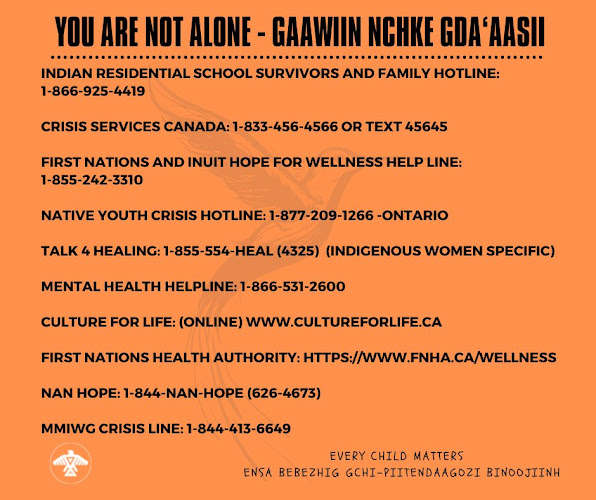
You are not alone
To Veronica Brown
Veronica, we adult adoptees are thinking of you today and every day. We will be here when you need us. Your journey in the adopted life has begun, nothing can revoke that now, the damage cannot be undone. Be courageous, you have what no adoptee before you has had; a strong group of adult adoptees who know your story, who are behind you and will always be so.
Diane Tells His Name
click photo
Lost Birds on Al Jazeera Fault Lines
click to read and listen about Trace, Diane, Julie and Suzie
NO MORE STOLEN SISTERS
click image
We conclude this series & continue the conversation by naming that adoption is genocide. This naming refers to the process of genocide that breaks kinship ties through adoption & other forms of family separation & policing 🧵#NAAM2022#AdoptionIsTraumaAND#AdopteeTwitter#FFY 1/6 pic.twitter.com/46v0mWISZ1
As the single largest unregulated industry in the United States, adoption is viewed as a benevolent action that results in the formation of “forever families.” The truth is that it is a very lucrative business with a known sales pitch. With profits last estimated at over $1.44 billion dollars a year, mothers who consider adoption for their babies need to be very aware that all of this promotion clouds the facts and only though independent research can they get an accurate account of what life might be like for both them and their child after signing the adoption paperwork.




:max_bytes(150000):strip_icc():focal(741x256:743x258):format(webp)/Custody-battle-072523-tout2-6ae541d56787418387bf606986a7ea42.jpg)









 Posts
Posts


