They Took Us Away

They Took Us Away
click image to see more and read more

it's free

click

How to Use this Blog

BOOZHOO! We've amassed tons of information and important history on this blog since 2010. If you have a keyword, use the search box below. Also check out the reference section above. If you have a question or need help searching, use the contact form at the bottom of the blog.


We want you to use BOOKSHOP to buy books! (the editor will earn a small amount of money or commission. (we thank you) (that is our disclaimer statement)

This is a blog. It is not a peer-reviewed journal, not a sponsored publication... WE DO NOT HAVE ADS or earn MONEY from this website. The ideas, news and thoughts posted are sourced… or written by the editor or contributors.

EMAIL ME: tracelara@pm.me (outlook email is gone) THANK YOU CHI MEGWETCH!

SEARCH

Showing posts with label tribal membership. Show all posts

Monday, January 27, 2025

Navajo Nation leaders raise alarm over reports of Indigenous people being questioned and detained during immigration sweeps

 WHAT?  MORE WILL HAPPEN with the Real ID ACT as well... Trace

Speaker of the Navajo Nation Council Crystalyne Curley speaks about the Radiation Exposure Compensation Act during a news conference on Capitol Hill in Washington, Tuesday, Sept. 24, 2024. (AP Photo/Jose Luis Magana)
CNN  — 

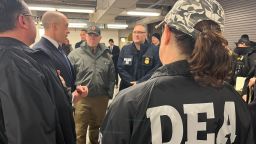
At least 15 Indigenous people in Arizona and New Mexico have reported being stopped at their homes and workplaces, questioned or detained by federal law enforcement and asked to produce proof of citizenship during immigration raids since Wednesday, according to Navajo Nation officials.

The reports, which have caused panic amongst tribal communities in both states, come amid the Trump administration’s attempt to ramp up undocumented immigrant arrests nationwide and amass a larger force to carry out the president’s deportation pledge. CNN has reached out to the White House for comment.

The reported raids and the exact number of Diné/Navajo and other Indigenous tribal citizens who were apprehended are still under investigation, Navajo Nation Council Speaker Crystalyne Curley told CNN. It is unclear if Immigration and Customs Enforcement or other law enforcement entities were conducting the apprehensions. ICE has not responded to CNN’s request for comment.

Navajo Nation officials have contacted the Department of Homeland Security, the governors of Arizona and New Mexico, and ICE to address the reports, the Office of Navajo President Buu Nygren said in a news release Friday.

“My office has received multiple reports from Navajo citizens that they have had negative, and sometimes traumatizing, experiences with federal agents targeting undocumented immigrants in the Southwest,” Nygren said in the release.

Justin Ahasteen, executive director of the Navajo Nation Washington Office, said his office has not confirmed any reports of ICE action against Navajo citizens.
According to Ahasteen, one tribal member was involved in a raid in Phoenix. Ahasteen told CNN the incident was a “wrong place, wrong time” situation and the tribal member, who presented their tribal identification and was questioned while in custody, was not the intended target.

The person was released, Ahasteen said.

CNN has also contacted New Mexico State Police, the Navajo County Sheriff’s Office and the Navajo Nation Police Department for comment.

Arizona state Sen. Theresa Hatathlie, who is Diné/Navajo, told CNN she received a report from the family of a Navajo woman who said she was questioned by ICE and asked to show proof that she was Native after her workplace was raided Wednesday morning.

The woman says she was at her work site in Scottsdale, Arizona, when she and seven other Indigenous citizens were lined up behind white vans and questioned for two hours without their cell phones or a way to contact their families, according to Hatathlie.

“Now is it ICE or some other entity, I don’t know,” said Hatathlie, who represents Legislative District 6, which encompasses the Navajo Nation. “I did work with some individuals to confirm whether or not ICE did do that work site raid, but the communication back to me was that it’s not a normal practice for ICE to confirm a raid or not.”

The woman says she was eventually permitted to use her cell phone and text family members, who sent her a photo of her Certificate of Degree of Indian Blood (CDIB), and she was then allowed to leave, Hatathlie said. It is unclear what happened to the seven other Indigenous people who were questioned.

The Navajo Nation Council received the reports through social media and calls to council delegates from families who said they were visited by ICE at their apartments and place of work, Curley said.

“There’s a lot of fear, and I know they’re probably feeling frustrated knowing that they don’t feel safe in the country where they were born or where their ancestors come from and there’s a lot of frustration of them being stereotyped,” Curley told CNN.

“I think there’s a confusion with other races, maybe just because having a brown skin, automatically being profiled or stereotyped to be in a certain group of race.”

Hatathlie pointed to the double standard of Indigenous people welcoming settlers who later colonized their lands, forced Native children into violent boarding schools and banned displays of Native cultural practices, only to be victims of practices such as immigration raids – when the law enforcement officials’ ancestors were immigrants themselves, she said.

”If you can’t say, ‘we’ve been here for time immemorial,’ then you’re an immigrant. You’re not from here, so who are you to classify our Indigenous people? These lands have been a melting pot for many ethnicities,” Hatathlie said.

“It’s too kind to say it’s racism or discrimination. It’s disrespect for humanity.”

Indigenous people urged to carry their documentation

Operation Rainbow Bridge, a nonprofit that supports Navajo citizens who are victims of Medicaid fraud in Arizona, has launched the Immigration Crisis Initiative to assist Indigenous people impacted by federal law enforcement raids.

Diné, which means “The People” and is how Navajo people refer to themselves, and other Indigenous tribal members are being advised to carry state-issued identification along with their Certificate of Degree of Indian Blood in preparation of possible run ins with federal immigration officials and other law enforcement.
The initiative has a hotline for people to call so Diné and other Indigenous citizens who are being questioned or detained can call for immediate assistance, and to help government officials identify the documents they are being presented with.

Although a person might be carrying their certificates and tribal identification cards, many of the reports said the agents who detained or questioned them didn’t acknowledge the documents as valid proof of citizenship, Hatathlie said.

“With the way things are going right now and these types of situations, we have to put measures in place in order to help our constituents and government entities so that they can be a resource,” Hatathlie said.

“Tribes should communicate to Homeland Security and say, ‘This is a sample of our travel enrollment card. This is the sample of our Certificate of Indian Blood. If you have any questions to verify, here is a hotline. Here is a website,’” Hatathlie added.

The Navajo Nation Office of the President released a tip guide for Diné who are confronted by immigration agents. The guide advises them to request to see the agents’ identification to confirm their legitimacy, exercise their right to remain silent and speak to an attorney if they are arrested or detained, and to document the interaction if possible so they can later report the encounter.

Navajo Nation officials urged Diné and other Indigenous tribal citizens to apply for tribal ID cards, such as the Navajo Nation Identification card, if they don’t have one. Families are also being urged to educate their children on the ongoing incidents.

The guidance also advises against opening their doors if immigration agents show up at their homes without showing a valid warrant signed by a judge.

“Some public sites, organizations, and restaurants are being raided by ICE,” Operation Rainbow Bridge states on its website. “As a precaution, your children should memorize your phone number and their (Social Security Number), and everyone should have current, valid documentation on them” including Social Security cards, Navajo Nation Identification cards, Certificate of Degree of Indian Blood or passports, according to the statement.

‘No one is illegal on stolen land’

For Indigenous peoples who inhabited the Americas for thousands of years before the colonization of their lands and the brutal treatment of their people, the recent sweeps have reopened old wounds.

Diné elder James Jackson, an honored activist in the Navajo community, told CNN the recent immigration raids and their impact on his community are “shameful.”

“It’s making people hyperaware of their surroundings, limiting their travel in their daily lives because they worry they will get stopped,” said Jackson, who lives in Tuba City between the four Sacred Mountains of Navajo 90 miles north of Flagstaff, Arizona.

Although he worries for his community, Jackson says he also feels anger on behalf of immigrants from other countries who came to the US to escape violence and economic hardship for the sole sake of their families’s survival.

“No one is illegal on stolen land,” Jackson said. “It really goes back to the Indigenous way of life, that everything is made for the people. People have to understand that this is not the way to live or to be honorable and neighborly with each other.”

Anti-immigration tactics like the recent raids, Hatathlie and Jackson said, go against Indigenous values and their ways of life which allowed Native people to prosper and live in harmony with the land for thousands of years before American colonization.

“We always talk about the environment and how we belong to the earth,” Hatathlie said. “That sets the groundwork for having respect for what’s around us, especially for our children and our great grandchildren, and they’re the future.”

There are concerns for the safety of multiple Native tribes who live in areas near the border, including Tohono O’odham, who have been in the Sonoran Desert for thousands of years and live on both sides, regularly traveling back and forth, Jackson said.

The reported raids have triggered panic and anger stemming from generational trauma endured by Native people whose ancestors and elders like Jackson had to fight to take back mere fragments of their land and reclaim their language and culture, which they had so long been forbidden from practicing, according to Hatathlie.

“We’ve come a long way building relations, but these initiatives of the current administration are a huge step backwards,” Hatathlie said. “These are the attitudes and the mindset of privileged individuals.”

“The settlers showed up sick, they were hungry, they were lost, and then all of a sudden, they were given a place to eat and sleep, and they ended up taking more than than they were provided,” she said. “They wore out the welcome mat at this point.”

CNN’s Andi Babineau contributed to this report.

LINK:  https://www.cnn.com/2025/01/27/us/navajo-detained-ice-indigenous-immigration-trump/index.html 

Thursday, June 23, 2016

The Social Worker in the US and #ICWA

By Trace Hentz (author, adoptee, activist)

Child “protection” is one of the biggest businesses in the country. We spend $12 billion a year on it. Let that sink in a minute.

 As many of you already know, Social Work is a career that requires a college degree. They are trained in colleges and universities across the US. These social workers gain control and have power over Indian children in every state. Many of the social workers are overwhelmed by their workload. "Children fall through the cracks (of the child welfare system," is heard often on the news when a child dies or is killed by a foster provider or adoptive parent.


I asked a recent graduate of Westfield University in Massachusetts if she had any ICWA training. She told me no.

Really?

Are there no Indians living in this state? I live here. There are two federally recognized tribes to date. There are many Indian people living in urban areas across the country, like in Boston and Springfield.

I bet if I asked this new university graduate if she knew how many federally recognized tribes there are in Massachusetts, she would have no idea. Or if I asked her how many tribes are federally recognized in the US, she wouldn't know that either. Few Americans know or care.

And if I asked her about Third World conditions on most reservations/concentration camps? Would she know that? Why else would 80% of Indians be living in big cities.

At the ICWA conference in CA, I gave them a quiz. I asked them several questions. I asked if they knew the federally recognized tribe in Rhode Island. Why did I ask that? Because a Narragansett from Rhode Island could be living in California. It's very possible. And would those judges and social workers know that tribe is federally recognized?  If a mother or father told them "I am Narragansett" in their California court room, making their child Narragansett, would that child receive protection from the federal law ICWA if they had no clue about that particular tribe?

We have a real big problem.

The fact that university doesn't require social workers to take courses on American Indians, offering recent or past history or ICWA, then these graduates can't effectively do their jobs when it comes to ICWA.

There are many tribes who are not federally recognized but acknowledged by their state. In Virginia there are SIX tribes who are state recognized. (That was part of my quiz too.)

There are even more state recognized tribes, like the Eastern Pequot and Schaghticoke in Connecticut, for example. If a child was eligible to be enrolled in their tribes, would they be protected by ICWA? Apparently not. ICWA rules say "federally recognized tribes." (see 2016 list in the sidebar of this blog)

It became evident when the Supreme Court made their ruling about Baby Veronica who is Cherokee. It appeared these important Supreme Court Justices knew little to nothing about tribal histories, sovereignty and membership requirements. Of course they used the racism of blood quantum to determine how "Indian" Veronica is... which was stupid and irrelevant.

This hurts us, all of us. Every child who enters the system has a price tag on their head. Especially Indian children. Each month the foster parents collect a check. The more kids they foster, the more money they make. It's an industry. (The same happens in the Mormon church when Native adoptees are labelled "special needs" even when they are not... those Mormon parents get an even bigger check each month.)

The social worker and the judge in the adoption system exist in that $12 billion dollar industry.

Read this about Adoption Bonuses HERE in Massachusetts.

And this quote hit me especially:

"...In this article I explain the financial infrastructure that provides the motivation for DSS to take people’s children – and not give them back."


We have to do better for ALL CHILDREN.

Poverty (violence, food scarcity, no job or underpaid, lack of hope) draws new children into the system every day. If we eliminated poverty for all people, their system would no longer be needed and obsolete.

Here is a story about the big gov't bureaucracy in Washington concerning child protection, ICWA and social work. Rafael López who was nominated by President Obama and confirmed by the United States Senate as the Commissioner of the Administration on Children, Youth and Families (ACYF) at the U.S. Department of Health and Human Services.

Rafael López: The child welfare system is a deeply broken system, and it does not yield the dramatically improved results for children and families that we would hope to see. We don’t need to accept or buy into the devastating statistics that have persisted for decades. But we first have to reimagine child welfare as something other than a crisis-oriented system....we propose collecting information on what happens with Native American and Alaskan Indian children, as defined in the Indian Child Welfare Act (ICWA). Without inquiry, many Indian children are not identified, thereby denying children, parents, and Indian tribes procedural and substantive protections under ICWA. READ HERE

The same lawyer who handled Baby V needed a new case and a new child to fill her wallet... Read: The Case of Baby A (AKA Save Lexi)


Wednesday, May 13, 2015

Curing the Tribal Disenrollment Epidemic: Calling for Change

FOR IMMEDIATE RELEASE

ARIZONA LAW REVIEW PUBLISHES GALANDA & DREVESKRACHT ARTICLE DETAILING TRIBAL DISENROLLMENT EPIDEMIC AND CALLING FOR A CURE

TUCSON, A, (May 11, 2015) – The editors of Arizona Law Review are pleased to announce the publication of Issue 57:1 which features the article Curing the Tribal Disenrollment Epidemic: In Search of a Remedy by Gabriel S. Galanda and Ryan D. Dreveskracht.


Download and read Curing the Tribal Disenrollment Epidemic: In Search of a Remedy here http://www.arizonalawreview.org/pdf/57-2/57arizlrev383.pdf

The article provides a comprehensive analysis of tribal membership, and the divestment thereof— commonly known as “disenrollment.” Chiefly caused by the proliferation of Indian gaming revenue distributions to tribal members over the last 25 years, the rate of tribal disenrollment has spiked to epidemic proportions and is without a remedy. The article, using historic and contemporary case studies, details the federal government’s role in promoting disenrollment and describes how disenrollment operates in ways that are antithetical to tribal sovereignty and self-determination. In concludes with potential solutions to cure the tribal disenrollment epidemic.

Praise for Curing the Tribal Disenrollment Epidemic: “This article is the most important, and most thoroughly researched and argued treatment of the tribal disenrollment available in literature,” says Professor Robert A. Williams, Jr., Co-Chair of the Indigenous Peoples Law and Policy Program at the University of Arizona. He adds, “It is a must read for all of Indian country.”

Galanda is a 2000 graduate of the University of Arizona James E. Rogers College of Law, and is an enrolled member of the Round Valley Indian Tribes. He is a founding partner of the law firm Galanda Broadman, PLLC, in Seattle; his firm represents tribal governments, businesses and members in all varieties of dispute resolution and business matters. Galanda’s practice focuses on complex, multi-party litigation and crisis management, representing tribal governments and businesses. As an emerging leader in the legal profession, he was named to the Puget Sound Business Journal’s “40 Under 40” and the National Center for American Indian Enterprise Development’s “Native American 40 Under 40” lists. Galanda also serves on the Native Nations Institute for Leadership, Management and Policy’s International Advisory Council. Galanda recently served as the Indigenous Peoples Law and Policy Program Distinguished Practitioner in Residence, lecturing on issues such as disenrollment and working with students.

Co-author Ryan D. Dreveskracht is a 2009 graduate of the University of Arizona James E.
Rogers College of Law. At Galanda Broadman, PLLC, his practice focuses on representing businesses and tribal governments in public affairs, gaming, taxation, and energy development. He writes prolifically about matters critical to Indian country, and has published in numerous peer-reviewed journals and law reviews. In 2013, he was named a “Rising Star” by the Super Lawyers rating service and Seattle Met Magazine.

Arizona Law Review is a student-edited journal that publishes four issues annually.

Curing the Tribal Disenrollment Epidemic: In Search of a Remedy and archival issues can be viewed at www.arizonalawreview.org.

Contact:
Chris Sloot, Editor-in-Chief, Arizona Law Review (520) 621-5500

[I did read this paper (92 pages) and it's very important. It's very very important we stand together. As adoptees we know we have to work hard to be brought back to our nations. Trace]

Happy Visitors!

NEW WEB ADDRESS

Because we don't want to lose information on this blog, we now have a domain name: American Indian Adoptees.com - click and save this link:

2026: WE HAVE A BACK UP BLOG COMING SOON: www.americanindianadoptees.blog (on wordpress) We are no longer on Facebook. We deleted our accounts.

WRITTEN BY HUMANS!

WRITTEN BY HUMANS!

Blog Archive

Featured Post

Your History Class Was a F*cking Lie | #NOMOAR

  Your History Class Was a F*cking Lie by Sean Sherman (Or: How the American Educational System Has Always Been a Racist Propaganda Program...


Native Circles

Native Circles
click logo for podcasts!

Most READ Posts

Bookshop

You are not alone

You are not alone

To Veronica Brown

Veronica, we adult adoptees are thinking of you today and every day. We will be here when you need us. Your journey in the adopted life has begun, nothing can revoke that now, the damage cannot be undone. Be courageous, you have what no adoptee before you has had; a strong group of adult adoptees who know your story, who are behind you and will always be so.

Diane Tells His Name


click photo

Lost Birds on Al Jazeera Fault Lines

Lost Birds on Al Jazeera Fault Lines
click to read and listen about Trace, Diane, Julie and Suzie

NO MORE STOLEN SISTERS

NO MORE STOLEN SISTERS
click image

ADOPTION TRUTH

As the single largest unregulated industry in the United States, adoption is viewed as a benevolent action that results in the formation of “forever families.”
The truth is that it is a very lucrative business with a known sales pitch. With profits last estimated at over $1.44 billion dollars a year, mothers who consider adoption for their babies need to be very aware that all of this promotion clouds the facts and only though independent research can they get an accurate account of what life might be like for both them and their child after signing the adoption paperwork.

Original Birth Certificate Map in the USA

Google Followers