


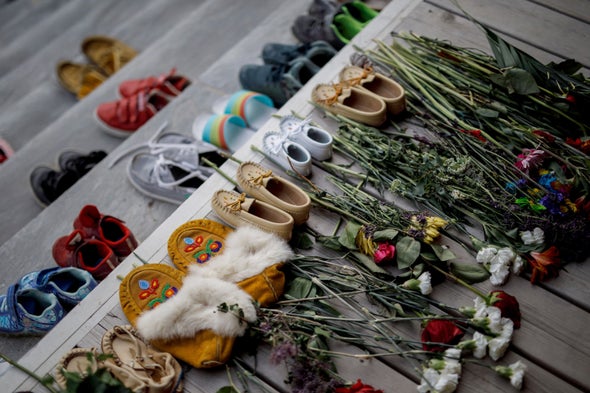
The recent discoveries of more than 1,300 unmarked graves at the sites of four former residential schools in western Canada have shocked and horrified Canadians. Indigenous peoples, whose families and lives have been haunted by the legacy of Canada’s Indian residential school system, have long expected such revelations. But the news has still reopened painful wounds.
Residential school survivor testimony has long been filled with stories of students digging graves for their classmates, of unmarked burials on school grounds, and of children who disappeared in suspicious circumstances. Many of these stories were heard by the Truth and Reconciliation Commission of Canada (TRC), which was formed in 2008 and collected testimonies from over 6,750 survivors. The TRC’s 2015 Final Report made it quite clear that further recoveries of unmarked graves at the schools were inevitable.
The goal of Canada’s Indian residential school system, after all, shared that of its U.S. Indian boarding school counterpart: “Kill the Indian, and save the man.” More than 150,000 children were taken from their homes between 1883 and 1997, often forcibly, and placed in distant boarding schools where the focus was on manual labour, religious instruction and cultural assimilation. The TRC Final Report concluded that the Indian Residential School system was an attempted “cultural genocide,” but the escalating number of recovered unmarked graves points to something even darker. Given that more than 1,300 graves have been identified using ground-penetrating radar at only four of the 139 federally run residential schools, the current official number of 4,120 students known to have died in the schools will end up being only a fraction of the actual total.







 Posts
Posts

