They Took Us Away

They Took Us Away
click image to see more and read more

it's free

click

How to Use this Blog

BOOZHOO! We've amassed tons of information and important history on this blog since 2010. If you have a keyword, use the search box below. Also check out the reference section above. If you have a question or need help searching, use the contact form at the bottom of the blog.


We want you to use BOOKSHOP to buy books! (the editor will earn a small amount of money or commission. (we thank you) (that is our disclaimer statement)

This is a blog. It is not a peer-reviewed journal, not a sponsored publication... WE DO NOT HAVE ADS or earn MONEY from this website. The ideas, news and thoughts posted are sourced… or written by the editor or contributors.

EMAIL ME: tracelara@pm.me (outlook email is gone) THANK YOU CHI MEGWETCH!

SEARCH

Friday, January 17, 2014

Baby Veronica Case UPDATE

 South Carolina court drops contempt charge against Dusten Brown

Dusten Brown and the Cherokee Nation reach an agreement with Baby Veronica's adoptive parents.
Dusten Brown: The deal won’t affect a criminal complaint of custodial interference, which Brown still faces in South Carolina.

Posted: Friday, January 17, 2014 
 

A South Carolina judge dropped a contempt of court case against Baby Veronica's biological father Thursday, bringing a definitive end to the drawn-out custody battle there.
The case was dropped "with prejudice," meaning it can never be refiled, after Dusten Brown and the Cherokee Nation reached an agreement with the adoptive parents. No settlement was paid, officials said.
Matt and Melanie Capobianco had been seeking compensation for expenses they racked up during a seven-week visit to Oklahoma last year to fight for custody of their 4-year-old adopted daughter, according to previous reports.
Thursday's agreement won't affect a criminal complaint of custodial interference, which Brown still faces in South Carolina, even though authorities are no longer seeking his extradition from Oklahoma.
It also won't affect a separate civil case here in Oklahoma, where the Capobiancos' attorneys are seeking more than $1 million in fees and expenses from Brown and his tribe, which fought alongside him to keep Veronica.
An agreement in South Carolina, however, might suggest that a similar resolution is possible for that case, which was filed in Oklahoma's Nowata County, where Brown and his wife live.
"I hope so, but I don't know," said Chrissi Nimmo, an assistant attorney general for the Cherokee Nation. "We'll have to see what happens."
Meanwhile, both the Capobiancos and the Browns have steadfastly stayed away from the media.
Brown hasn't spoken publicly since early October, when he spoke at a brief press conference to announce that he was dropping all legal efforts to get Veronica back.
The Capobiancos appeared briefly on the "Dr. Phil" television show in late October but have not given interviews since.
At the time, they confirmed that Brown and his family were still in contact with Veronica, although they didn't elaborate on what kind of contact or how much.
There's no information on whether such contact is still happening.
The Capobiancos arranged a private adoption with Brown's ex-fiancee and came to Oklahoma for Veronica's birth in 2009.
Brown, who was about to deploy to Iraq with the Oklahoma National Guard, didn't find out about the adoption until Veronica was 4 months old.
He says he was tricked into a signing a document that said he wouldn't contest the adoption.
With help from the Cherokee Nation, he gained custody of Veronica in 2011, but the Capobiancos appealed that decision all the way to the U.S. Supreme Court.
The justices ruled that Brown didn't have standing under the federal Indian Child Welfare Act, but they sent the case back to a South Carolina court for a custody ruling, and the legal battles continued for months.
Brown refused orders to return Veronica to South Carolina until the Oklahoma Supreme Court issued an unfavorable ruling Sept. 23, when he gave the girl back to the Capobiancos.
SOURCE

Thursday, January 16, 2014

Will NPR ever get Adoption Reporting right? @NPRWeekend #adoptees

READ THIS FIRST:

By Margie Perscheid on Paradigm Shift: Oh, media and adoptive parents, will we ever get adoption reporting right?...: I had to change that title, because really the problem isn't just with the media, it's with Adoptive Parents (APs), too. And that includes me....


Commentary by Trace:

I changed the title too!

Margie's blog is speaking about NPR’s Sunday interview with transracial adoptive parent Rachel Garlinghouse who adopts three Black kids then writes a book about them, and what she plans to do (since they are still very young).

Hmmm, doesn't that sound familiar? It is.

There are thousands of news stories and books by people who adopt kids transracially. (Think of the constant news about Cherokee child Veronica Brown transracially-adopted by the privileged non-Indian Capobiancos adoptive parents who had the media eating out of their hands!)

Amazon is literally flooded with books exactly like that -- FOR and BY people like Rachel.

(Google: how to adopt a baby - you'll be shocked by the amount of books...)

It's the hidden agenda and devious nature of Adoption Propaganda. 

Their message is:  you just keep on "adopting" and keep on promoting those adoptions. Those billions of dollars will keep generating for our adoption industry.

I heard the NPR interview and thought, "Keep on telling people what a good person you are, Rachel!  Not how you are actually promoting yourself on the backs of your children's race -  how that somehow makes YOU special, worth an interview on NPR."

What happens though is Rachel's book is about HER - what makes her and others so special and good to adopt a child who is not "white." (I wrote about this earlier - how some people get "high" on adopting - it makes them feel "drugged" good.)

I will repeat this as I have said this before on this blog! Actually writing these books is a total invasion of the adopted child's privacy.  A small child could never give permission to allow an adoptive parent to write about them as a child!!

How this will play out - once her children have grown? Rachel is not thinking that far - she's too interested in getting press for her book and selling copies. (There are plenty of blogs by adoptive parents who violate their child's privacy yet no one ever shuts them down.) Did her publisher discuss how this would affect her child's PRIVACY!?

Had Rachel considered how this could impact her adopted children once they get to school?

To NPR - how dare you! You had conducted an interview with an adoptee who had been adopted transracially and axed it - for reasons unknown??


Well, honestly, that's the norm for mass media, and typical propaganda.

(There are thousands of adoptees who would tell you how they really feel about being adopted.)

You know what's changed?

An instant immediate response! Check out Laura Dennis's blog: NPR GATE and all the bloggers who responded including Margie's post above. (And of course my commentary on this blog will be tweeted today)

I have a long list of adoptees (who contributed to the anthology TWO WORLDS) who'd love to tell their stories on NPR!

To conclude my RANT for the day:

Margie writes, "All we can do is our best, for our children and for their community. And sometimes we do our best when we do no more than listen."

Adoptees, share this please on social media and tweet your thoughts to @NPRWeekend

My friend Julie tweeted this: 
@NPRWeekend contacts AP and PAP focused infertility/adoption org to find #adoptees? Try again. We’re right here. #SundayConvo #nprgate
— Julie Stromberg (@LifeAdopted) January 16, 2014

Wednesday, January 15, 2014

Cherokee Nation Changes Placement Preferences Under ICWA

Veronica Brown

Article here.
The Cherokee tribal resolution, which passed unanimously, states: “In any adoptive placement of a Cherokee child under state law, a preference shall be given, in the absence of good cause to the contrary, to a placement with a biological parent or parents; a member of the child’s extended family; other members of the Cherokee Nation; or other Indian families.”
Speaker of the Council Tina Glory-Jordan, an attorney, praised the council’s work on the legislation.

“Because of recent cases, there is a need to include a fit parent or biological parent when it comes to placement of Cherokee children,” said Glory-Jordan.

“We’ve come to a day where so many courts don’t want to recognize ICWA. This law will make it easier, the next time our social workers go to court.”

It seems more tribes are going to be tightening and reinforcing the ICWA federal law in their own statutes. It's about time!   Trace 

Monday, January 13, 2014

MAKING CONTACT: My Interview with Native Genealogist Karen Vigeault-MLIS (updated)

By Trace A. DeMeyer

I was so surprised and happy to receive a gracious email from Karen as I do know many adoptees who get stuck on doing genealogy when they open their adoptions and have a name or family story that says there is INDIAN BLOOD. Once you have a name, you have to connect a parent or grandparent to a tribal roll. This has been a real problem for many adoptees.
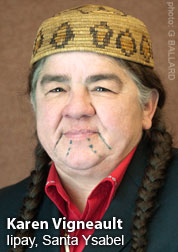
The following interview is with Karen Vigneault-MLIS. She is an academic research librarian, genealogist and historical researcher. Karen is a member of the Iipay Nation of Santa Ysabel. 
She has offered to help adoptees do family genealogy to be enrolled with their tribal nations. This offers hope for many of us! But remember that adoptees must do all the necessary steps to get their adoption records. She explains why this is so very important.

Karen, you have helped a few Native adoptees find their way back home. Can you share an example?
http://theacademy.sdsu.edu/TribalSTAR/services/EMailNewsletter/Archive/Sep_Oct2013/TS_Drumbeats_Sep_Oct_2013.html
Above is the link to pics and small article showing all that were involved in Patrick's aka Quinton's (his real name) story.  It was interesting because in his case his mom was adopted as well.. but she had passed.. so we had to get both cases opened. By opening his mothers we found more info on grandmothers last name. They spelled it wrong, which meant I had to try and decipher what it possibly matched on Aleutian records. I also called Alaska and spoke to people from villages in the area asking if they ever heard the name I thought it was.. In the end we found the enrollment documents on the tribal website.. He filled them out, sent out the adoption records as well.. and ultimately was enrolled..


Opening records seems to be the biggest roadblock for many adoptees.  How have you opened or accessed records?
I myself did not open the records. I had connections along the way and the ADOPTEE did their part in requesting info and documents... It starts with going to family court and requesting to get the records opened. Here in California we also have CILS (CA. Indian Legal Services.. which also has a form to petition to have your records opened.
http://www.calindian.org/about/cils-history

You work with another person that trains judges on these types of cases. You have opened records to get the adoptee enrolled. How did you do this? 
(see above) It is important that adoptees cultivate relationships with people connected to the court system. 

Have you used the Indian Child Welfare Act to petition the courts?
Yes

Do you recommend an adoptee use someone like you and could someone get in touch with you for your help?
Yes I think working with someone who already has the experience navigating through websites/ documents and Indian country would make the task a little easier. I can be reached at my email kumeyaayindian@hotmail.com
[I wish to thank Karen for this amazing offer to help adoptees in their search.]


Please click on the links above for photos and more information...Trace


Sunday, January 12, 2014

New anthology planned for Native adoptees


CALLED HOME (2014) will document new adoption journeys

Adoptee-journalist Trace A. DeMeyer has announced that she is collecting narratives and essays from Native adoptees who are not yet in reunion and those in reunion for a brand new anthology to be published in 2014 . The deadline for submissions is APRIL 15, 2014.  Her friend and fellow adoptee Patricia Busbee has signed on as co-editor.

DeMeyer was introduced to Cherokee adoptee Patricia Busbee by mutual friends, and they collaborated on their first anthology, “TWO WORLDS: Lost Children of the Indian Adoption Projects,” which launched on Amazon and Kindle in 2012. (ISBN: 978-1479318285, Price: $16.95 (PAPERBACK), $6.99 (EBOOK). The lost children (adoptees) in this anthology share intimate details of their personal lives, their search for identity and family, and their feelings about what happened to them.

After generations of Native children were forcibly removed from their Tribes and placed in residential boarding schools in North America, thousands upon thousands of Native children were also being placed in closed adoptions with non-Indian families.  Finding these children became non-stop detective work for DeMeyer who started research in 2005 which culminated in her memoir “One Small Sacrifice” in 2010.  (An updated second edition was published in 2012.)

“Because of both books, I get emails from new adoptees almost every day. I explain about the history of the Indian Adoption Projects and its successor ARENA and how it was unofficially ethnic cleansing via adoption assimilation, condoned and paid for by the US and Canadian governments and several churches who operated programs to facilitate these adoptions,” DeMeyer said. “Many times the adoptee tells me how they felt very isolated and alone but could not share their need to search with their adoptive family. I tell them about my search and reunion, offer my help and introduce them to search angels.”

Both DeMeyer and Busbee agree that publishing “TWO WORLDS: Lost Children of the Indian Adoption Projects” was an important contribution to American Indian history but even more of this history needs to be published.  Their book has been chosen by Brock University in Canada for its BROCK READS program in 2014. Patricia and Trace will be at Brock on March 25, 2014 to do a book talk and panel with some of the Two Worlds contributors.  They hope more universities will use it as part of their curriculum.

DeMeyer said, “Very little is known or published on our history. Many of these adoptees were children (not all were babies) and many were not orphaned but simply removed. We know states in the East were used as destinations to remove children from the midwest and west -- very far away to make it difficult or next to impossible to find tribal family. With sealed adoption files, it’s a miracle many of them succeed at all.”

Their first book covers the history of Indian child removals across the US and Canada, the adoption projects, their impact on Indian Country and how it impacts the adoptee and their families, Congressional testimony, quotes, news and several narratives from adoptees in the US and Canada in the 375-page anthology.

The second anthology will include updates from adoptees in their first book. For those still searching, adoptees can publish their photo and birth information.

“I encourage adoptees who have not found their tribal relatives to submit as much as they know, so we can help them find their families and help them have a successful reunion. That is our goal with this new book,” DeMeyer said about the new anthology CALLED HOME.  “Watching the Baby Veronica saga, we hope that more Americans will understand the impact of the Indian Adoption Projects and ARENA Programs, and how the Indian Child Welfare Act was made federal law in 1978 because of our removals.  Adoptees born prior to ICWA lived through it and need to share their astonishing stories of survival.”

Contact: Trace A. DeMeyer, 413-258-0115 (message)
Send submissions and questions to tracedemeyer@yahoo.com (email)

Friday, January 10, 2014

Canada accused of hiding child abuse evidence

Archive Photo


"I was given that porridge I got sick on and I had to eat that … And if you don’t eat, then you’re going to get beat up some more, and you’re going to get punished – and if you throw up again you’re going to have to eat that too, so what choice do you have?” Metatawabin, 66, says at times he and his classmates were forced to sit in an electric chair – either as punishment or as entertainment for the staff at St Anne’s Indian Residential School, which operated from the early 1900s to 1976 in northern Ontario province.  Now, Metatawabin says, the government is hiding information about the school... St Anne’s was part of a government-supported school system to "assimilate" aboriginal children.  About 150,000 indigenous children were forcibly removed from their families by the federal government for decades starting in the 1800s and put into church-run residential schools. Many suffered physical and sexual abuse and squalid living conditions, and a Truth and Reconciliation Committee recently said at least 4,000 children died – a number that could be much higher..."
via Canada accused of hiding child abuse evidence – Features – Al Jazeera English.

Sunday, January 5, 2014

At least 4,000 aboriginal children died in residential schools, commission finds


Archive Photo

Truth and Reconciliation Commission officials expect toll to rise as more records reviewed

OTTAWA — Thousands of Canada’s aboriginal children died in residential schools that failed to keep them safe from fires, protected from abusers, and healthy from deadly disease, a commission into the saga has found.
So far, the Truth and Reconciliation Commission has determined that more than 4,000 of the school children died.
Read more here: ottawa citizen


Note from Trace: If it happened in Canada, it happened in America, too. Are tribes here investigating? I hope so...I'll be reporting on this blog as more truth comes to light...


Saturday, January 4, 2014

Numbers

By Trace A. DeMeyer

I was asked recently how many domestic adoptions take place in America each year. I did some research and was surprised to see how much the numbers are shrinking, which means the Nightlight Adoption Agency who handled the Baby Veronica transaction must be very nervous and scouring poor communities like Indian reservations to snatch more infants to sell to people like the Capobiancos (shown at right).
Yes, I am cynical these days. The agencies are going to push to keep their profit margins somehow. They are going to charge more and more to keep their doors open and pay desperate mothers well to relinquish.


Infant Domestic Adoption: A Gradual Slowdown

Every five years, NCFA hires a researcher to survey state administrators in order to determine the total number of infant domestic adoptions in the U.S. As reported in Adoption Factbook V, there were 18,078 infant domestic adoptions in 2007, down from 22,291 in 2002, the last year in which the survey was conducted. The first NCFA survey (1982) identified 17,602 infant domestic adoptions. Since the peak year of 1992, when 26,672 adoptions were identified, the number of private domestic adoptions has dropped each year.
One of the reasons for the decreasing number of domestic adoptions may be a parallel decrease in the percentage of unmarried women relinquishing children for adoption. According to data from the National Survey of Family Growth, relinquishments have declined from nearly nine percent in the 1970s to under one percent of births to never-married women by 1995 (the last available data year). Reasons offered by researchers include an increased social acceptance of single motherhood, and a higher number of unmarried mothers in their 20s rather than their teens.

Read more here: http://www.adoptivefamilies.com/articles.php?aid=2309

Wednesday, January 1, 2014

HARVEST CAMP, PENOKEE HILLS | 25 Stories of Indigenous Resistance in 2013

Paul DeMain on Harvest Education Learning Project (Harvest Camp) from Paulette Moore on Vimeo.

For Land and Life: 25 stories of Indigenous resilience that you might’ve missed in 2013

Native American activist and adoptee Paul DeMain
I want to add that my adoptee friend Mel Gasper (Zuni-Lac Courte Oreilles Ojibwe) made big news in 2013. He helped keep the Harvest Camp at Penokee Hills running. I didn't get to see him but I did bring him some supplies this past summer. I love Mel! And Paul DeMain, another Native adoptee, who used to be my boss at News From Indian Country, was also greatly responsible for setting up and running the camp. These great men are warriors.

Read more: http://www.lconews.com/2013/04/lco-to-establish-harvest-camp-at.html and http://indiancountrytodaymedianetwork.com/2013/07/31/inside-harvest-camp-ground-zero-wisconsin-mining-war-150669

Sunday, December 29, 2013

Monday, December 23, 2013

All I want for Christmas is my OBC

Ohio signed an adoption access bill....Read here

I posted on Facebook all I want for Christmas is my OBC (original birth certificate) - still wishing for that real piece of paper...Trace

Early infant mortality in Canada called 2nd worst in developed world


by aboriginalpress

"At the root of it is a distribution problem," Smylie said in a telephone interview. "We're an affluent country, but at a systems level we're still not distributing all of our health and social resources equally to all groups."  Smylie said the social imbalance that sees aboriginals struggling with higher than average levels of poverty is compounded by the country's geography. Canada's vast size ensures that people living in remote northern communities often have to travel dozens, even hundreds, of kilometres to receive proper maternity care, Smylie said. Such factors drive up infant mortality within the first year and by extension those infants who do not survive their first 24 hours on earth, she said.

Friday, December 20, 2013

Biggest news story in 2013? #BabyVeronica UPDATED

Why Veronica's story needs to be the story of the year

by Sherrie Roe Bean

I am not from South Carolina but I think that Veronica Brown should be the biggest story of the year nationwide. We can argue about the details of the case all day long but if anyone really wants to know what happened they should read the bench ruling by Judge Malphrus. She is the ONLY judge who heard testimony from everyone involved and examined evidence (like the infamous text message.) Interestingly enough her verbal bench ruling is VERY detailed and thoughtful and carefully explains her position on everything although she has been called inexperienced and "wrong". The narrative of the opinions cited from all of the higher courts do not reflect anything that she ruled, how does that happen? Basically when the SCOTUS ruled that ICWA did not apply they were stating that Veronica Brown's father was not entitled to that hearing at all and his parental rights could have been terminated while he was serving our country in Iraq. Even if that was "legal" there is nothing "right" about it. Someday Veronica will speak and I wonder will anyone listen if she tells us that she was heartbroken and missed her daddy? Will anyone feel sorry for doing this to her? I am sad to say that I think they probably won't. Many adoptees have spoken out on her behalf only to find that nobody cares what they think. We have changed and sealed their birth certificates, stolen their original identities and expected them to just get over it and appreciate the "better life" that their adoptive parents were able to give them. Sad really. Veronica Brown should be the story of the year because it has awakened a sleeping giant. Adoptees are speaking out and gaining attention. The "business" of adoption to provide a child for a home rather than a home for a child is being exposed. This is only the beginning. ICWA?? The only people I know who have a problem with ICWA want something from the Natives, their land, their casinos, their babies. As long as their Nations are sovereign they can't take from them. Yep, this story isn't going away any time soon. It IS the story of the year and hopefully it will be next years story of the year as well. Ronnie Brown's sparkle is going to change the world.

From Facebook Page: https://www.facebook.com/StandingOurGroundForVeronicaBrown/posts/334224673382602 

AND this: Voting on Facebook

What was the top Charleston/South Carolina story in 2013? Choose from our list of newsmakers - listed in no particular order - and tell us why.


Priscilla Stone Sharp Veronica Brown - Many thousands of us were traumatized by Veronica's kidnapping and forced adoption, but a lot of good is coming out of it.
Most major, many hundreds of people have become alarmed enough to galvanize forces to expose and fight the adop
tion industry. We are formulating rallies and protests, getting petitions going, contacting state and federal officials with demands for investigations of corrupt bureaucrats and lawyers, gathering information on other fathers' rights violations and forced adoptions and going to court with them, blogging, Facebooking, tweeting and twittering. There are some making videos and memes. Others gathering the laws of specific states so that we can approach legislators with needed changes.
This is turning out to be what we have been waiting for for decades - the American public (indeed, the world) is waking up to the rampant corruption and abuses of the adoption industry. Things are changing. As I've said all along, the Capobianco name will be cursed in adoptoraptor land forevermore. Because of their outrageous behavior, adoption will never be business as usual ever again.
Age: 68
Occupation: Retired
Town: State College, PA

Wednesday, December 18, 2013

The art of Ben Chosa Jr.


My Photo 


I wanted to share this amazing art by Lac Du Flambeau Anishinabe-Menominee adoptee Ani Ben Chosa Jr..... he contributed an essay in the anthology TWO WORLDS.


Here's his artist blog: http://www.banishedart.blogspot.com/

His writing blog from prison: http://scottckieson.blogspot.com/

Friday, December 13, 2013

No, I'm not crazy

By Trace L Hentz (formerly DeMeyer)

I think about integrating parts of my persona that were buried or stunted or created as an adoptee growing up with strangers.

Last week I had posted on Facebook how I experienced huge chunks of CRAZY, had patterns of unhealthy behavior and even how big blocks of memory seemed hazy or gone. This does not make me any different (or better off or worse off) than others.  If I am to heal myself, I need to know and see how I coped as this little girl who lived in fear and confusion.

My thoughts now?  My crazy hazy chunks of time were in fact self-preservation – it was the only way I could handle what I had to face to avoid fracturing or destroying my delicate developing mind. (And this did happen to others living in a dysfunctional setting in childhood.) I am now aware I had various coping tools, as did my friends. One of the best tools was a vivid imagination. Another one: listening to the small voice inside, a voice of sanity and clarity. Another tool was determination. I was determined to survive and very determined to create a safe environment for myself as a young adult, when I could move physically and emotionally away from where I was raised. I was determined to open my adoption and find my relatives and my ancestry. I never lost that determination. I grew strong.

I had a conversation a few days ago with co-author Patricia [Our anthology is Two Worlds: Lost Children of the Indian Adoption Projects] about this process of integration, how we created little people who could handle situations, a character and persona tougher than us – and now as grown-ups, these little people are no longer needed.  I am not suggesting we had multiple personalities. That is too psycho-speak for us.  As babies and toddlers, we were confronted with strangers who called themselves our parents and they had their own instability. (Both of us had an alcoholic parent). Their imbalance caused our childhoods to be terrifying and unstable. That can put us in a situation of weakness and vulnerability. Our real fears made us very unstable and untrusting.
We chose to survive so we had to be creative in some way. Being creative is an outlet for a grief this enormous. Patricia is definitely an artist and I was a musician – and we both kept journals.
Add to that we are abandoned as infants and not nurtured and denied the bonds with our mother-creator. That also created an instability and frailty that carried forward from childhood to adulthood. This trauma is called the PRIMAL WOUND. Read Nancy Verrier if you are curious.

Remember the movie The Three Faces of Eve? Though Eve was an adult, she had created personalities who could stand-in for her. One movie that terrified me was SYBIL. Sally Fields played a child who was terribly abused and created numerous personalities who stood in for her while she underwent the abuse.  In therapy, these movie characters found out they had created stand-ins, what I call the little people. When they are no longer needed they can melt away. Or integrate back into the soul.

Split Feathers, what American Indians call adoptees or their lost children, have this integration challenge.  It has nothing to do with being crazy, though adoptees tell me they feel like they acted crazy in trying to deal with the strangers who raised us.  I don’t see how we could not be crazy. What other method would work? We had to be split.

Patricia and I are both Native adoptees.  We know this history now. We know it’s historical trauma in our DNA. We know we have the tools to heal this ourselves.

Even as kids we could see we were very different from our stranger parents, yet adoption forced us to pretend, be good and show we were grateful.  Isn’t that crazy?

Anyone who questions the Adoption Cartel (and their propaganda and billions in profit) will be called crazy.

What is crazy are the people who believe “adoption” works so well. How a closed adoption is good – that is crazy. Punishing a woman for having a baby while unmarried and forcing her to give up her child – that is crazy. Sealing our adoption records – that is crazy.  Giving people the idea they can buy an orphan – that is crazy. Believing an adopted child won’t want to know the truth or find their birth relatives – that is crazy.

There are couples right now holding a bake sale, asking their friends to raise money so that they can adopt an orphan. That is crazy – dangerously crazy! Read The Child Catchers if you want the truth about orphans (and how many of these children are not orphans at all but have living parents!! They are sold into adoption as a commodity.)

The fact is adoption is human trafficking.  If a child is taken from their natural parent(s) and sold to strangers, that is trafficking.  If money is exchanged for children and babies, that is trafficking. If lawyers and judges and adoption agencies charge money to handle babies for sale, they are trafficking in humans.

I do write this as a survivor of human trafficking, what was a closed adoption that I opened.  I write this from a place of sanity and balance, after years of working on myself, knowing myself, finding my relatives, and yes, learning the truth.

No, I am not crazy.

Thursday, December 12, 2013

OHIO Governor signs Adoptee Access (updated)

BIG NEWS


Call Betsie Norris of Adoption Network Cleveland for details, questions and to find out what this bill can do for you: (216) 482-2314


The amended bill includes the original contact preference and medical history provisions and adds a one-year period in which a birthparent can request to have only their name redacted (whited out) from the birth certificate. After the 1 year period has expired, no birthparent may redact and adoptees from 1964 -' 96 can begin to request their adoption files. This is NOT A DISCLOSURE VETO - all adoptees will receive the contents of their adoption files.

Other new provisions include:
  • mandating that birthparents who redact submit a social and medical history form; 
  • permitting birthparents to un-redact at any time; 
  • adding a mechanism for adoptees to request updates on medical history from birthparents who redacted; 
  • and allowing adoptees born in Ohio but adopted out-of-state and adoptees born out-of-state but adopted in Ohio to request their adoption files. While the redaction portion is not what we had hoped for, we are encouraged that, in practice, the sub bill will function in a way that retains the integrity of the bill. 
We thank Senators Beagle and Burke for fighting a good fight in the Senate!

Only 10 States allow adoptees access to their own information so OHIO is GOOD NEWS!
Pennsylvania and Washington are still working on their laws - stay tuned to this blog! ...Trace


Monday, December 9, 2013

AMAZING new scholarship on Indian Slavery and Genocide

Honorable Justice Murray Sinclair


Photos by Trace
By Trace A. DeMeyer

I was very fortunate to attend some of these panels at Yale in November and had planned to write about some of what I heard. It would actually be better if you watched the panels yourself! This was a ground-breaker - since many of the presenters are Native authors working on new research!

Please watch all of them but especially The Honorable Justice Murray Sinclair, Chair, Truth and Reconciliation Commission of Canada
VIDEO

THE CONFERENCE:
Indigenous Enslavement and Incarceration in North American History
 
Video from the Gilder Lehrman Center’s 15th Annual International Conference, held November 15-16, 2013 in Luce Hall at Yale University is now online.
 
Studies of indigenous slavery have multiplied in the past decade, changing not only the ways we think about slavery, but also race, citizenship, and nation. This conference brought together some of this exciting new work and traced its effects on and within Native American communities. It did so self-consciously in its expressed focus on slavery and incarceration. Such an emphasis, we hope, connected new slavery scholarship done in early American history with contemporary investigations into incarceration and prison studies.
Video of the conference is online at: http://www.yale.edu/glc/indigenous-slavery/schedule.htm

AND:
I was also able to meet the esteemed author Margaret D. Jacobs who has a new book coming out about American Indian Adoption. As we hugged, we both cried. It was my honor to meet this scholar and thank her for her academic scholarship on our behalf. I didn't know she would be aware of this blog American Indian Adoptees or my two books - but she knew.
Margaret Jacobs is seated at left
  • Margaret Jacobs, University of Nebraska
  • Tsianina Lomawaima, University of Arizona
  • Tiya Miles, University of Michigan
  • Ned Blackhawk, Yale University
  • Moderator: David W. Blight, Yale University VIDEO

Four Horses

2013-12-09-angusquapelle1.jpg
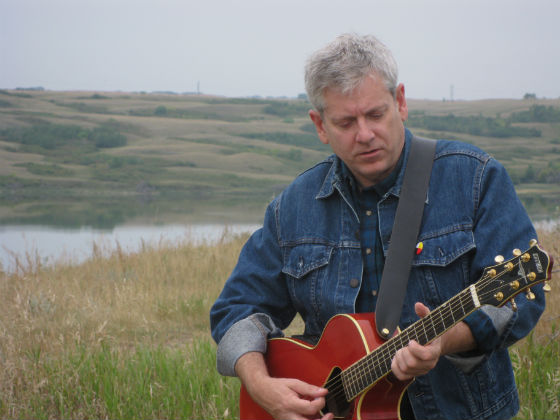
Charlie Angus recording Four Horses in the Qu'Appelle Valley
Charlie Angus

I thought I knew Canadian history.
The stories of the National Dream and the Medicine Line may have been dull compared to the myths of the American "wild" west but they spoke of a nation founded on compromise and good governance.
However, as I stood with guitar in hand on the grasslands of the Qu'Appelle Valley I saw my country in a way I had never imagined. Not so long ago on these picturesque fields, Aboriginal children were suffering death rates that were higher than in any western nation until the dark days of the Warsaw Ghetto. And the response from the government of the day to this tragedy was anything but fair.
I came to the Qu'Appelle Valley for the filming of the video "Four Horses." It is a musical video project intended to shed light on this dark history. The project was inspired by James Daschuk's harrowing new book Clearing the Plains: Disease, Politics of Starvation and the Loss of Aboriginal LifeDaschuk's work is grounded in years of academic research but his analysis of how John A. MacDonald used starvation as a deliberate policy to break the Tribes of the west is stirring discussion across the country.

Writing the song "Four Horses" was my way of being part of the discussion. The metaphoric horses of the Apocalypse -- disease, war, famine and death -- touched a chord with Daschuk and publisher University of Regina Press. We began collaborating on the video to reintroduce this history to a new generation.

This is the story of those four horses.

The First Horse
To Fort Qu'Appelle came a Dapple Grey
As the children coughed blood in the autumn rain.
They broke the treaty when the buffalo failed
And fenced the land for the CP rail.


Daschuk takes us back to the brutal winter of 1878 when Ottawa began receiving reports of the starving Cree, Assiniboine, Okanese and Blackfoot begging for food and dying in front of government forts. The collapse of the buffalo economy was a catastrophe that had been expected for some time. In fact, when Treaty 6 was signed two years earlier, the government made guarantees of food and medicine to help transition the people if hunger hit the plains. But as the winter wore on, MacDonald reneged on the Treaty commitments.


In a notorious House of Commons debate, he bragged that the government would withhold food "until the Indians were on the verge of starvation, to reduce the expense." Hunger became a convenient tool for forcing the First Nation people onto marginal reserve lands to secure the development of both the CPR and immigrant farm settlement.

The Second Horse
I saw a black horse at Cut Knife Creek
But the Great Poundmaker was a man of peace
He spared the soldiers true to his word
So they hung the braves at Fort Battleford.


The loss of the buffalo reduced the Plains tribes to destitution. When the starving Cree and Blackfoot went to Fort Battleford to seek food from the Indian Agent the government responded with soldiers, cannons and gatling guns.
The Cree had not come to fight. They wanted food for their families. However, when the troopers attempted to move against the hungry people they found themselves overexposed and facing a defeat that would have been larger than the Little Big Horn. Any American can tell you the story of Crazy Horse and Sitting Bull but how many Canadians know the story of the great leader Poundmaker? He ordered the Braves to allow the soldiers to go leave unharmed in order to prevent bloodshed.
In response, the federal government "hunted to death" the Cree and Assiniboine braves. A number were publicly executed at Fort Battleford in the largest mass hanging in Canadian history. MacDonald forced the famine-struck families to witness the hanging in order to "convince the Red Man that the White Man rules."

The Third Horse
The third horse danced for the Great White Chief.
Hunger's a lesson that's so easy to teach.
To kill a warrior you need a gun in hand
But to kill a people you need a bureaucrat man.


One of the most disturbing aspects of Clearing the Plains is how the famine became an institutionalized tool used by Indian Affairs used to further degrade the people forced onto reserves. Officials who tried to improve conditions were often fired or overlooked for advancement. For example, the government removed Dr. John Haggerty who is credited with stopping a smallpox epidemic. The government saw his efforts as a waste of money. Instead, the government promoted venal Indian Agents who used the withholding of food and forced sexual favours to lord over destitute communities. Thus was born the bureaucratization of misery that became the hallmark of Indian Affairs throughout much of the 20th century.

The Fourth Horse
The pale horse waits at the mission school.
Progress they say can be so cruel.
But the spirit lives on across the Great North Plains
As the people find their voice again.


The Pale horse is the symbol of death. And nowhere did death take a bigger toll than among the children forced into mission schools where the tuberculosis rates were appalling.
But the Four Horses also teaches us something else -- the extraordinary resilience and determination of First Nation people. Despite a century of substandard education, health care and housing, they have not been eradicated or assimilated. In fact, they are now reclaiming their rightful place in Canada. 

SOURCE:  Huffington Post, Dec. 9

Thursday, December 5, 2013

Swept up by the Relocations Programs

In the documentary Lost Sparrow, these four Crow tribal members as children were adopted by non-Indians in New York State. The boys were killed in a tragic accident trying to save their sister from abuse.
By Trace A. DeMeyer

I was speaking with an adoptee yesterday who was told by his adoptive parents that maybe he was put up for adoption due to the Indian Relocation Programs. Maybe his Indian parents tried living in the big city and failed and because of poverty or whatever, my friend as a young boy was swept up by social services who placed him for adoption. My friend actually can speak some of his language but we are not certain if he is Lakota or not.

Indians moved around in these relocation programs. An adoptee could be from Montana and raised in New York.

Read this: http://www.pbs.org/indiancountry/history/interactive_map.html

This reminds of the first story I wrote for Talking Stick Magazine about Native adoptees who are casualties of forced removals - not all children were taken from the reservations - some were snatched from big cities, too. You see it fits the pattern of the "Nation Builders" to create an idea, even a bad one, and innocent children are usually the casualties.

The PBS website offered this:  Since first contact, Native Americans have been given three choices — which weren't really choices at all.

Assimilate

The first “choice” was for a tribe to assimilate into the dominant American culture, become "civilized," give up tribal ways and be absorbed into America society. Many tribes tried this, many times through history. Education was the tool for assimilation in the boarding school experience. The government push to assimilate native tribes continued through the 1950s Urban Relocation Program.

Relocate

Even if a tribe, like the Cherokee, tried to join the American society, they could still be forced to relocate to Oklahoma Indian Territory hundreds of miles away. That's what happened on the Trail of Tears.

Genocide

Some tribes chose to fight or were forced to resist. While many have won some battles, they lost all the wars. Hundreds and thousands of Native Americans were killed in battles or by disease or starvation. One of the worst examples of genocide was what happened to the California tribes.
On our Interactive Map, you will see how various tribes experienced assimilation, relocation or genocide during American history.


So we see history is full of puzzles and mysteries like lost children who are swept up by relocation programs and placed for adoption like my friend who has no clue where he belongs or which tribe or what happened to his family.  It is his puzzle and others we need to solve....

If you'd like to read my earlier post about the tragic documentary LOST SPARROW, click here

Saturday, November 30, 2013

Private eyes to hunt for residential school abusers

The federal government intends to hire private investigators to track down the alleged perpetrators of residential school abuse.

A First Nations woman cheers while taking part in the Walk for Reconciliation in Vancouver, B.C., on Sunday September 22, 2013. Thousands of people attended the walk that wrapped up a week Truth and Reconciliation Commission of Canada events in the city. From the 19th century until the 1970s, more than 150,000 aboriginal children were required to attend state-funded Christian schools in an attempt to assimilate them into Canadian society. They were prohibited from speaking their languages or participating in cultural practices. The commission was created as part of a $5 billion class action settlement in 2006 - the largest in Canadian history - between the government, churches and 90,000 surviving students.
Darryl Dyck / The Canadian Press
A First Nations woman cheers while taking part in the Walk for Reconciliation in Vancouver, B.C., on Sunday September 22, 2013. Thousands of people attended the walk that wrapped up a week Truth and Reconciliation Commission of Canada events in the city. From the 19th century until the 1970s, more than 150,000 aboriginal children were required to attend state-funded Christian schools in an attempt to assimilate them into Canadian society. They were prohibited from speaking their languages or participating in cultural practices. The commission was created as part of a $5 billion class action settlement in 2006 - the largest in Canadian history - between the government, churches and 90,000 surviving students.

OTTAWA—The Canadian government intends to hire private investigators to track down alleged perpetrators of abuse in the Indian residential school system.

Aboriginal Affairs and Northern Development Canada is seeking private eyes to track down as many as 1,000 clergy members, former residential school staff, and students alleged to have abused Aboriginal children in the residential school system.

The goal is to give the alleged perpetrators an opportunity to participate in a court-ordered adjudication process known as the Independent Assessment Process (IAP), which helps residential school survivors settle claims for the abuse they endured.

Once located, the former residential school employees will be given the chance to voluntarily participate in the IAP.

“Canada is obligated to make an effort to locate and contact persons named as alleged perpetrators in claims filed in the (IAP),” wrote Andrea Richer, spokeswoman for Aboriginal Affairs Minister Bernard Valcourt, on Thursday.

Richer emphasized that participation is voluntary.

“It is the choice of the alleged perpetrator to participate or not in the IAP process.”

The federal government is required to locate the alleged perpetrators under a settlement agreement reached with Aboriginal groups in 2006. The hunt will take investigators from Nova Scotia to British Columbia and throughout Canada’s North.

Investigators will be asked to locate between 800 and 1,000 of the alleged perpetrators in the first year of a potential four-year contract. Once their targets have been located, investigators will turn over contact information to Aboriginal Affairs. In the event those named in survivors’ claims have died, investigators will be asked to provide proof.

Related stories

It’s not the first time the federal government has deployed private investigators to attempt to locate those named by residential school survivors, but the numbers suggest there are many Ottawa has yet to find.

It’s been estimated that 150,000 children were wrenched from their family homes and put into the federally-funded, church-run residential school system between the 1870s and the 1990s.
Approximately 13,000 former students took legal action against churches and the government for the emotional, physical and sexual abuse, as well as the underpinning systematic racism, they endured in the residential school system.

In June 2008, Prime Minister Stephen Harper stood in the House of Commons to formally apologize for the government’s role in perpetuating the school system.

“To the approximately 80,000 living former students and all family members and communities, the Government of Canada now recognizes that it was wrong to forcibly remove children from their homes, and we apologize for having done this,” Harper said.

“The burden of this experience has been on your shoulders for far too long. The burden is properly ours as a government, and as a country. There is no place in Canada for the attitudes that inspired the Indian residential schools system to ever again prevail.”

The apology was the high-water mark for relationship between First Nations and the Conservative government. That relationship is now strained on a myriad of fronts, spectacularly demonstrated by 2012’s Idle No More protests across the country.

First Nations have also pressed, to no avail, for a commission into missing and murdered aboriginal women. Many, including the Assembly of First Nations, have also lined up to oppose federal plans for new education standards on reserves. AFN Chief Sean Atleo has likened the planned First Nations Education Act to an intrusion into First Nations affairs akin to the residential school system.
The government has also been criticized — most recently by a report from Auditor General Michael Ferguson — for not cooperating with the Truth and Reconciliation Commission, mandated to compile a complete historical record of the residential school system’s legacy.

“Are whoever the contract winner is going to have access to documents identifying some of these perpetrators? These are documents that the Truth and Reconciliation has to go to court to get,” said Jean Crowder, MP for Nanaimo-Cowichan and the New Democrat’s Aboriginal Affairs critic. “Are they going to have a broad access to documents? Are they going to get more than the TRC gets, because the TRC is fighting to get documents that the government won’t cough up?”

The department has budgeted $521,980 for the first year of the contract spanning from the award to March 31, 2015. An optional second year has been budgeted at $383,000, for a total of $904,980.
Two further optional years have been planned, meaning the search could potentially continue until 2018.

Thursday, November 28, 2013

Thanksgiving? The deprivations and atrocities that followed


By Stephen L. Pevar
Every schoolchild is taught that the holiday of Thanksgiving commemorates the feast the Pilgrims arranged to thank the Indians for their friendship, for sharing their land, and for showing them how to grow, harvest, and store food. Accounts say that the generosity of the Indians saved the colonists from starvation during the harsh New England winter of 1620.

Very few schoolchildren are also taught, however, about the deprivations and atrocities that occurred to the Indians afterwards, first at the hands of the colonists and then by the United States government. Ironically, if the United States believes today that it has a poor immigration policy, imagine how self-destructive the Indians’ immigration policy was by welcoming the very people who would soon seek to destroy them.

Within 100 years after the United States gained its independence from Great Britain, tens of thousands of Indians were killed in wars defending their homelands. The United States entered into nearly 400 treaties with Indian tribes between 1783 and 1871 (when Congress ended treaty-making with the Indians), during a time when tribes were very powerful. In exchange for Indians relinquishing most of their territories and ending their defense of them, the US set aside smaller portions of land that were forever guaranteed to the treaty tribe.

When the federal government became stronger, however, it broke virtually all of these treaties and confiscated most of the land guaranteed in them. During the 1830s, for instance, Indians living in the Southeast were marched at bayonet point nearly 2000 miles to “Indian Country,” now the state of Oklahoma, during which thousands died.

These land grabs and treaty abrogations were even approved by US Supreme Court. The case of Lone Wolf v. Hitchcock, decided in 1903, involved an 1867 treaty in which Congress guaranteed the Kiowa and Comanche Tribes that no additional land would be taken from their reservation unless the tribes gave their express consent. Several years later, the federal government took additional land despite opposition from the tribes. The Supreme Court held that Congress has “plenary power” (full and complete authority) over the Indians and can break a treaty essentially whenever it wishes.
Lone Wolf the Younger, Kiowa. Photo taken by De Lancey W. Gill.  Public domain via Wikipedia Commons.
Lone Wolf the Younger, Kiowa. Photo by De Lancey W. Gill. Public domain via Wikipedia Commons.

In addition to taking Indian land, the federal government, during the latter part of the 1800s, encouraged social reformers and missionaries to remove Indian children from their reservation homes and place them in boarding schools (sometimes thousands of miles away), where their Indian culture was literally beaten out of them. The government also prevented the Indians from leaving their reservations to obtain food, and many Indians starved to death. When some Plains tribes continued to resist placement on reservations, the government began slaughtering the bison on which they depended. Millions of bison were killed and left to rot, until by 1900, there were less than a thousand bison left. With their food gone, Indians were forced to surrender. Hatred for the Indians was so profound that General Sheridan, when told by one Indian that he was a “good Indian,” reportedly smirked and said, “The only good Indians I ever saw were dead.” Sheridan was one of the generals who ordered the slaughtering of the bison.

During the past 50 years, conditions have improved for most tribes as a result of a shift in public attitude towards Indians and a change in congressional policies. A few tribes have even become wealthy as a result of casinos. But conditions on most reservations remain substandard and impoverished. As President Barack Obama noted in November 2009, the unemployment rate on some Indian reservations is 80%, nearly a quarter of all Indians live in poverty, 14% of all reservation homes don’t have electricity, and 12% don’t have access to a safe water supply.

Non-Indians often wonder why more Indians haven’t left the reservation to seek a “better” life. But this underestimates and misunderstands the importance to many Indians of their tradition, culture, and religion, much of which is tied to the land. Whereas millions of immigrants came to the United States to join the “melting pot,” many Indians have resisted assimilation and remain deeply rooted in their ancestral homelands.

For those non-Indians who wish to commemorate the origins of Thanksgiving, there are many ways to do so. One would be to urge public schools to tell the whole story about the Indian experience. Another would be to lobby Congress to enact more helpful Indian policies and programs. A third would be to donate to organizations that give assistance to Indians in their efforts to rejuvenate their governments and restore their economic, political, and social structures, such as the Native American Rights Fund, the Association of American Indian Affairs, the National Indian Child Welfare Association, and the National Congress of American Indians, among many.

Thanksgiving is a wonderful holiday. Hopefully, this year and in years to come we will spend part of the holiday reflecting on its origins and dedicating ourselves to fostering the values of the Indians who selflessly assisted their new neighbors.
Stephen L. Pevar is the author of The Rights of Indians and Tribes, Fourth Edition. He is a senior staff counsel of the American Civil Liberties Union. Mr. Pevar worked for Legal Services on the Rosebud Sioux Reservation from 1971-1974, and taught Federal Indian Law at the University of Denver School of Law from 1983-1999. He has litigated numerous Indian rights cases and has lectured extensively on the subject.
Subscribe to only American history articles on the OUPblog via email or RSS.

Happy Visitors!

WRITTEN BY HUMANS!

WRITTEN BY HUMANS!

Blog Archive

Featured Post

Your History Class Was a F*cking Lie | #NOMOAR

  Your History Class Was a F*cking Lie by Sean Sherman (Or: How the American Educational System Has Always Been a Racist Propaganda Program...


Native Circles

Native Circles
click logo for podcasts!

Most READ Posts

Bookshop

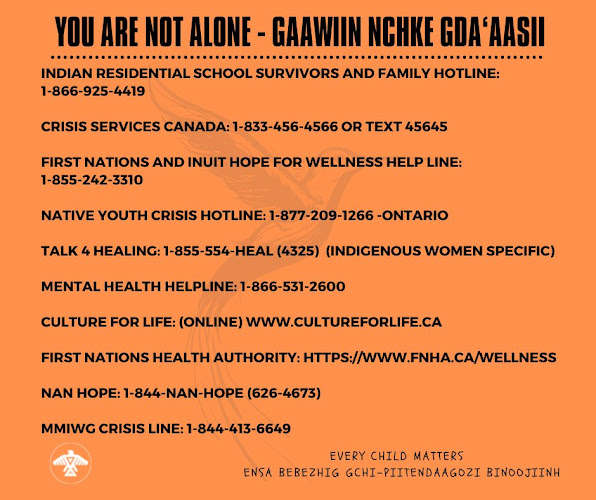
You are not alone

You are not alone

To Veronica Brown

Veronica, we adult adoptees are thinking of you today and every day. We will be here when you need us. Your journey in the adopted life has begun, nothing can revoke that now, the damage cannot be undone. Be courageous, you have what no adoptee before you has had; a strong group of adult adoptees who know your story, who are behind you and will always be so.

Diane Tells His Name


click photo

Lost Birds on Al Jazeera Fault Lines

Lost Birds on Al Jazeera Fault Lines
click to read and listen about Trace, Diane, Julie and Suzie

NO MORE STOLEN SISTERS

NO MORE STOLEN SISTERS
click image

ADOPTION TRUTH

As the single largest unregulated industry in the United States, adoption is viewed as a benevolent action that results in the formation of “forever families.”
The truth is that it is a very lucrative business with a known sales pitch. With profits last estimated at over $1.44 billion dollars a year, mothers who consider adoption for their babies need to be very aware that all of this promotion clouds the facts and only though independent research can they get an accurate account of what life might be like for both them and their child after signing the adoption paperwork.

Original Birth Certificate Map in the USA

Google Followers