


Stories we loved to tell | Baker Lake woman’s journey through her family’s history a stirring moment to write about
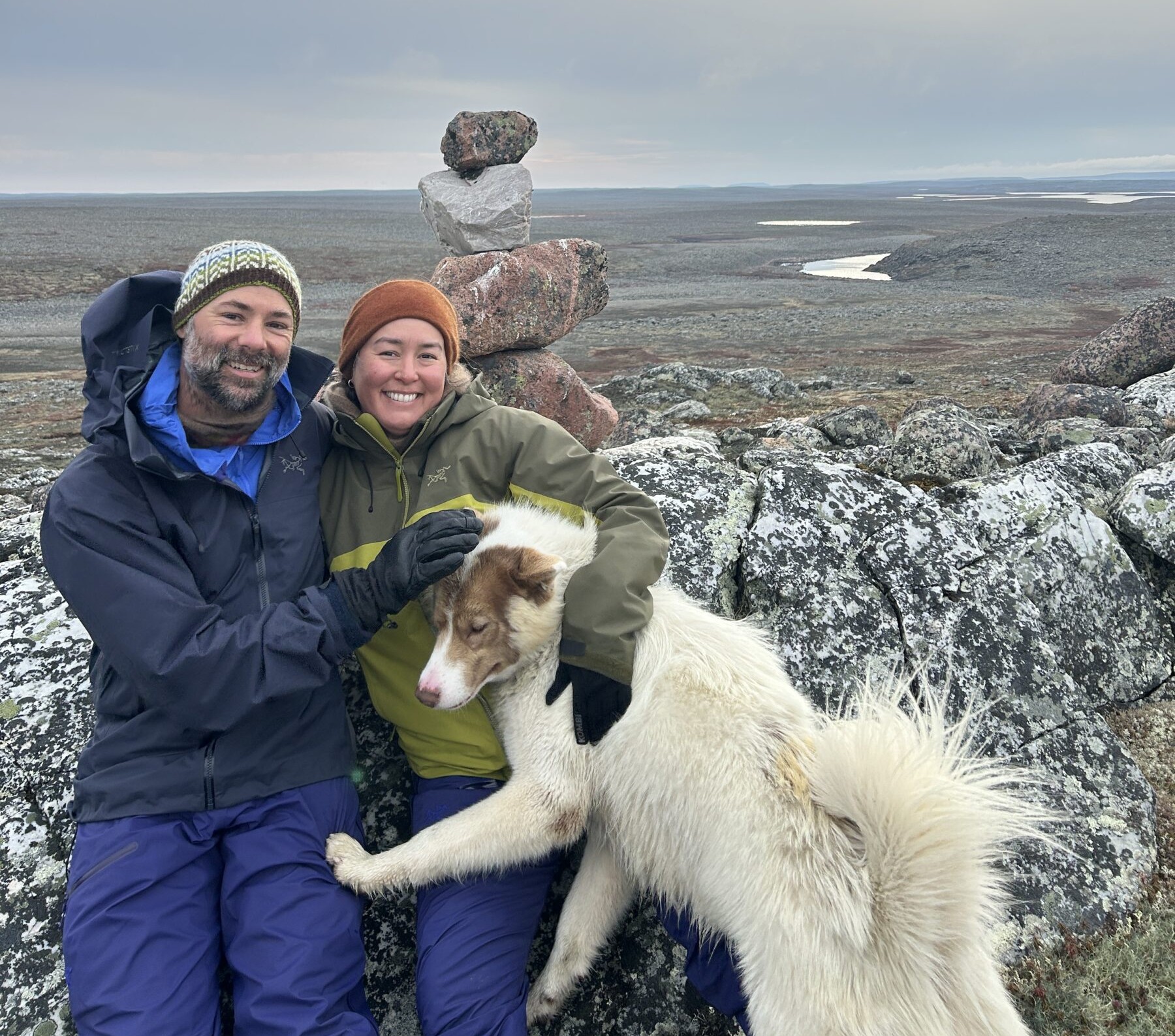
| Erik Reid and Gayle Uyagaqi Kabloona pose for a photo with their dog Tempe in front of one of many inuksuit the group used to guide their journey. (Photo courtesy of Gayle Uyagaqi Kabloona) |
In this year-end series, Nunatsiaq News reporters look back on their most memorable stories from 2025.
Working as a reporter, you often find yourself telling unhappy stories but every once in a while you get one that leaves you feeling inspired.
That’s where I found myself in October while writing about a woman who was trying to reconnect with her Inuit roots.
Starting in the 1930s, Inuit were displaced from their traditional lands by the federal government and moved to permanent settlements. They were forced to abandon their way of life of that involved migrating between winter and summer camps.
For Gayle Uyagaqi Kabloona, who now lives in Ottawa, this displacement is still within living memory. Her father, Thomas Kabloona, now in his 70s, shared stories with her about his family’s last migration to winter caribou hunting grounds in the 1950s before they moved to Baker Lake permanently.
“I’ve always loved my dad’s stories,” she told me in August when she was still planning the trip.
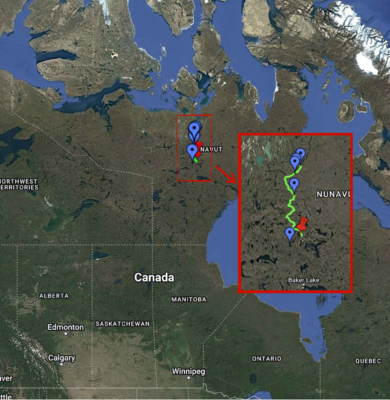 |
| A map showing the approximate route the group took from Back River south to a place called Amarulik, which means “the place where there are wolves.” |
Her father described the family’s traditional migration while poring over maps and describing what living on the land was like back then.
In August, Uyagaqi Kabloona, her partner, her sister and a couple of friends embarked on the 200-kilometre journey. They followed the same route her family had taken for generations before colonization. It had been nearly 75 years since her father had last completed the trek, when he was five years old.
The route started in Back River, approximately 200 kilometres north of Agnico Eagle Mines Ltd.’s Meadowbank Mine. They proceeded south for 23 days and reached the family’s traditional winter caribou hunting spot called Amarulik, which means “the place where there are wolves.”
It isn’t often that you get to cover a story that is so neatly and sweetly bookended. I was lucky enough to speak to her at the beginning of her journey and at the end.
She described finding numerous inuksuit along the route. At times, she said, it felt like she was being guided by her ancestors.
With help from relatives and the inuksuit, she located the graves of some of her ancestors.
“If you lined them up, you were pointed directly at where the graves were,” she said in October, referring to the inuksuit.
It’s a privilege to be a journalist. Sometimes, we are lucky enough to connect to a story that’s so deeply important to someone.
For Uyagaqi Kabloona, making the journey was a way to experience what life was like for her family in Inuit Nunangat before colonization.
SOURCE: https://nunatsiaq.com/stories/article/some-stories-start-in-the-present-and-pull-you-into-the-past/







 Posts
Posts


No comments:
Post a Comment
Please: Share your reaction, your thoughts, and your opinions. Be passionate, be unapologetic. Offensive remarks will not be published. We are getting more and more spam. Comments will be monitored.
Use the comment form at the bottom of this website which is private and sent direct to Trace.