


Panelists discussed educational initiatives, the maintenance of tribal heritage and the legal sovereignty of each of their tribes
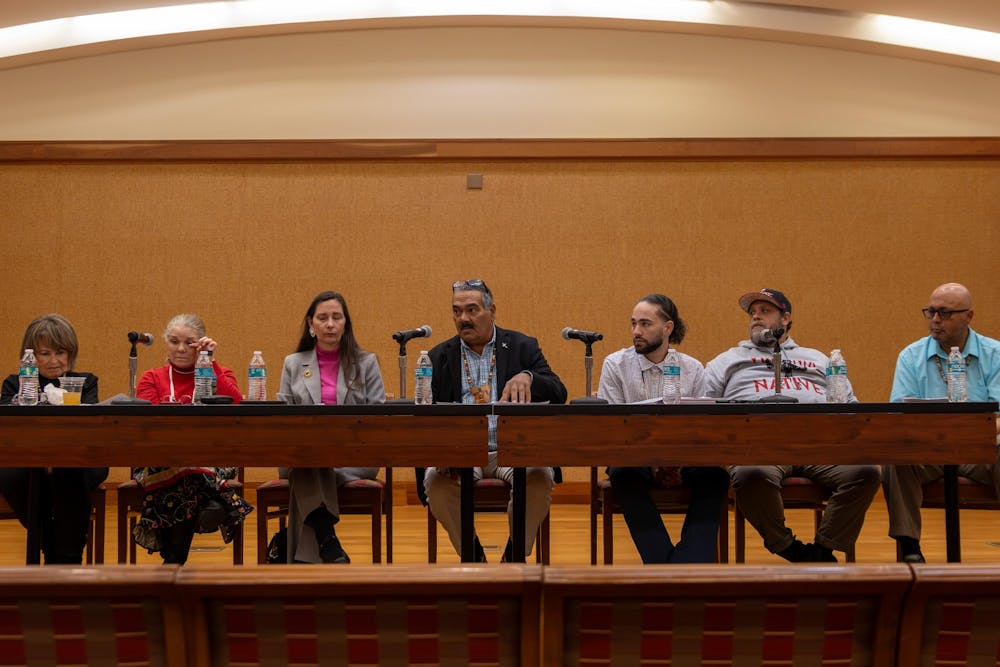
Representatives from Virginia’s federally recognized Tribal Nations gathered for a University-sponsored discussion Saturday on politics, policy and culture. At the event, hosted in the Albert & Shirley Small Special Collections Auditorium, the panel of seven tribal leaders discussed the process of gaining federal recognition for tribal nations, the significance of tribal voices in history and in education and the maintenance of tribal heritage.
The event was co-sponsored by the University’s Native and Indigenous Relations Committee, the Office of the Vice Provost for Academic Outreach, University Tribal Liaison Kody Grant and Assistant English Prof. Sarah Richardson’s ENWR 2520, “Special Topics in Writing — Virginia’s Native Community” class. It featured representatives from the seven federally recognized Tribes across Virginia — The Chickahominy, Eastern Chickahominy, Monacan, Nansemond, Pamunkey, Rappahannock and Upper Mattaponi.
A major topic that the panel discussed was the sovereignty of each nation as individual, separate entities. In the Commonwealth of Virginia, there are seven tribal nations recognized at the federal level and 11 tribal nations recognized at the state level. The relationship between tribal nations and the federal government is, under the U.S. Constitution, a relationship between two sovereign nations.
The panelists highlighted the importance of sovereignty and the need for better recognition and support from state and federal governments. Kerry Canaday, a member of the Chickahominy Indian Tribe, discussed the legal relationships of tribal nations and the federal government — he noted the federal government dictates how the tribe can spend their money, which limits their sovereignty as a nation.
“[Legally], we’re on the same playing field as Israel, England [and] France,” Canaday said. “When the United States gives them money, they are not told how to spend it, but … we’re told how to spend it, and then we [have to] report back to the government how we spent it — did we spend it the way that they said to? Did we use it all?”
Chief Frank Adams of the Upper Mattaponi Tribe also spoke about this topic extensively, describing the restrictions on the tribe’s funding and the ability to function independently. Adams explained that while the state of Virginia makes money through taxes, the tribe must have their own laws and businesses to remain funded.
The tribal representatives further cited a recent decision in Caroline County by the Virginia Department of Environmental Quality to permit the drawing of water from the Rappahannock River and dumping of the wastewater into the Mattaponi River. The Rappahannock Tribal Nation has contended that the DEQ did not involve them in its decision and deliberation regarding reducing the negative impacts on Rappahannock land.
Gerri Wade, a citizen of the Rappahannock Tribe, said that the DEQ has neglected to work with the Rappahannock people or consult them on the maintenance of the environment of their tribal lands. She noted that the DEQ is attempting to build a data center which is going to deplete the river of clean water.
“You can’t replace river water, you can’t keep it clean with what they’re doing,” Wade said. “[The data center] will affect the fish and the wildlife, the ecosystem and everything.”
Irma Adams, a citizen of the Nansemond Tribe, also mentioned the significance of the environment to tribal nations. She discussed how the Nansemond Tribe took custody of the ancestral land of their nation in October 2022, and that the land was a “mess” when they gained possession because it had previously been the site of a concrete factory.
Adams said that the land was stripped, full of invasive species and had heavily polluted land and water. However, the tribe has now started restoring land by working with the Virginia Department of Forestry to plant trees.
Panelists also touched on the conservation of tribal heritage and culture through education and awareness. The Virginia Tribal Education Consortium is a group with the goal to “support the academic achievement and career and technical education success of tribal citizens.”
Canaday, a CTE project director and VTEC Office Liaison, emphasized the significance of Native American representation in educational curriculum. Canaday is currently working on developing new Standards of Learning coursework — the K-12 educational guidelines of Virginia — that is intended to include better representation of Indigenous history.
“Teachers are hungry to know about the accurate Virginia Indian history, and not … just written from one side, as history is always written in the eyes of the winners,” Canaday said. “[Our tribes] are still here [and] we still have our stories. We know what we were taught, and know what our people went through.”
VTEC also serves to support education for first-generation students, offering direct financial assistance as well as aid in other ways. However, according to Canaday, they have had difficulties in obtaining grants to fund the education of students who are tribal members. As a result, many tribal citizens are focused on trying to garner more support for VTEC and its programs.
First-year College student Katherine Rose, who was in attendance for the event, said that hearing directly from the representatives of the tribal nations was impactful and exposed the shortfalls of the relationship between the Virginia government and tribal nations.
“Virginia has a lot more work to do in regards to what the state does for its tribal nations,” Rose said. “I hope that U.Va. can become a bigger part of that.”
NOTE: Some of these tribes have fought a hundred years for recognition. As they state in this story, THEY ARE STILL HERE.... The government stalls and stalls... Trace







 Posts
Posts


No comments:
Post a Comment
Please: Share your reaction, your thoughts, and your opinions. Be passionate, be unapologetic. Offensive remarks will not be published. We are getting more and more spam. Comments will be monitored.
Use the comment form at the bottom of this website which is private and sent direct to Trace.