BOOZHOO! We've amassed tons of information and important history on this blog since 2010. If you have a keyword, use the search box below. Also check out the reference section above. If you have a question or need help searching, use the contact form at the bottom of the blog.
We want you to use BOOKSHOP to buy books! (the editor will earn a small amount of money or commission. (we thank you) (that is our disclaimer statement)
This is a blog. It is not a peer-reviewed journal, not a sponsored publication... WE DO NOT HAVE ADS or earn MONEY from this website. The ideas, news and thoughts posted are sourced… or written by the editor or contributors.
EMAIL ME: tracelara@pm.me (outlook email is gone)
THANK YOU CHI MEGWETCH!
BIFF (Buffalo International Film Festival Premier)
Ku Stevens (17) is the
solo runner at his high school with no coach. Living on the Yerington
Paiute reservation in Northwest Nevada, he is driven by his ambition to
run for his dream school, the University of Oregon.
As Ku trains, unreconciled
emotions unearth the memory of his great-grandfather, Frank Quinn. At 8
years old, Frank ran 50 miles across the desert to escape an Indian
boarding school. Frank’s story becomes interwoven with Ku’s journey to
run a collegiate qualifying time.
This coming-of-age
documentary is told from Ku's perspective as he struggles to navigate
his dream of becoming a collegiate athlete as the memory of his great
grandfather's escape from an Indian boarding school begins to connect
past, present, and future.
Will Ku outrun his history or will he learn to run in parallel with it to achieve his dreams?
Clear
Sky October 16, 4 PM North Park Theatre
Director Michael Del Monte in attendance. Given up for adoption the day he was born, Shawn’s life spirals into addiction as he struggles with a broken connection to his Anishinaabe culture and a deep resentment toward the mother who abandoned him. Through intense psychedelic therapy and the relentless
grind of distance running, CLEAR SKY follows Shawn’s fight to save his life, culminating in a cross-country road trip to confront the person he resents most: his mother. Filmed over three years, this intimate story bridges ancient traditions and modern science. Hailed by Derek Cianfrance (Blue Valentine) as 'a cinematic masterpiece,' CLEAR SKY is an unflinching portrait of one man’s journey to heal and find his place in the world.
A vivid ode to land and an intimate, inspiring portrait of an Indigenous Elder’s final year as he fights to reclaim his homeland, scarred by the largest contaminated site in the Southern Hemisphere. Banjima Elder Maitland Parker calls his yurlu (homeland) in
the Pilbara region of Western Australia “poison country”; this haunting truth is etched into his body as he lives with terminal mesothelioma, an aggressive cancer resulting from asbestos exposure. Six decades prior, the Wittenoom mines left behind more than
three million tonnes of waste rock laced with deadly asbestos fibres, turning 46,840 hectares of Banjima Country – an area eight times the size of Manhattan – into a toxic exclusion zone. Today, Aboriginal communities in Western Australia have the world’s
highest mortality rate from mesothelioma. Yurlu | Country follows Maitland as he confronts government inaction and corporate greed in the hope of allowing his people to reconnect with and heal their ancestral lands. This powerful documentary bears witness
to Australia’s very own – albeit largely unknown – Chernobyl-style disaster. Braiding imagery of beautiful yet contaminated terrain with poignant interviews and damning archival footage, the film stands as a testament to First Nations resilience amid ongoing
dispossession, and is a rousing call to action to redress the cultural, environmental and physical wounds caused by colonisation and industry.
By Zig-Zag, WarriorPublications.wordpress.com
(Originally pub. 1999 as Colonization is Always War, Revised 2012) “If anyone is trying to destroy you, STOP HIM!” Karoniaktajeh – Louis Hall, Warrior’s Handbook p. 1 War & Colonization
Just slightly over 500 years ago, in 1492, three European ships under
the command of Christopher Columbus arrived on the shores of what has
come to be known as the Americas. With this began a genocidal war aimed
at destroying Indigenous nations, occupying our ancestral territories,
and plundering the natural wealth of the earth. How many tens of
millions of Indigenous people were killed in this war will never be
known, although the methods of massacres, biological warfare,
executions, torture, and the enslavement of entire nations, has been
well documented by historians.
Similar invasions were being carried out in Africa and parts of Asia
during this same period. This systematic campaign of genocide and
colonization was a total war waged against Indigenous nations by
European colonialist nations. No one can deny this historical fact.
Colonization can be defined as the practise of invading other lands
for the purpose(s) of settlement and/or resource exploitation. When the
land is already occupied by another people, the result is usually war.
In fact, colonialism occurs in a similar manner to many military
conflicts between nations: there is a reconnaissance, an invasion,
occupation, and then assimilation (the same methods can be seen in Iraq
and Afghanistan).
War can be defined as, “a state of hostilities that exists between or among nations,
characterized by the use of military force… a violent clash between two
hostile, independent, and irreconcilable wills, each trying to impose
itself on the other. “The means to that end is the organized application or threat of violence by military force.”Warfighting, p. 3
Here in North America, military violence can be said to have
characterized the imposition of colonialism & the establishment of
settler-nations up to 1890. That year, 300 Indigenous men, women and
children were massacred by US military forces at Wounded Knee, South
Dakota. By the late 1880s, the use of gun-boats to destroy villages had
ended along the Northwest Coast. In the southwest, Apache guerrillas had
also been defeated. At this time, the military domination of Indigenous
peoples was virtually complete. This was only slightly over 100 years
ago.
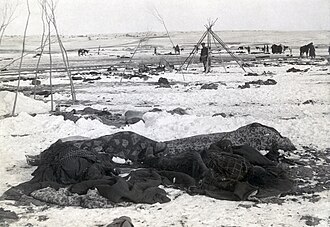
Mass grave at Wounded Knee, 1890; the massacre was carried out by the reformed 7th Cavalry
Is There A War Against Indigenous Peoples Today?
Today, there are some who believe that military force and violence
does not characterize our present-day reality here in N. America. But
this is not entirely correct: The selective use of military/police
violence can be clearly seen in recent examples from the last 30 year
period.
Thousands of soldiers and police, using military equipment, weapons
and tactics, have been deployed against Indigenous movements and
communities.
The most notable examples being:
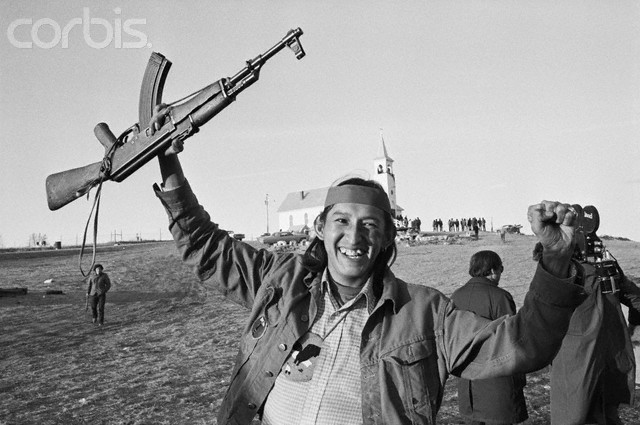
• the 71-day siege at Wounded Knee, S. Dakota, in 1973. Hundreds of
police, FBI and paramilitaries, with military assistance including
armoured personnel carriers, weapons, ammunition, etc., engaged in
fire-fights with warriors in bunkers and trenches. 2 warriors were shot
& killed.
• the re-occupation of Ganienkah by Mohawks in New York state in
1974. Hundreds of state police laid siege, and gunfire was exchanged
with white vigilantes. NY state eventually retreated & negotiated a
parcel of land still occupied today.
• the blockade at Cache Creek, BC, in 1974.
• the re-occupation of Anicinabe Park near Kenora, Ontario, in 1974.
• the 1975 shoot-out at Oglala, S. Dakota (two FBI agents and one
warrior killed). Hundreds of FBI agents were deployed to Pine Ridge in a
massive search for AIM members.
• Restigouche, 1981: over 500 Quebec police raid the Mi’kmaq
community of Restigouche, carrying out assaults & searches for
‘illegal’ fishing.
• the 77-day standoff at Kanehsatake (Oka) and Kahnawake, near
Montreal, Quebec, in 1990. Over 4,500 Canadian soldiers were deployed.
One SQ police officer was killed in an initial raid by a heavily-armed
police tactical unit on Mohawk road-block, July 11.
Kanehsatake/Oka 1990: a 77-day armed standoff between warriors and military.
• the month-long siege at Gustafsen Lake, BC (Ts’Peten), in 1995.
Over 450 RCMP ERT members were used, with 9 Bison armoured personnel
carriers from the Canadian military. During the siege, RCMP used an
explosive charge to disable a vehicle, then rammed it twice with an APC.
In a fire-fight which occurred, as many as 20,000 rounds were fired by
police, yet only one defender was wounded (1 dog killed).
• the re-occupation at Ipperwash (Aazhoodeena), Ontario, 1995. A
police tactical unit opened fire on unarmed protesters, killing Dudley
George and shooting a 15-year old youth in back (1 dog killed).
• Burnt Church 2000-01. Hundreds of heavily armed DFO & RCMP
officers (inc. ERT units) in boats, helicopters, & planes were used
against Mi’kmaq lobster fishermen & security escorts (inc. Westcoast
Warrior Society).
• July, 2001: over sixty RCMP were used to dismantle a road block at
the Sutikalh re-occupation camp near Mt. Currie, BC. Along with a
helicopter & dog teams, heavily-armed ERT members were used to
arrest 7 (unarmed) people. The blockade had shut down all commercial
traffic on Highway 99, a vital link between Vancouver & the southern
interior.
Wounded Knee, 1973
• Sun Peaks (Skwekwekwelt), where RCMP arrested approx. 80 elders
& NYM’ers from 2000-08. These arrests resulted from occupations,
road-blocks, & protests against expansion of the Sun Peaks ski
resort (near Kamloops, ‘BC’).
• September 21, 2002: RCMP from the Integrated Security Enforcement
Team (INSET)—an anti-terrorist unit created after 9-11— along with ERT,
raided homes of Westcoast Warrior Society members on Vancouver Island
(BC).
• April 8, 2003: RCMP with ERT & helicopter raided NYM member
homes in Bella Coola & Neskonlith (BC). They seized computers,
discs, address books, & printed materials.
• October, 2003: a convoy of approx. 100 RCMP in over 30 large
vehicles & vans, with ERT units, riot cops, and dog teams, rolled
through Cheam as a show of force (Cheam had blockaded a CN railway
cutting through their reserve in protest against logging in Elk Creek).
• June 27, 2005: over 30 Vancouver Police & RCMP (including ERT
& INSET members) arrest 2 members of the Westcoast Warrior Society
in Vancouver. They confiscate 10 rifles that had been legally purchased
at Lever Arms. No charges are laid and the weapons kept as part of an
ongoing investigation (shortly after, the WWS announces its
disbandment).
• Spring, 2006: hundreds of Ontario Provincial Police are deployed
against the Six Nations reserve near Caledonia, Ontario, after a housing
development & highway are blockaded as part of a land reclamation.
On April 20, police attempt to remove people from the reclamation site
using batons & pepper spray but are forced back. This begins months
of blockades and sabotage.
During these incidents & the time periods in which they occurred,
hundreds of people were assaulted, arrested, and jailed. At least six
Indigenous people died during these incidents; in S. Dakota, between
1973-1976, nearly 70 members/associates of the American Indian Movement
(AIM) were killed by paramilitary groups & BIA police, acting under
the direction of a corrupt tribal president, with the complicity of
local, state, and US federal law enforcement agencies. FBI agents
supplied training and equipment to these paramilitary & tribal
police forces.👇
What: Native Organizers Alliance is organizing Harvard
students and faculty to participate in a ceremony to commemorate the
return of remains and artifacts stolen from the Wounded Knee massacre
site. In the early 19th century, a traveling shoe salesman stole items
from a gravesite at Wounded Knee in South Dakota. At the event, more
than 131 items including moccasins, weapons, arrows, and clothing, will
be returned to representatives of the Oglala Sioux and Cheyenne River
Sioux Tribes.
Speakers will include
Kevin Killer, Oglala Lakota Tribe President
Nipmuc Chief Cheryll Toney Holley;
Chair of the Massachusetts Commission On Indian Affairs
Ann Meilus, Barre Museum Association Board President
The aftermath of the Wounded Knee Massacre (Photo/Wikimedia Commons)
By Native News Online Staff
On
Friday, the National Congress of American Indians (NCAI) pushed back on
the U.S. Department of Defense’s (DoD) decision to retain the Medals of
Honor awarded to soldiers involved in the Wounded Knee Massacre on
December 29, 1890. This decision announced on Thursday disregards
the well-documented truth of a brutal, unprovoked massacre carried out
by the 7th Cavalry against the Lakota people—and ignores the moral
obligation to confront past injustices with integrity.
Wounded Knee was not a “battle.” It
was the deliberate mass killing of more than 350 unarmed Lakota men,
women, and children who had sought refuge at Wounded Knee Creek. Contrary to Secretary of Defense Pete Hegseth’s claim that these medals
are “no longer up for debate,” the event is widely recognized as a
historical atrocity. This includes acknowledgment by historians, Tribal
Nations, and even the U.S. Senate, which expressed its regret through
Concurrent Resolution 153 in 1990. By preserving these medals, the DoD
perpetuates the injustice and deepens the pain felt by the victims'
descendants and Native communities across the country.
“Honoring those involved in the
Wounded Knee Massacre with the United States’ highest military award is
incompatible with the values the Medal of Honor is meant to represent,”
said Larry Wright Jr., NCAI Executive Director. “Celebrating war crimes
is not patriotic. This decision undermines truth-telling,
reconciliation, and the healing that Indian Country and the United
States still need.”
These medals should never have been
awarded. In 2024, the DoD initiated a formal review of the medals, but
despite decades of advocacy by tribal nations, historians, and members
of Congress, this week’s announcement confirms the medals will remain.
NCAI stands in solidarity with the Lakota Nations, Tribal communities,
Native veterans, and active-duty service members—who serve the United
States at higher rates than any other demographic—calling for the
correction of the historical record and the alignment of our highest
honors with our highest principles.
NCAI echoes the powerful voices of
tribal leaders whose communities continue to bear the intergenerational
trauma of this horrific event.
“Secretary Hegseth’s decision is
another act of violence against our Lakota people,” said Chairwoman
Janet Alkire, Standing Rock Sioux Tribe. “The Wounded Knee Massacre was
an unprovoked attack on men, women, children and elders who had been
rounded up by the military. As Indian people, we know what bravery and
sacrifice means. We serve in the military at greater rates than any
other group in the United States. I served in the Air Force with men and
women who were brave and served with honor. The actions at Wounded Knee
were not acts of bravery and valor deserving of the Medal of Honor. There is nothing Hegseth can do to rewrite the truth of that day.”
“The Wounded Knee Massacre was one
of the darkest days in U.S. history,” added Chairman Ryman LeBeau,
Cheyenne River Sioux Tribe. “The U.S. Cavalry stopped our people out on
the high plains, surrounded them with guns and cannons, disarmed them,
opened fire, and murdered them. Women and children were chased down and
shot in the back. This is one of America’s darkest days and the medals
must be revoked. They tarnish America’s Medals of Honor. There is no
honor in murder. Secretary Pete Hegseth made this decision on his own
concurrence with no contact or request for consultation to the Tribes.”
NCAI calls on the Department of
Defense to immediately release the findings of the review that led to
this deeply flawed and ahistorical decision. The DoD must reverse course
and engage directly with NCAI and the leaders of the Great Plains
Tribal Chairman's Association. In addition, we urge Congress to pass the
“Remove the Stain Act” to ensure the Medal of Honor reflects true
courage—not cowardice and cruelty—and that our nation’s history is
preserved with honesty and respect.
Mashantucket Pequot Tribal Chairman Skip Hayward (back row left) and his family in an early photo in Mashantucket (My photo)
By Trace Hentz (blog editor)
In 1999, when I took the Pequot Times editor job in
Connecticut, I’d tried to read as much as I could find about New England “Indians”
and especially the Mashantucket Pequot Tribal Nation. I’d found a book “The Spirit
of New England Tribes” in a bookstore on the Cape, and fortunately I read it
cover to cover before I took the job. But
it wasn’t enough and I knew that.Books
for the general public were hard to find, and I think that was on purpose. “We
are not supposed to know,” and I have written that headline often. And it’s true.
If the colonizer didn’t write it (in books), it didn’t
happen. Got it?
As part of our introduction to the tribe, when we are hired,
we watch the film, THE WITNESS, at the Pequot Museum. It gives a glimpse of the
history that lead to a massacre at Fort Mystick in the 1600s. It’s so hard to
put into words but it was brutal and traumatic to watch, and then to comprehend. Killing women, children, and elders, shooting them as they tried to escape the burning
fort, that was a wake-up call for me. What kind of monsters would do that?
(Well, if you look up massacres, there are over 1000 documented in this place
we call America.) It’s something we are not
supposed to know.
Later I was asked to give a history talk for Foxwoods
employees and most employees seemed (to me) to be clueless (but interested) in early
history in this part of Connecticut. A lack of history causes suspicion and
that was the case with many people I met. They felt or said out loud, the Pequot were
not real “Indians.” Well, that was not
true and it took a lot of writing and research in the Pequot Times every month to counter that falsehood. (I worked there
5 years.)The only way to counter ignorance
is with TRUTH. So I searched and published
“Genocide and Enslavement of the Pequot” by Dr. Kevin McBride, who was the director
of the Pequot Museum’s Research Center. I heard him give a talk at Yale and
asked if I could publish it.
Just being here in New England, I could tell right away they
hide history, lots of it. It might upset
people, I guess?In 2000, I wrote a
paper on Native slavery called “First Contact” and gave a short talk at the Native
American Journalist’s conference in Florida. Many of the best Native journalists I knew
were surprised about the slavery part, but knew something about massacres.
Yes, in some tribes they do teach about colonization and first contact with non-Indians, slavery, massacres, but not all tribes.
Did you enjoy your history class in school? I remember they
focused on the Nazis and Jews and world wars. Why didn’t we learn about American atrocity, starting in the 1600s right here
in New England? What about Slavery?
I asked the research center to give me as much as they could
so I could publish it. As an editor, it’s our job to educate, offer news, and sneak in some real
history when possible.
I call myself a citizen journalist now, and part-historian.
I am still very interested in Native Slavery. My prayer was answered when I saw that Brown
University (in Rhode Island) had a presentation on this topic in June. Challenge yourself to keep learning, please.
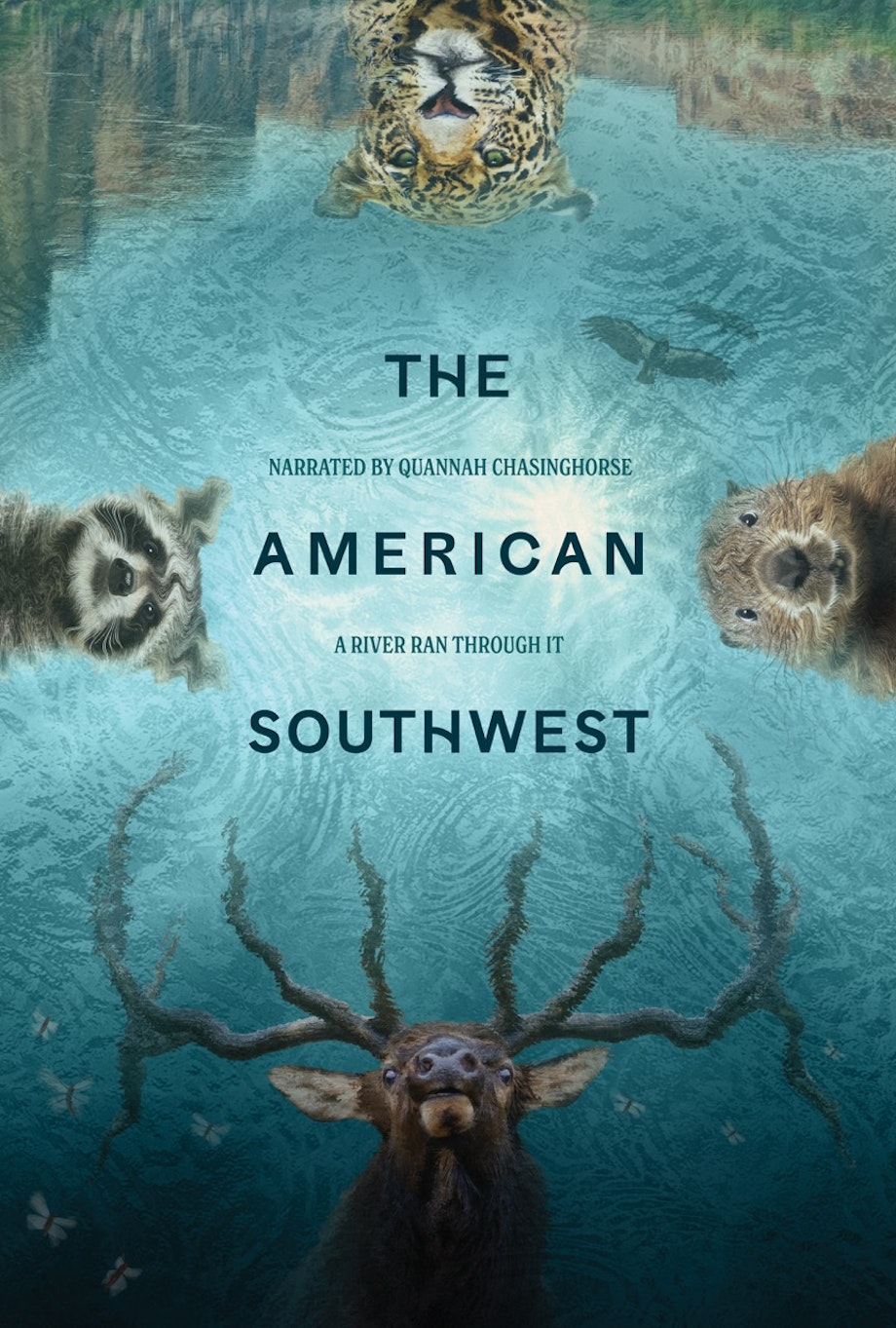
Go behind the scenes with Quannah Chasinghorse as she shares her experience narrating The American Southwest.
In this special Q&A, she reflects on her favorite scenes and what it meant to give voice to the wild places and stories of this iconic region.
The American Southwest hit select theaters on September 5!
From the snowclad Rockies to the scorching Mojave desert, the Colorado River nourishes wildlife and sculpts the legendary landscapes. With narration by Quannah Chasinghorse, THE AMERICAN SOUTHWEST follows the river’s journey to sustain society and the natural world… through the lens of bugling elk, dam-building beavers, immigrant jaguars, and the region’s most fascinating wild characters.
Display copies of updated tribal textbooks detailing the history and
culture of the five Native nations that share land with North Dakota.
(Mary Steurer/North Dakota Monitor)
The
North Dakota Department of Public Instruction has released the first of
a series of updated textbooks on the five Native nations that share
land with North Dakota.
The book — titled “Journey to
Understanding” — provides a brief introduction to the tribes’ history
and culture. It’s the first time a new edition of the work has been
released in more than two decades.
The textbook will soon be distributed
to schools across the state, though a digital version is already
available to download for free on the University of North Dakota’s Scholarly Commons website.
“Journey to Understanding” was first
published in 2002 as cultural training material for social workers at
the North Dakota Department of Human Services. The agency hired the
Bismarck-based Native American Training Institute to write it to help
its employees better understand the state’s Native communities.
Now, the Department of Public Instruction is promoting it as an educational resource for K-12 classrooms.
The agency will also soon release
updated versions of four tribe-specific textbooks on the Standing Rock
Sioux Tribe, Mandan, Hidatsa and Arikara Nation, Turtle Mountain Band of
Chippewa and Spirit Lake Nation. Like “Journey to Understanding,” new
editions of the books haven’t been published in more than 20 years.
The five books have long been
considered leading sources for information on the tribes, and are
referenced in K-12, college and professional settings, according to the
Department of Public Instruction.
A first-ever textbook on the Sisseton-Wahpeton Oyate is also in the works.
The series is a collaborative effort
between the state, the tribes, Native culture organizations and higher
education institutions. The tribes and tribal colleges had full
editorial oversight of the books’ content.
In addition to publishing all six
books online, thousands of copies will be printed and distributed to
schools across North Dakota.
The
cover of “Journey to Understanding,” a recently updated textbook on the
history and culture of the five Native tribes that share land with
North Dakota. The cover art is by Paula TopSky, a member of the
Shoshone-Bannock Chippewa Cree. (Photo courtesy of the North Dakota
Department of Public Instruction)
“Journey to Understanding” is an
ideal resource for anyone looking for a primer on the tribes, said
Cheryl Ann Kary, executive director of Sacred Pipe Resource Center and
the textbook’s author.
It covers topics including tribes’
status as sovereign nations, treaties and federal policies like the
General Allotment Act, which reduced Native land ownership by
distributing collectively owned tribal land to individual Native
citizens.
The book also details some of the spiritual beliefs, values and traditions common to many tribes.
Kary, a citizen of the Standing Rock
Sioux Tribe, said many North Dakotans could benefit from resources like
“Journey to Understanding”. Many state leaders try to tackle complicated
issues involving the tribes despite lacking basic knowledge about their
communities, she noted. Kary compared this to trying to read poetry
without first learning the alphabet.
“There’s so much just fundamental,
foundational knowledge you have to know first before you can even talk
about these complex issues,” she said.
While most of the content in the
first and second edition of “Journey to Understanding” is the same, the
latter version includes some new content as well. For example, it
includes more information on the federal Indian Child Welfare Act of
1978, a federal law that protects tribes’ right to keep Native children
in their communities, Kary said.
The Department of Public Instruction expects to release the other five books in the series over the next several months.
It’s partnering with United Tribes
Technical College and Sisseton Wahpeton Oyate Publishing to print the
textbooks. Each K-12 school across the state will receive free copies of
the books, with middle and high schools getting at least 25 sets of the
series. Eventually, members of the public will be able to purchase
their own copies.
Sashay Schettler, the Department of
Public Instruction’s assistant director of Indian and multicultural
education, said making the books available both online and in print will
make it easier than ever for young North Dakotans to learn about the
tribes.
“Honestly, it makes my heart happy,” Schettler, a citizen of the MHA Nation, said.
She noted the books can be a resource
that helps schools comply with a state law adopted in 2021 requiring
K-12 schools in North Dakota to teach Native American history.
The textbooks are the culmination of
several decades of work by hundreds of people, according to a reflection
on the revision process by state employees included at the end of
“Journey to Understanding”.
The first editions of the books on
the Standing Rock Sioux Tribe, the MHA Nation, Spirit Lake Nation and
Turtle Mountain Band of Chippewa were spearheaded by Cheryl Kulas,
former director of Native education at the Department of Public
Instruction and an Oglala tribal citizen.
The agency hopes to facilitate revisions of the books every few years going forward, staff indicate in the reflection.
North Dakota Monitor reporter Mary Steurer can be reached at msteurer@northdakotamonitor.com.
Sashay
Schettler, left, and Lucy Fredericks present new editions of textbooks
on the five tribes that share land with North Dakota at an April 10,
2025, reception. The original set of textbooks hadn’t received updates
since their initial publication in the 1990s and early 2000s. (Mary
Steurer/North Dakota Monitor)
The jingling of the bells becomes as loud as a waterfall, and that is
her intention. The resonant jingle dance aims to imitate water and its
healing power.
I have been to Manitoulin Island many times... If you can, please visit.
The Canadian island is located in Lake Huron, one of North America's Great Lakes.
Robert Redford’s Final Acting Role Features Iconic Chess Scene with George R.R. Martin
Robert Redford and George R.R. Martin Helped Bring 'Dark Winds' Into The World | Credit: AMC
Robert Redford’s
final bow on screen arrived not with a bang, but a quiet, intense
moment of strategy and silence: a chess game shared with none other than
George R.R. Martin in AMC’s neo-Western series Dark Winds. This
unexpected yet profoundly significant cameo, debuting in the season
three premiere of Dark Winds in March 2025, was the brainchild of Martin
himself, both men executive producers of the show.
Watching these two giants sit across a
dimly lit jail cell, moving pieces on a chessboard, crystallizes an
extraordinary convergence of talent and legacy. For Redford, who passed
away on September 16, 2025, this was more than a final role; it was a full-circle moment
in a career deeply intertwined with the stories of the American
Southwest and authentic representation of Native American culture.
Redford’s final cameo in Dark Winds cements his enduring legacy, not
just as an actor or director, but as a genuine ally who fought to bring
Native voices to the forefront of cinema and television. His presence,
brief yet profound, honors the stories he cherished and the people whose
stories he wanted told truthfully.
Remember this: It’s a stark reminder: Sometimes the best way to kill something and rob it of its history is to place it in a museum.
Meet six kids from a small community in the Arctic who felt disconnected
from their Inuvialuit identity — until they went on a journey to
connect with their past. The students teamed up with CBC Kids News to
document a trip they took to see their ancestors' artwork and artifacts
on display in museums across the country. They discovered a connection
that runs deeper than they thought.
This
year’s Toronto International Film Festival features a record eight
Indigenous films. One of the feature films, Ni-Naadamaadiz: Red Power
Rising, tells the story of an Indigenous uprising in northern Ontario in
1975. Producer and co-writer Tanya Talaga discusses the importance of
Indigenous films in truth and reconciliation.
In the dimly lit rooms of the National Archives, Joe Maxwell
recalled digging through what he described as “the bowels” of the U.S.
government as he and other student research assistants sifted through
boxes full of paperwork as a part of Project Return, a nationwide
project set to launch officially in October.
The project’s goal is to return
documents to the survivors of Native American boarding schools who were
taken from their families and attended abusive classrooms.
These residential schools, which were
located across the U.S., Canada, and more than 526 of which were
federally funded, according to The National Native American Boarding School Healing Coalition, were often the site of abduction, acculturation, abuse, and death, with the U.S. Department of the Interior reporting at least 973 children died while attending these schools.
Many people who survived were unaware
documents from their time in the schools even existed. Report cards,
photographs, and letters sent to and from the families of the children
remained unreturned.
“Most Indian boarding school survivors that I’ve ever met were not aware that there were records in the National Archives,” Carrie Lowry Schuettpelz said,
the director of the Native Policy Lab and a UI associate professor of
practice in the School of Planning and Public Affairs.
Schuettpelz was recently awarded the Andrew W. Mellon Foundation grant to fund Project Return in July.
“Part of the reason that I do this is
that they don’t know they exist, and the process for getting them is
not straightforward,” she said.
As a part of the pilot for Project
Return, the program partnered with the Chickasaw Nation, which provided
Schuettpelz and the student research assistants with a list of student
records they were interested in having repatriated and returned to their
rightful owners.
HOMELANDS celebrates the eightieth year in the life of Mvskoke artist
Rick Grimster. Born to an English mother and a Native American father,
war baby Rick was raised by adoptive parents in the UK.
In this series of acrylic paintings, Grimster playfully merges
abstract impressions of England and America through masterful use of
colour, pattern and texture. Together these autobiographical landscapes
chart his remarkable passage through time on two continents and his
lifelong journey of transformation from adoptee to Indigenous elder.
HOMELANDS is a love letter to the people and places that gave life to this extraordinary artist.
This exhibition coincides with National Adoption Week.
The
empire grows stronger and voices like Colbert, Kimmel, or basically
anybody who says out loud that Charlie Kirk was a racist piece of white
trash is being thrown aside through government pressure. Americans are
acting like they just realized censorship can happen to white people
also. While the media (and who owns the media nowadays?) is busy
tiptoeing around the fall of democracy and ignoring the blatant
authoritarian actions of the current White House agenda, Trump and
clowns are busy defining their own brand of “cancel culture” wrapped in
the typical nationalistic patriotic bullshit shielded by hypocritical
Christian beliefs. We should all know by now it’s just more
distraction to throw fuel on the fire of their division war and keep the
conversation away from exposing the cheetoh stained Epstein files.
In
reality, America as a government has been silencing people since 1776.
The only thing new now is who’s feeling the muzzle. It’s not just
Indigenous people, Black folks, immigrants, and the poor anymore. Now
it’s nipping at privileged voices who always assumed their mic was
untouchable.
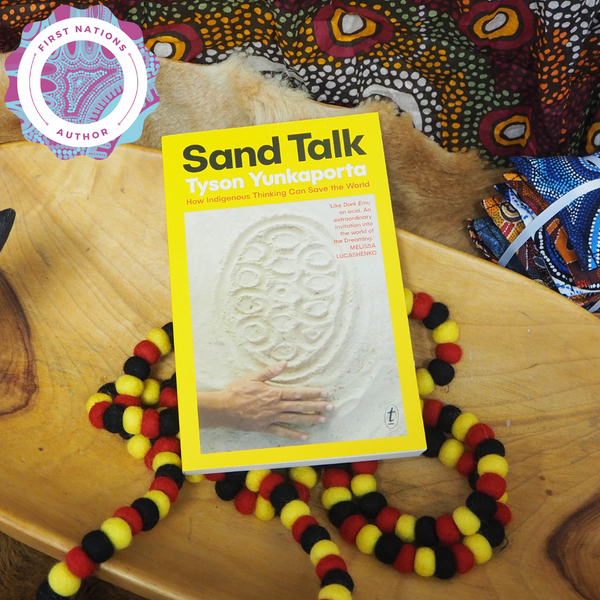
"Sand Talk How Indigenous Thinking Can Save the World" By Tyson Yunkaporta
What happens when global systems are viewed from an
Indigenous perspective? How does it affect the way we see history,
money, power and learning? Could it change the world?
This
remarkable book is about everything from echidnas to evolution,
cosmology to cooking, sex and science and spirits to Schrodinger's cat.
Tyson
Yunkaporta looks at global systems from an Indigenous perspective. He
asks how contemporary life diverges from the pattern of creation. How
does this affect us? How can we do things differently?
Sand Talk provides
a template for living. It's about how lines and symbols and shapes can
help us make sense of the world. It's about how we learn and how we
remember. It's about talking to everybody and listening carefully. It's
about finding different ways to look at things.
Most of all it's about Indigenous thinking, and how it can save the world.
Sometimes it is hard to write in English when you’ve been talking to your great-grandmother on the phone but she is also your niece, and in her language there are no separate words for time and space. In her kinship system every three generations there is a reset in which your grandparents’ parents are classified as your children, an eternal cycle of renewal. In her traditional language she asks you something that
translates directly into English as ‘what place’ but actually means ‘what time’, and you reluctantly shift yourself into that paradigm, because you know it will be hard as hell to shift back out of it again when you go back to work. Kinship moves in cycles, the land moves in seasonal cycles, the sky moves in stellar cycles and time is so bound up in those things that it is not even a separate concept from space. We
experience time in a very different way from people immersed in flat schedules and story-less surfaces. In our spheres of existence, time does not go in a straight line, and it is as tangible as the ground we stand on. - Tyson Yunkaporta, Sand
Talk: How Indigenous Thinking Can Save the World
Sand Talk: How Indigenous Thinking Can Save the World is a 2019 book by Tyson Yunkaporta that sets out to look at the world, especially sustainability, through Aboriginal perspectives.[1] Yunkaporta calls for fewer token gestures such as land acknowledgements and more meaningful inclusion.[2] The book engages with other Indigenous people to draw from their lived knowledge, which creates paradoxes for the reader.[3]
By Melanie Payne ( mpayne@news-press.com ) August 15, 2010 Alexis Stevens liked to describe herself as a model citizen. She was adopted fr...
Bookshop
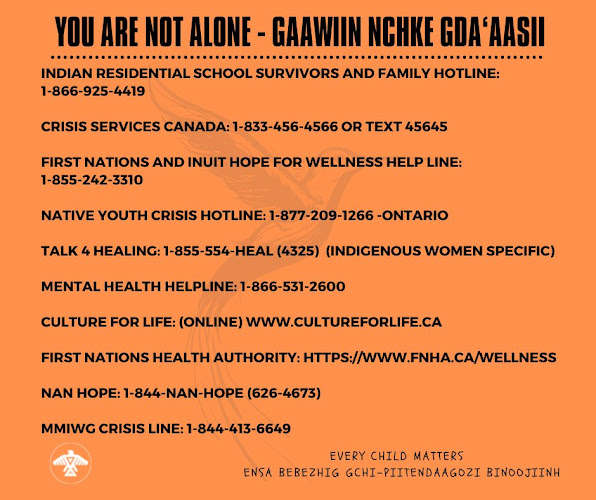
You are not alone
To Veronica Brown
Veronica, we adult adoptees are thinking of you today and every day. We will be here when you need us. Your journey in the adopted life has begun, nothing can revoke that now, the damage cannot be undone. Be courageous, you have what no adoptee before you has had; a strong group of adult adoptees who know your story, who are behind you and will always be so.
Diane Tells His Name
click photo
Lost Birds on Al Jazeera Fault Lines
click to read and listen about Trace, Diane, Julie and Suzie
NO MORE STOLEN SISTERS
click image
We conclude this series & continue the conversation by naming that adoption is genocide. This naming refers to the process of genocide that breaks kinship ties through adoption & other forms of family separation & policing 🧵#NAAM2022#AdoptionIsTraumaAND#AdopteeTwitter#FFY 1/6 pic.twitter.com/46v0mWISZ1
As the single largest unregulated industry in the United States, adoption is viewed as a benevolent action that results in the formation of “forever families.” The truth is that it is a very lucrative business with a known sales pitch. With profits last estimated at over $1.44 billion dollars a year, mothers who consider adoption for their babies need to be very aware that all of this promotion clouds the facts and only though independent research can they get an accurate account of what life might be like for both them and their child after signing the adoption paperwork.















 Posts
Posts

